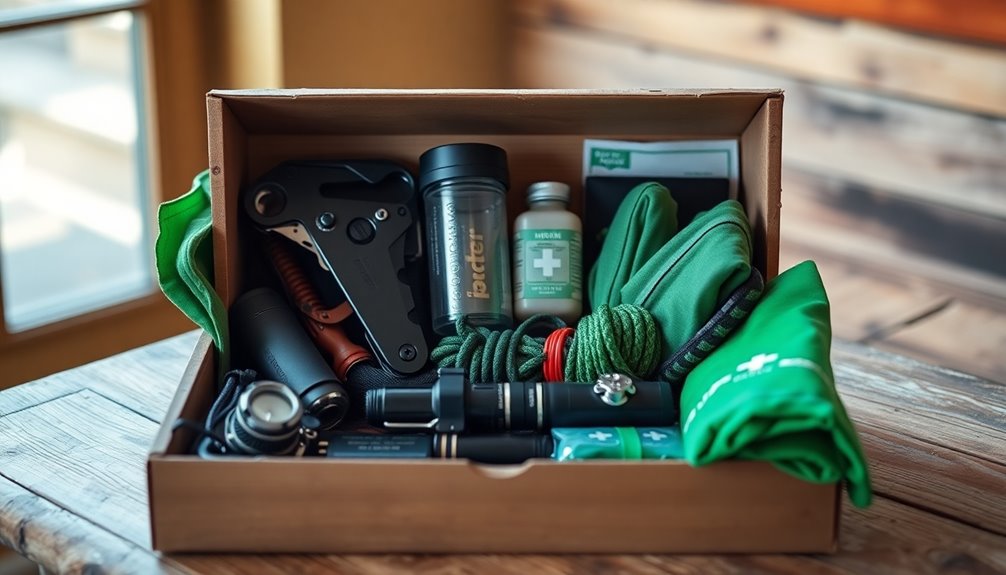
To navigate without GPS, you rely on your map, compass, and natural cues from the sky and surroundings. Use the map and compass to set your course and confirm your location, especially in unfamiliar terrain. When the sky is clear, identify key stars or the sun to help keep your direction. Recognizing natural landmarks like mountains or rivers further guides your journey. Keep exploring, and you’ll discover how to master these classic skills to find your way everywhere.

Get garden gear delivered free with Prime
- Fast, free delivery on millions of items
- Prime Video, Amazon Music and more included
- Member-only deals all year
Key Takeaways
- Use a physical map to identify landmarks, terrain features, and your current location through visual cues.
- Employ a compass to determine directions and establish bearings relative to your surroundings.
- Observe the sky, identify constellations, stars, or the sun to orient yourself and maintain your course at night.
- Cross-reference natural landmarks with your map for verification and improved navigation accuracy.
- Develop skills in terrain reading, celestial observation, and compass use to navigate confidently without electronic devices.

In a world increasingly reliant on GPS technology, it’s easy to forget that effective navigation doesn’t always require digital tools. Before smartphones and satellites, explorers relied on their skills, intuition, and natural clues to find their way. One of the oldest and most dependable methods is celestial navigation, which involves using the sky as your map. By observing stars, the sun, and the moon, you can determine your position and heading, even when other tools fail. All you need is a basic understanding of celestial bodies and a simple navigation instrument like a sextant. With practice, you can identify key stars and constellations, helping you maintain your course during the night. This method is especially useful in remote wilderness or open waters, where landmarks might be sparse or obscured by weather.
Alongside celestial navigation, natural landmarks play an essential role in orienting yourself. When you’re traveling through familiar terrain or exploring new landscapes, look for distinctive features like mountain peaks, river bends, cliffs, or unique rock formations. These landmarks serve as visual cues that can confirm your location or guide you toward your destination. For instance, a prominent hill or a distinctive tree can be your reference point if you memorize their positions in relation to your route. In coastal navigation, bays, headlands, and islands are invaluable for confirming your position on a map. Using natural landmarks requires keen observation and an understanding of the landscape, but it’s a dependable way to navigate without relying on technology.
Additionally, understanding the best tools and techniques for traditional navigation can enhance your confidence and accuracy during outdoor adventures. Combining celestial navigation with natural landmarks gives you a powerful toolkit for wilderness or open-sea adventures. When the sky is clear, you can use celestial cues to set your course, then verify your position using visible landmarks. Conversely, during overcast weather or at dawn and dusk, natural features become even more critical. Always keep a physical map and compass handy, as they complement your natural observations and help you stay oriented. Learning to read the terrain and sky takes patience and practice, but it grants you independence from electronic devices. Ultimately, mastering these traditional navigation skills guarantees you can find your way in any environment, reaffirming the timeless connection between humans and the natural world.
Top picks for "navigation without compas"
As an affiliate, we earn on qualifying purchases.
Frequently Asked Questions
How Accurate Are Traditional Navigation Methods in Dense Forests?
Traditional orientation methods in dense forests can be quite accurate if you rely on proper map orientation and accurate compass calibration. You might face challenges like limited visibility and thick canopy, but with steady compass use and good map skills, you can stay on course. Keep your compass calibrated and regularly check your map orientation to avoid errors. Practice improves your confidence and precision in navigating through challenging, wooded terrains.
Can Stars Be Used for Navigation During the Daytime?
Actually, you can’t use stars for navigation during the daytime because stellar positioning relies on seeing stars, which are hidden by the bright sun. Daytime star visibility isn’t possible, so you’ll need other methods like the sun’s position or a compass. Ironically, while stars are great at night, they’re just not visible when the sun’s shining, making daytime navigation a different challenge altogether.
What Are Common Mistakes to Avoid When Using a Compass?
When using a compass, avoid common mistakes like ignoring magnetic interference, which can lead to inaccurate readings. Make sure your compass is properly calibrated before heading out, especially if you’ve recently experienced shocks or drops. Keep the compass away from metal objects, electronic devices, and power lines, as they can disrupt the magnetic needle. Regularly check and reset your compass to maintain reliable navigation, especially in unfamiliar terrain.
How Do Weather Conditions Affect Celestial Navigation?
Weather conditions can be your navigational storm, cloud cover, and atmospheric interference obscure celestial cues you rely on. When clouds block the sky, stars become hidden, making it harder to determine your position. Atmospheric interference, like haze or humidity, distorts celestial signals, leading to inaccuracies. To navigate effectively, check weather forecasts, stay alert for changing conditions, and have backup methods ready—because clear skies aren’t always guaranteed.
What Skills Are Essential for Beginners Learning Traditional Navigation?
You need to master map reading and compass handling to navigate effectively without GPS. Start by understanding how to interpret map symbols and scale, then practice taking bearings with your compass. Develop your ability to orient maps accurately and keep track of your position. These skills enable you to navigate confidently, even in challenging conditions, enhancing your independence and safety in the outdoors.
Conclusion
Remember, orienting without GPS is like sailing by the stars—your trusted compass and map become your guiding lights. Trust your instincts, read the signs, and embrace the journey. Without modern gadgets, you’re the captain steering through uncharted waters, discovering new paths and sharpening your senses. So, lift your head, look around, and trust in your skills. True direction comes from within—your inner compass, guiding you home through the night’s silent, endless sky.
Halloween Picks
halloween
As an affiliate, we earn on qualifying purchases.