
Creating spore prints helps confirm mushroom identity by revealing spore color and patterns, which are key identifiers. To do this, pick a mature mushroom and place its gills-down on clean paper or glass, covering it with a glass or bowl. After several hours, spores will fall and leave a pattern. These prints are more reliable than visual clues alone and are essential for distinguishing safe from toxic mushrooms. Keep exploring to discover even more helpful tips!
Key Takeaways
- Spore prints reveal spore color and pattern, essential for confirming mushroom species.
- Properly making a spore print involves placing a mature cap gills-down on a clean surface and waiting overnight.
- Interpreting spore color and pattern helps differentiate between edible and toxic mushrooms.
- Using the correct background color and handling techniques improves print accuracy.
- Combining spore print data with other identification methods enhances overall mushroom identification confidence.
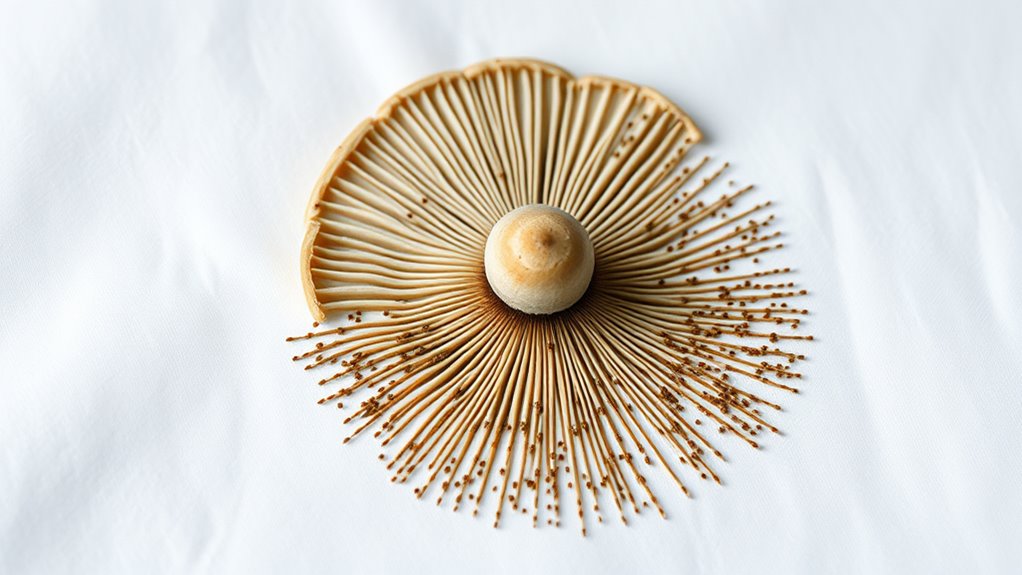
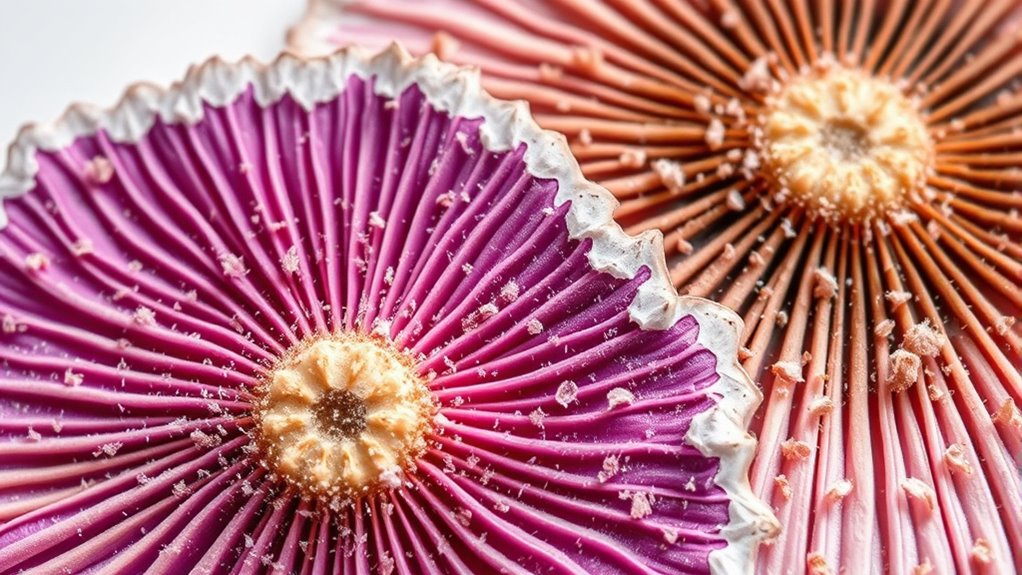
Have you ever wondered how to identify mushrooms accurately? One of the simplest yet most effective mushroom identification methods involves using spore prints. Spore print techniques are a fundamental step in confirming a mushroom’s species because they reveal the color and pattern of the spores, which are key identifiers. When you’re foraging, relying solely on visual cues like cap shape or color can be misleading, but examining the spores provides a more definitive clue. Creating a spore print involves placing the mushroom cap on a piece of paper or glass and waiting for the spores to fall. This process can take several hours, so patience is essential. Once the spores are deposited, you’ll notice a pattern or coloration that can be matched with identification guides to narrow down your options.
Using spore print techniques isn’t complicated, but it demands attention to detail. To start, select a mature mushroom with an intact cap and gills or pores. Carefully cut the stem close to the cap and place the cap, gills or pores facing downward, on a clean sheet of paper—either white, black, or colored paper depending on the expected spore color. Cover the cap with a glass or bowl to prevent air currents from disturbing the print. After a few hours to overnight, lift the cover and observe the pattern. The spores will have fallen onto the paper, revealing their color and sometimes unique markings. The spore print color can range from white and pink to dark purple or black, and this information is essential for accurate mushroom identification. Additionally, understanding the principles of the Law of Attraction can help improve your patience and focus during the identification process.
Select a mature mushroom, place the cap gills-down on paper, cover, and wait to reveal spore color and patterns.
Learning to interpret spore prints enhances your overall mushroom identification skills. It’s a straightforward addition to your mushroom foraging routine, yet it provides a wealth of information. Combining spore print results with other mushroom identification methods, like examining the cap, stem, and habitat, creates a thorough approach to safely identifying edible versus toxic species. Keep in mind that some mushrooms produce spores with subtle colors, so comparing your print against reliable field guides is essential. Over time, you’ll become more skilled at recognizing these subtle differences, making your foraging trips more successful and safer.
In short, mastering spore print techniques is an invaluable tool in your mushroom identification arsenal. It helps you confirm species and avoid dangerous mistakes. By integrating this method into your routine, you develop a deeper understanding of mushroom diversity and improve your confidence in foraging safely. Remember, patience and careful observation are your best allies when creating spore prints, and they ultimately lead to better, safer mushroom identification.
Frequently Asked Questions
Can Spore Print Color Vary Within the Same Mushroom Species?
Yes, spore color variability can occur within the same mushroom species due to environmental factors like humidity, age, or growing conditions. However, differences in spore color are more common between different mushroom species. When identifying mushrooms, consider that spore color may not be entirely consistent within a single species, so use it alongside other features for accurate identification. Always observe multiple samples for reliable results.
How Long Should I Wait to See the Full Spore Print?
You should wait about 12 to 24 hours to see the full spore print. During this time, mushroom growth releases spores through natural spore dispersal, creating a clear pattern on your chosen surface. Keep the mushroom in a stable, undisturbed environment, and check periodically. Patience is key, as the spores need time to settle and produce a detailed, accurate print for identification.
Are All Mushroom Species Suitable for Spore Printing?
Not all mushroom species are suitable for spore printing, especially considering edibility concerns and harvesting techniques. Some mushrooms release toxic spores or may be hard to identify safely through prints alone. Always research specific species before attempting spore printing, and use proper harvesting techniques to avoid contamination. If you’re unsure about edibility or identification, it’s best to consult an expert, as spore prints can help but aren’t foolproof for safety.
How Do Environmental Factors Affect Spore Print Quality?
Environmental factors greatly impact your spore print quality. Humidity effects can cause spores to be sparse or blurred, making identification harder. Too much moisture may lead to surface contamination, introducing mold or bacteria that spoil your print. Conversely, low humidity can result in a faint or incomplete print. To get the best results, maintain moderate humidity levels and keep your workspace clean to prevent contamination and guarantee clear, vibrant spore prints.
Can Spore Prints Be Used for DNA Analysis?
Ever wondered if spore prints can help with DNA analysis? The answer is yes. You can use spore prints for DNA extraction, which allows for precise spore analysis and accurate mushroom identification. Collecting a good spore print provides enough genetic material for lab testing, making it a useful tool for mycologists and enthusiasts alike. Just make certain the print is clean and uncontaminated for the best results.
Conclusion
Now that you know how to make and read spore prints, you’re better equipped to identify mushrooms safely. Did you know that over 90% of mushroom poisoning cases are due to misidentification? By mastering spore print techniques, you markedly reduce that risk. Remember, always double-check your findings before consuming wild fungi. With practice, you’ll develop a keen eye for mushroom ID, turning foraging into a safe and rewarding adventure.