
TL;DR

Get garden gear delivered free with Prime
- Fast, free delivery on millions of items
- Prime Video, Amazon Music and more included
- Member-only deals all year
An Ideal Home gardening report says October is too early for routine pruning of most trees because they have not yet entered dormancy. Citing tree expert Gareth Mitchell, it identifies acers, birches and newly planted trees as exceptions that may need only light removal of dead, damaged, diseased or rubbing growth.
Most trees should not be pruned in October, but acers, birches and newly planted trees may receive a light corrective trim when needed, according to an Ideal Home gardening report. The advice, citing tree expert Gareth Mitchell, warns that many trees have not yet reached their dormant season and says October cuts should focus on dead, damaged, diseased or rubbing branches rather than reshaping the canopy.
The report says the main pruning period for many trees is late autumn to late winter, when they are dormant. October is generally early autumn, so deciduous trees losing their leaves are not necessarily ready for a routine annual prune. It gives apple trees as an example: their recommended pruning time is winter, and cutting them earlier can cause stress.
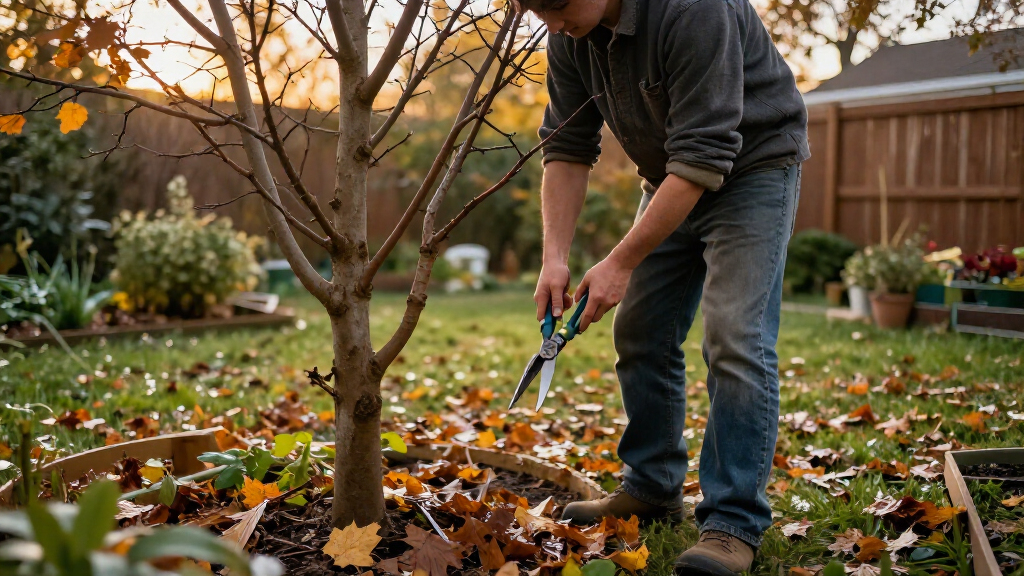
Mitchell, founder of Tree2MyDoor, advises gardeners to check Japanese maples and other acers for dead, damaged or crossing branches before dormancy. Acers have a naturally attractive shape and generally need little pruning, the report says. Any work in October should therefore be selective rather than an attempt to reshape the whole tree.
Birches and newly planted trees are the other exceptions. Mitchell says small dead or damaged birch branches can be removed in October; crowded branches that rub can also be taken out. Newly planted trees may need minor corrective cuts to remove broken growth or balance their shape. The report does not recommend substantial pruning for any of the three groups.
Why October Cuts Need Restraint
The timing matters because pruning is a wound to a tree, and cutting at the wrong point in its seasonal cycle can add stress. Mitchell says poorly timed pruning can lead to excessive sap loss or leave a tree more exposed to disease. The report’s guidance offers a practical distinction for gardeners: October can be a time to inspect trees and address specific damage, but it is not a general invitation to prune.
That distinction may prevent gardeners from treating leaf fall as a signal that all trees are ready for a full trim. For most trees, waiting until the appropriate dormant-season window is the safer course described in the report. Where a cut is justified in October, keeping it light and limited reduces unnecessary intervention and leaves broader shaping for a more suitable time.
As an affiliate, we earn on qualifying purchases.
Dormancy Sets the Pruning Window
The report frames October as a point between the growing season and the dormant period, which it places broadly between late autumn and late winter. Although some plants can be pruned during October, the guidance says most trees should wait. A tree shedding leaves may still be active enough that a routine prune is premature.
The exceptions are based on particular needs rather than a blanket seasonal rule. Acers can be checked for the three categories of unwanted growth—dead, damaged and diseased—and for branches crossing or rubbing. Birch pruning is limited partly because heavy late-winter or early-spring cuts can coincide with peak sap flow, according to Mitchell. Recently planted trees may need small corrections if branches were broken or their growth is uneven.
“Timing really matters when it comes to pruning.”
— Gareth Mitchell, gardening expert and founder of Tree2MyDoor
As an affiliate, we earn on qualifying purchases.
How Much Pruning Is Appropriate
The report does not set out precise branch-size limits, detailed cutting techniques or a single date when the dormant season begins; those conditions can vary. It also does not say that every acer, birch or newly planted tree should be pruned in October. The advice is conditional: inspect the tree and remove only specific unwanted or damaged growth when necessary.
It does not provide a tree-by-tree schedule covering species beyond the examples discussed, nor does it assess individual tree health. Gardeners uncertain about a tree’s condition or the right timing for a particular species may need advice tailored to their location and circumstances. The article’s guidance should not be read as support for heavy pruning in October.
As an affiliate, we earn on qualifying purchases.
Inspect Now, Defer Routine Cuts
Gardeners can use October to check for dead, damaged or diseased branches, as well as growth that is crossing or rubbing, and make only small corrective cuts where needed on the three groups identified. For other trees, the report advises waiting until the appropriate pruning period rather than cutting simply because leaves are falling.
The next step is to follow species-specific timing as the season progresses. For apple trees and most other trees discussed as not yet dormant, routine pruning should be left for the recommended winter or dormant-season window. The report gives no further timetable or follow-up guidance beyond that seasonal advice.
planting and pruning tools for newly planted trees
As an affiliate, we earn on qualifying purchases.
As an affiliate, we earn on qualifying purchases.
Key Questions
Can most trees be pruned in October?
No. The Ideal Home report says October is too early for routine pruning of most trees because many have not entered dormancy. It recommends waiting for the appropriate dormant-season period.
Which trees may be lightly pruned in October?
The report names acers, birches and newly planted trees. Any October work should be limited to necessary corrective cuts, such as removing dead, damaged, diseased or rubbing branches.
Should Japanese maples be shaped in October?
The report says to check Japanese maples and other acers for specific problem branches, not to give them a broad shaping prune. It notes that acers naturally have an attractive shape and generally need little pruning.
Why does the report caution against pruning birches in late winter?
Mitchell says birches can lose sap when heavily pruned in late winter and early spring, when sap flow is at its peak. The report says October can be a safer time to remove small dead or damaged branches, but does not recommend heavy pruning.
Source: rss
Halloween Picks
halloween
As an affiliate, we earn on qualifying purchases.