TL;DR

Get garden gear delivered free with Prime
- Fast, free delivery on millions of items
- Prime Video, Amazon Music and more included
- Member-only deals all year
A Gardening Know How report outlines six ways to put Halloween pumpkins to use in the yard rather than discard them, including composting and seed saving. The usable options depend on the pumpkin’s condition: remove paint, wax, lights and other contaminants, and account for the fact that seeds from hybrid or cross-pollinated pumpkins may not grow true to type.
Gardening Know How has published six ways to reuse Halloween pumpkins in gardens and yards, including breaking them down for compost and saving seeds for planting. The advice offers an alternative to throwing usable pumpkins away, while stressing that painted or otherwise contaminated sections should be discarded.
The report says pumpkins should be clean and free of contaminants before they are used in garden projects. Remove candle stubs, wax and battery-powered lights; sections treated with craft paint, glitter, chemical sealants or artificial snow should go in the trash. The guidance applies to carved pumpkins only when they have not been coated with those materials.
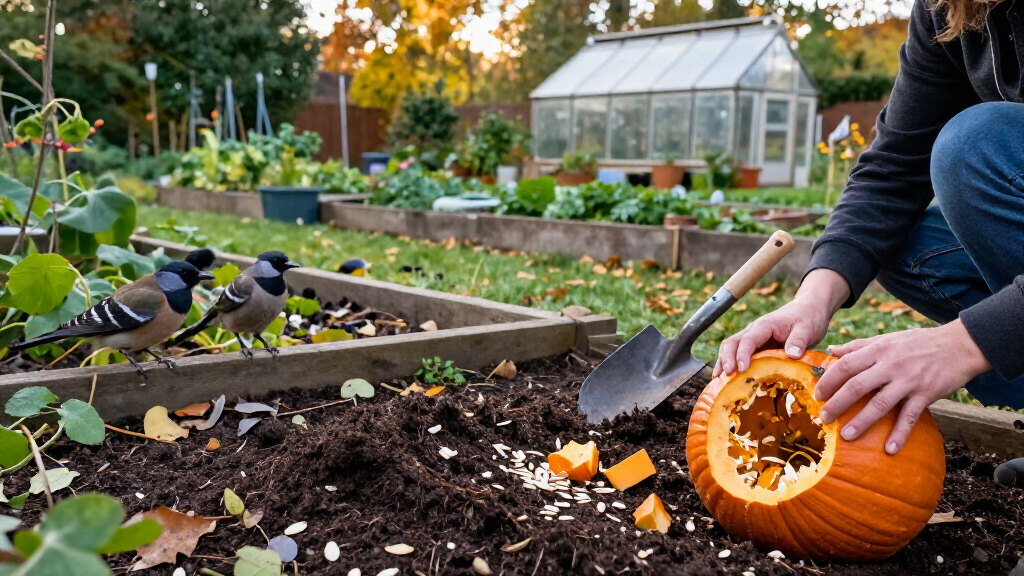
For compost, the report recommends chopping a pumpkin into fist-sized pieces rather than leaving it whole, since the rind can slow decomposition. It says to combine each bucket of chopped pumpkin with two buckets of dry material such as shredded leaves, straw or torn cardboard. Another option is trench composting: bury the pieces in a trench 18 to 24 inches deep, then cover them with 12 inches of soil.
The article also describes saving seeds from healthy, mature pumpkins. It recommends washing away the pulp, drying seeds in a warm, ventilated place out of direct sunlight for two to three weeks, then storing them in a labeled paper envelope in a cool, dark location. It cautions that carving pumpkins are often hybrids and that cross-pollination can make the next generation’s fruit unpredictable.
Keeping Pumpkin Nutrients in the Yard
Reusing a sound pumpkin can return its organic material to a garden instead of sending it out with household waste. The report says pumpkin tissue can contribute to compost and soil life, while the seeds offer a possible source of plants for a later season. These options matter most to gardeners who have space for a compost pile or bed and want to make use of material already on hand.
The advice is not a guarantee of quick results. Decomposition depends on soil and weather, and buried pumpkin may persist longer in heavy clay than in loose, well-drained soil. The article estimates two to three months for breakdown in well-drained soil, but says pieces can remain in clay for a year. Those timelines are guidance from the report, not a measured promise for every garden.
Popular right now

Shark Rocket Ultra-Light Corded Stick Vacuum, HV301, Gray/Orange

Shark PowerPro Reveal Plus Cordless Vacuum Cleaner, Charcoal, IZ376H

Shark Clean & Empty Cordless Stick Vacuum with Auto-Empty System, BU3521
As an affiliate, we earn on qualifying purchases.
Why Pumpkins Need Preparation
The report frames the advice around the days after Halloween, when unwanted pumpkins are commonly put out with the trash. It says millions of pumpkins go to landfills each year and can release greenhouse gases as they break down in low-air conditions; it does not provide a specific source or calculation for that figure in the supplied material.
Preparation affects how useful a pumpkin will be. Carving varieties with softer flesh, such as Howden and Jack O’ Lantern, are described as easier to cut up for soil use. Firmer heirloom varieties may hold their shape longer. Temperatures also matter: colder conditions can preserve a pumpkin on a porch, while warmer weather can accelerate mold and attract fruit flies, according to the report.
““The only rule is that your fruit needs to be clean and free of contaminants.””
— Gardening Know How report
Limits of the Garden Advice
The supplied report excerpt gives detail on composting and seed saving, then begins a section about turning a pumpkin into a bird feeder but cuts off before explaining that method. It names a total of six uses, but the source material provided here does not include the complete descriptions of all six. The remaining methods should not be inferred from the headline.
The excerpt also does not provide independent research citations for its landfill estimate, decomposition timings or wildlife-related advice. Seed outcomes are uncertain because of hybrid genetics and possible cross-pollination, and actual composting times vary with local conditions.
Choose a Use Before Rot Sets In
Gardeners can first inspect each pumpkin and remove any treated or decorative materials. A clean pumpkin can then be chopped for a compost pile or buried in a suitable bed; seeds intended for saving need to be washed and dried fully before storage. In warmer regions, the report advises acting promptly because heat can speed mold growth and attract fruit flies.
The source material does not identify a follow-up date or a next event. Its practical next step is to select a method suited to the pumpkin’s condition and the garden’s space, while treating its timings as estimates rather than guarantees.
Key Questions
Can a carved pumpkin go into compost?
Yes, if it is clean and untreated. Remove candles, wax, lights and any painted, glittered or sealed sections. Chop the pumpkin before adding it to compost.
How should I balance pumpkin in a compost pile?
The report recommends mixing one bucket of chopped pumpkin with two buckets of dry browns, such as shredded leaves, straw or torn cardboard, to help keep the pile aerated.
Will saved pumpkin seeds grow the same kind of pumpkin?
Not necessarily. The report says carving pumpkins are often hybrids, and cross-pollination with nearby squash can produce unpredictable fruit in the next generation.
How long does buried pumpkin take to break down?
The report estimates two to three months in loose, well-drained soil, while pieces in heavy clay may remain for as long as a year. Conditions vary by garden.
Source: gardeningknowhow.com