
TL;DR

Get garden gear delivered free with Prime
- Fast, free delivery on millions of items
- Prime Video, Amazon Music and more included
- Member-only deals all year
Amateur Gardening reports that horticulture expert Simon Wilkinson recommends five plants for adding colour, texture and movement to gravel gardens: Mexican feathergrass, English lavender, catmint, Adam’s needle and creeping thyme. The advice stresses good drainage, suitable planting conditions and avoiding overcrowding; the plants’ performance will depend on the garden and local conditions.
Amateur Gardening has published five plant recommendations from horticulture expert Simon Wilkinson for gardeners who want gravel beds with more colour and texture: Mexican feathergrass, English lavender, catmint, Adam’s needle and creeping thyme. The advice focuses on plants suited to free-draining soil, while noting that drainage and spacing help determine whether a gravel garden thrives.
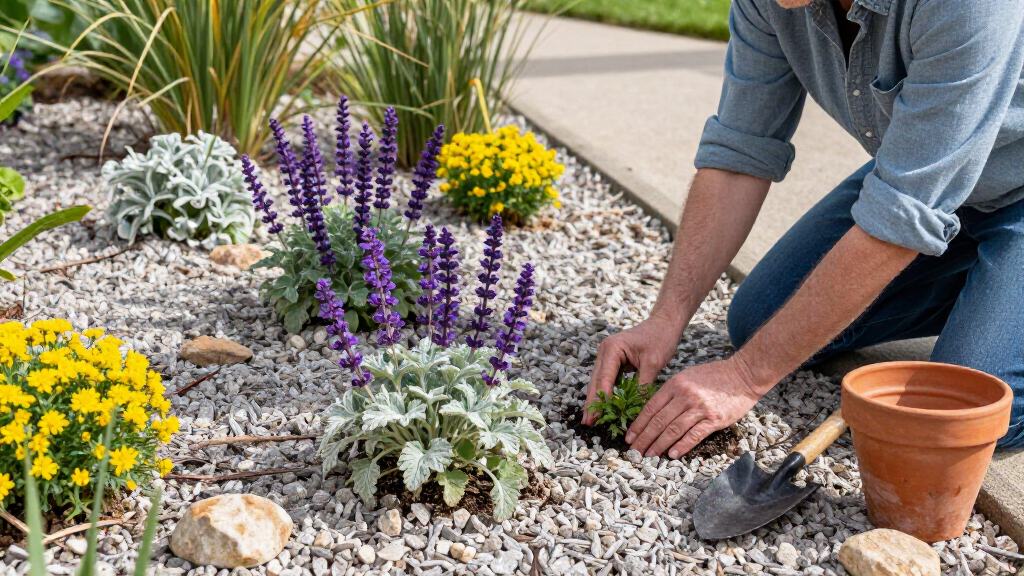
Wilkinson, managing director of Wilkinsons Landscapes, said gravel gardens need not be limited to sparse planting and grey stone. His list combines plants with different forms and uses: Mexican feathergrass for movement, English lavender for purple flowers and fragrance, and catmint for pale blue and purple blooms. The source says the flowers of lavender and catmint attract pollinators, including bees.
Adam’s needle (Yucca filamentosa) is an evergreen, hardy plant that produces tall white flowers, according to the report. It needs good drainage and does not do well in wet soil. Creeping thyme grows close to the ground and is suggested for smaller spaces or pathways, including between stepping stones.
The report’s basic preparation advice is to choose a sunny spot, clear weeds, consider using weed membrane and spread about two inches of gravel. It also recommends edging the area with materials such as bricks or wood to contain the stone. These are general suggestions, not guarantees that every site or plant will perform the same way.
Designing Gravel Beds With Variety
The recommendations offer gardeners a way to think about gravel as a planting surface rather than a finished, mostly bare landscape. Combining upright grasses, flowering perennials and ground-covering thyme can create differences in height, movement and texture, while repeated planting can make a bed look more coordinated.
Wilkinson’s advice also links appearance to practical site conditions. Gravel alone does not make a planting low-maintenance: plants need suitable soil and drainage, and some need pruning after flowering. A poorly drained or low-lying area may not suit the five selections, so matching plants to the site matters as much as choosing a colour scheme.
Popular right now

KitchenAid Classic Series 4.5-Quart Tilt-Head Stand Mixer, Onyx Black

Dyson Cyclone V10 Origin Cordless Vacuum

Ninja Foodi 10-Qt DualZone Smart XL Air Fryer, 6-in-1, DZ550
As an affiliate, we earn on qualifying purchases.
Plant Choices and Site Conditions
The report frames gravel gardening as an option for people seeking a garden that can cope with dry conditions and needs less routine attention once plants are established. It says interest in the approach has grown after a period of unseasonably hot weather in the UK, but provides no survey, figures or independent evidence measuring that increase.
Wilkinson advises gardeners to assess the land and drainage before starting. He warns that damp, low-lying areas can turn a gravel bed wet and unsuitable for plants that need free-draining conditions. Rather than forcing a dry-garden scheme into such a spot, the report suggests choosing plants that suit wetter conditions. It also recommends repeating varieties instead of packing in too many different plants, to avoid an overcrowded, uncoordinated look.
“The absolute key to a successful gravel garden is choosing plants that are happy in free-draining conditions.”
— Simon Wilkinson, speaking to Amateur Gardening
Limits of the Planting Advice
The source does not provide trial results, comparative maintenance data or a detailed assessment of how the five plants perform across different climates and soil types. Its recommendations are attributed to Wilkinson and should be treated as general gardening guidance, not a guarantee of success in every garden.
It is also unclear from the report how much watering or care each plant may need during establishment, or how local winters and soil conditions affect them. The article’s reference to increased interest in gravel gardens after hot UK weather is not supported by a stated measurement or time period.
Check Drainage Before Planting
Gardeners considering the approach should first check whether the chosen area is sunny and drains well, then select plants suited to those conditions. The report recommends clearing weeds, using a weed membrane if needed, applying roughly two inches of gravel and adding edging to keep the surface in place.
After planting, allow enough room for growth and consider repeating a smaller number of varieties. Lavender may need pruning once its flowers have died, while plants that dislike wet soil should not be placed where water collects. The source sets out no further scheduled development; outcomes will depend on site conditions and plant care.
Key Questions
Which five plants does the report recommend for gravel gardens?
It names Mexican feathergrass, English lavender, catmint, Adam’s needle and creeping thyme. They are presented as options for adding movement, flowers, evergreen structure or ground cover.
Do gravel gardens need to be in full sun?
The report recommends choosing a sunny spot because many drought-tolerant plants suited to gravel benefit from an open, sunny location. The source does not say that every plant on its list has identical light requirements.
What is the main condition for a successful gravel garden?
Wilkinson identifies good drainage as the key consideration. Adam’s needle, in particular, is described as needing well-drained soil and disliking wet conditions.
How much gravel does the report suggest using?
Its basic preparation advice suggests spreading about two inches of gravel after clearing weeds. It says a weed membrane may be used if required and suggests edging to help contain the gravel.
Are gravel gardens automatically low-maintenance?
No. The report says suitable plants may need little attention once established, but site drainage and plant choice still matter. It also notes that English lavender should be pruned after flowering to keep it compact and healthy.
Source: amateurgardening.com