TL;DR

Get garden gear delivered free with Prime
- Fast, free delivery on millions of items
- Prime Video, Amazon Music and more included
- Member-only deals all year
In an Amateur Gardening report published Nov. 4, 2026, editor Kim Stoddart recommends clearing foliage from greenhouse and polytunnel coverings, while timing exterior cleaning for after most leaves have fallen. She also advises storing reusable pots and trays, ventilating shelters periodically as temperatures drop, and removing yellowing lower leaves.
Amateur Gardening editor Kim Stoddart has published an autumn maintenance checklist for greenhouse and polytunnel growers, advising them to remove foliage from plastic coverings, preserve airflow as temperatures fall and store reusable containers. The measures are intended to protect light levels and plant health through the colder months.
Stoddart says dead or decaying foliage from tall-growing crops, including tomatoes and grapevines, can cling to a shelter’s plastic covering. If left there, it can block light and, over time, contribute to damage to the plastic. She recommends clearing debris from the inside covering first, using a hose spray and a sponge or soft brush. Fallen leaves on the exterior can also stick to the skin and should be removed.
For the outside, Stoddart suggests waiting until most leaves have fallen before cleaning, since more may accumulate over the next few weeks. Her method for reaching the top of a polytunnel is to tie bedsheets together and pull them back and forth across the surface with another person’s help. She advises keeping the plastic itself clear while leaving some lower foliage or ground cover where it can provide shelter for wildlife such as spiders and ground beetles.
For pots and trays, Stoddart describes a low-intervention approach: empty spent compost onto beds or borders, shake planters and put them away for next year. She says she does not routinely wash trays or modules, but qualifies that advice for gardeners concerned about a particular pest or disease, including eggs. She also recommends pairing trays when a module has split, to keep the equipment in use.
Keeping Light and Airflow Through Winter
Autumn maintenance can affect both the condition of a growing shelter and the crops kept inside it. Removing foliage from plastic helps limit shading, while periodic ventilation can reduce the conditions that encourage fungal disease. Stoddart advises opening doors or windows briefly several times a week, even as colder weather prompts growers to keep them closed more often to retain warmth.
Her advice also balances plant care with practical reuse and wildlife shelter. Gardeners can retain usable pots and trays rather than discard them, while leaving some suitable cover at ground level. The report does not quantify the effect of these steps on yields or the lifespan of a covering; it presents them as seasonal maintenance practices.
Popular right now

De'Longhi Rivelia Fully Automatic Espresso Machine with Milk Frother, White

Breville BES870XL Barista Express Espresso Machine, Brushed Stainless Steel

Dyson V15 Detect Cordless Vacuum
As an affiliate, we earn on qualifying purchases.
A Seasonal Check on Plastic Covers
The report, published by Amateur Gardening on Nov. 4, 2026, focuses on work to do during the current fortnight in a greenhouse or polytunnel. It is a seasonal advice article rather than a report of a new policy, study or industry development.
Stoddart says a plastic outer covering can sometimes remain serviceable beyond its recommended replacement date if it is kept clean and damage is repaired promptly. She gives her own polytunnel, whose cover she says is at least 16 years old and still working well, as an example. That is her personal experience, not a general lifespan guarantee for other covers.
“The more you look after your polytunnel or greenhouse, the more productive it will be for the longer term.”
— Kim Stoddart, Amateur Gardening editor
Limits of the Seasonal Advice
The report does not provide controlled comparisons showing how much cleaning or ventilation changes crop health, yields or plastic-cover lifespan. Stoddart’s example of a covering lasting at least 16 years is an account of her own polytunnel and should not be read as a prediction for other materials or sites.
How often a particular shelter needs cleaning or airing will depend on its conditions, crops and the weather. The article gives general timing and methods, but does not set a fixed schedule or discuss every greenhouse material. It also leaves the decision about washing trays to gardeners, especially where there is concern about a specific pest or disease.
Tasks for the Coming Weeks
Stoddart’s immediate sequence is to clear debris from inside coverings, keep an eye on further leaf fall and postpone exterior cleaning until most leaves are down. As temperatures dip, growers can keep doors and windows closed more often while still opening them briefly several times a week when conditions allow.
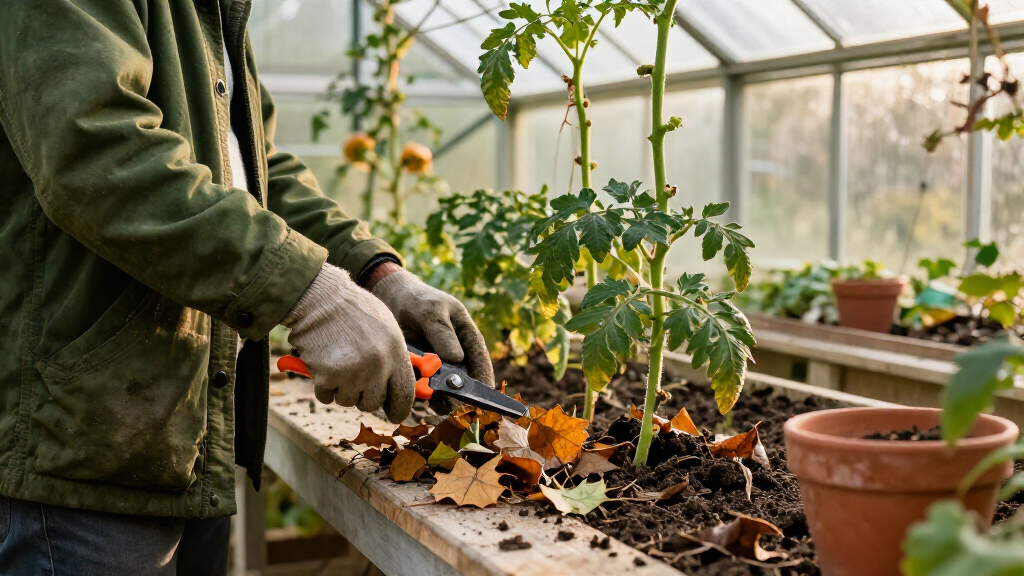
She also recommends removing yellowed lower leaves and continuing to pick healthy leaves from plants that can produce through winter. Gardeners can then empty and store containers, checking first for any pest or disease concern that may make cleaning appropriate.
Key Questions
When should I clean the outside of a polytunnel?
Stoddart advises waiting until most leaves have fallen, since leaves can continue dropping for several weeks in autumn. She suggests a similar gentle cleaning method for the exterior once that period has passed.
How should foliage be removed from greenhouse plastic?
For the inside, Stoddart recommends a hose spray with a sponge or soft brush. For hard-to-reach exterior areas, she describes pulling tied-together bedsheets back and forth across the covering with a helper.
Should greenhouse doors and windows stay closed in cold weather?
Stoddart says growers will want to retain heat by keeping them closed more, but advises brief ventilation a few times a week to help limit fungal-disease buildup.
Do pots and seed trays need to be washed before storage?
Stoddart says she shakes out and stores her containers without routinely washing trays or modules. She advises treating that as a personal choice and cleaning them if a particular pest or disease, including eggs, is a concern.
Source: amateurgardening.com