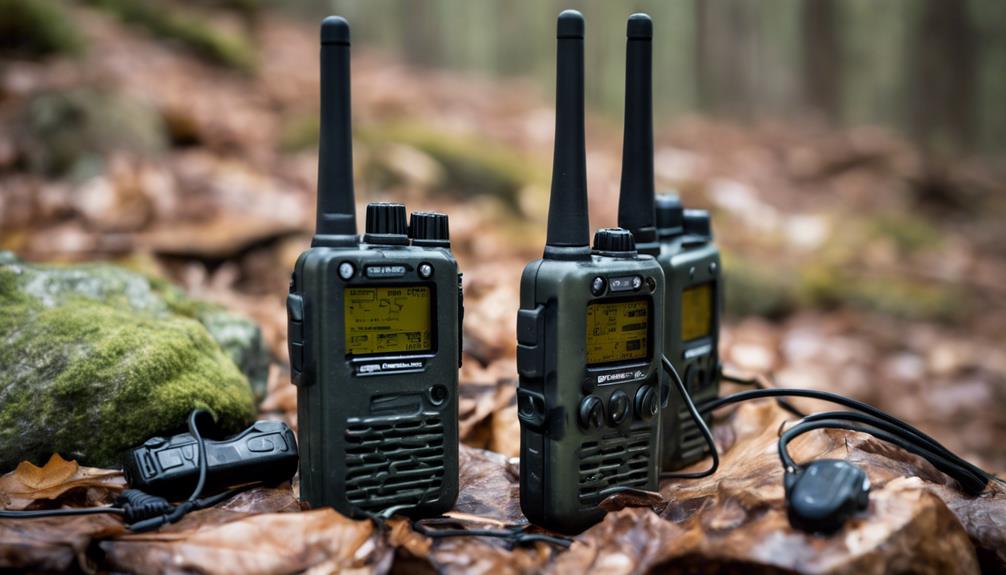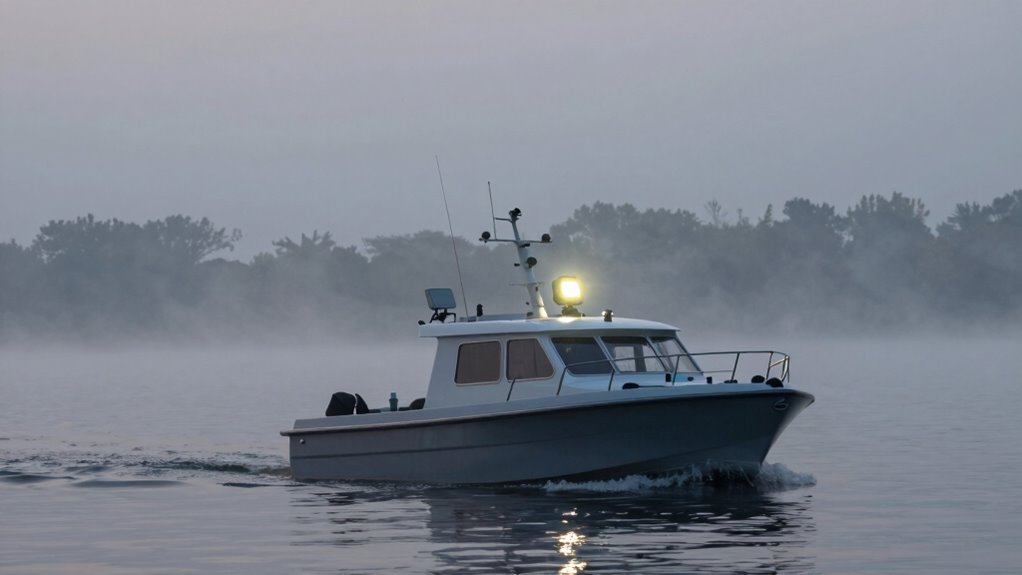

When visibility drops, guarantee your AIS system is properly maintained, with updated software and clear antennas for ideal signal transmission. Keep your MMSI number current for accurate identification, and ensure your power supply is stable. Turn on your AIS to broadcast your vessel’s position, course, and speed, making you visible to nearby vessels. Regularly monitor AIS data for approaching ships, and if you want to learn how to maximize safety with these tips, keep exploring further.
Key Takeaways
- Ensure your AIS system is properly installed and maintained for optimal signal transmission.
- Keep your MMSI number updated to accurately identify your vessel to others.
- Regularly update AIS software and keep hardware in good working condition.
- Clear antennas of obstructions to maintain strong, reliable VHF signal coverage.
- Use AIS data to monitor nearby vessels’ positions and adjust course proactively in low visibility.

Have you ever wondered how small boats stay safe and avoid collisions on busy waters? The answer lies in effective collision avoidance techniques and reliable signal transmission. When visibility drops due to fog, rain, or night, your vessel’s ability to communicate and detect others becomes critical for safety. Automatic Identification System (AIS) plays a crucial role here, enabling you to see and be seen even when the water’s surface isn’t cooperating. AIS transmits your boat’s position, course, and speed, and receives similar data from nearby vessels. This constant exchange of information helps you build a real-time picture of your surroundings, making it easier to make quick, informed decisions to avoid collisions.
Understanding how AIS handles signal transmission is key to grasping how it enhances safety. AIS uses VHF radio frequencies to send and receive data packets between vessels and shore-based stations. These signals are transmitted automatically whenever your AIS is active, ensuring continuous updates to your vessel’s position. Because AIS messages are broadcast at regular intervals, other nearby boats equipped with AIS can detect your presence even if you’re not within visual range. This is especially useful in poor visibility conditions, where your sight might be limited, but your AIS can still alert others to your location.
AIS uses VHF radio to automatically broadcast and receive vessel data at regular intervals, ensuring continuous situational awareness in low visibility.
Collision avoidance relies heavily on this system’s ability to provide accurate, timely information. When an AIS target appears on your display, you can see its heading, speed, and distance. This information allows you to assess whether you’re on a collision course and decide whether to alter your course or speed. Many small craft operators use AIS as a proactive tool—rather than just a passive receiver—by paying close attention to nearby vessel data and maintaining safe distances. Properly interpreting AIS data ensures you’re not only aware of other vessels’ positions but also their intentions, thanks to the system’s ability to display vectors and projected courses. Additionally, maintaining your system’s performance by keeping software updated and hardware in good condition is vital for reliable operation.
In conditions of low visibility, AIS becomes even more essential. Since visual cues are limited, your reliance on signal transmission increases. It’s important to keep your AIS system properly maintained and configured to ensure it transmits and receives data effectively. Regularly updating your MMSI number, keeping antennas clear of obstructions, and ensuring your system is powered correctly help optimize its performance. Ultimately, AIS enhances collision avoidance by providing a dependable, real-time communication network that keeps you informed about nearby vessels, helping you navigate safely through challenging conditions.
Frequently Asked Questions
What Is the Legal Requirement for AIS on Small Boats?
You need to comply with AIS regulations if your small boat operates in certain waters or meets specific size criteria. Generally, your boat must be registered, and AIS installation is required by law if you’re in areas where it’s mandated, such as commercial or commercial-mooring zones. Always check local regulations to confirm your boat registration and AIS equipment meet legal standards, helping you stay compliant and visible, especially in low visibility conditions.
How Does AIS Differ From Radar or Other Navigation Tools?
Imagine you’re in a ship’s radio room in the 1930s, but today, AIS differs from radar by providing detailed vessel information like identity and course, not just echoes. Unlike radar, which depends on signal range and visual detection, AIS actively transmits data for collision avoidance. It helps you see and be seen, especially in low visibility, offering a clearer picture of nearby vessels than traditional tools.
Can AIS Be Used Effectively in Crowded Harbors?
Yes, AIS can be very effective in crowded harbor navigation. It provides real-time data on nearby vessels, helping you spot potential collisions early. However, be aware of AIS visibility challenges, especially with small or transmitting vessels. To maximize safety, use AIS alongside radar and visual lookout. Stay alert and maintain a safe speed, as AIS alone isn’t foolproof, especially when signals are weak or obstructed in busy harbor environments.
What Maintenance Does AIS Equipment Require?
Did you know regular maintenance can extend your AIS device’s lifespan by over 30%? You should inspect your marine battery regularly to verify it’s charged and functioning properly. Additionally, check antenna connections and cleanliness to maintain signal strength. Replace batteries as needed and clean or secure antenna connections to prevent corrosion. Proper maintenance guarantees your AIS system stays reliable, keeping you visible and safe, even in challenging conditions.
How Does Weather Affect AIS Signal Transmission?
Weather can considerably impact your AIS signal transmission through signal attenuation and atmospheric interference. When fog, rain, or storms occur, they weaken the AIS signals, reducing their range and clarity. You might notice less reliable position updates or delayed alerts. To stay safe, make sure your AIS equipment is well-maintained and consider supplementary visual or radar methods during adverse weather conditions, as these help compensate for decreased signal strength.
Conclusion
Now that you know the essentials of AIS for small craft, you’re better prepared to stay safe when visibility drops. Remember, it’s better to be safe than sorry, so keep your AIS updated and pay close attention to your surroundings. When visibility fades, your AIS is your lifeline, helping you avoid trouble before it finds you. Stay alert, trust your equipment, and you’ll navigate safely through even the foggiest waters.