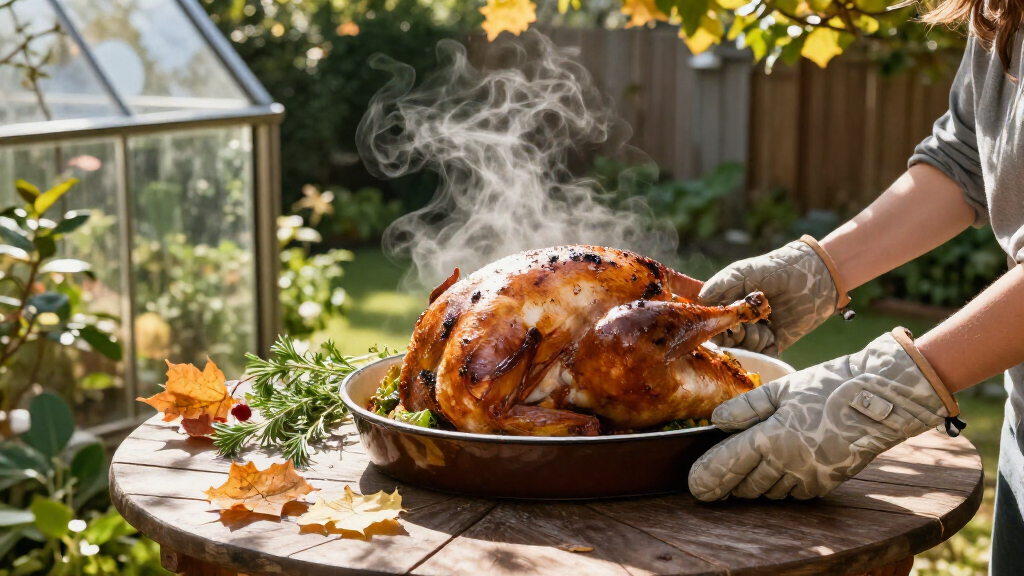

Choosing a turkey roasting pan is a tradeoff between a sturdy pan that can handle more than the oven and a lighter, often cheaper pan built mainly for roasting. Stainless steel pans typically offer greater durability and are more likely to move from oven to stovetop for gravy. Aluminum pans are easier to lift when loaded and can be a practical choice for occasional holiday cooking, though thinner versions may bend and may not work on every cooktop.

Get garden gear delivered free with Prime
- Fast, free delivery on millions of items
- Prime Video, Amazon Music and more included
- Member-only deals all year

Extra-Large Nonstick Turkey Roasting Pan with U-Shaped Rack, 18.7 x 13.6 in
- ✔ Material: Carbon steel
- ✔ Finish: Two-layer nonstick
- ✔ Rack: Removable U-shaped rack

EWFEN Nonstick Turkey Roasting Pan with U-Shaped Rack, 17 × 13 Inch
- ✔ Material: Carbon steel listed; description also says aluminized steel
- ✔ Finish: Nonstick
- ✔ Rack: U-shaped rack

Glad Nonstick Carbon Steel Roasting Pan with V-Shaped Rack, 15 x 10.3 Inches
- ✔ Material: Carbon steel
- ✔ Finish: Nonstick
- ✔ Rack: V-shaped iron rack
For cooks who roast several times a year or want one pan for roasting and pan sauces, stainless steel is usually the better investment. If your main concern is carrying a heavy bird safely, keeping the upfront cost down, or storing a lightweight pan, aluminum may suit you better. Construction matters as much as the metal: thickness, handles, rack design, and cooktop compatibility can change the outcome.
At a Glance
| Criteria | Stainless steel turkey roasting pan | Aluminum turkey roasting pan | Winner |
|---|---|---|---|
| Durability | Generally resists dents and holds up well to repeated use; quality varies by thickness and construction. | Lightweight, but thin pans can warp or dent; sturdier models last longer. | A |
| Weight and handling | Usually heavier, especially with a large bird and drippings inside. | Usually easier to lift and maneuver, though handles and loaded weight still matter. | B |
| Heat distribution | Can heat less evenly than aluminum unless it has a substantial base or bonded core. | Conducts heat well; sturdier construction helps reduce hot spots and warping. | B |
| Stovetop gravy use | Often compatible with gas and electric cooktops; induction compatibility depends on the base. | Cooktop use depends on construction; many aluminum pans are not induction-compatible. | A |
| Cleaning and maintenance | Dishwasher suitability varies; stuck-on fond may need soaking or scrubbing. | Can stain or discolor; some finishes require gentler cleaning and care. | Depends |
| Price and long-term value | Higher upfront cost, often worthwhile for frequent use and stovetop cooking. | Often cheaper, making it attractive for occasional roasting. | Depends |
Extra-Large Nonstick Turkey Roasting Pan with U-Shaped Rack, 18.7 x 13.6 in
When the menu centers on a large bird, this pan makes the strongest case in the group: it is specified for turkeys up to 26 pounds, more than the EWFEN’s 22-pound claim, and substantially larger in its external dimensions than Glad. Its U-shaped removable rack lifts the turkey from the pan surface, while the rack-free pan can serve for casseroles or baked dishes afterward. That flexibility makes it the most capable all-season choice here, provided it fits the oven.Fit is the decisive caveat. The stated external size is 18.7 by 13.6 by 6 inches, and the product calls for at least 20 inches of interior oven length, 15 inches of width, and 7 inches of height. We should measure the oven with room for safe handling, not just compare the pan to a shelf. The two-layer nonstick coating can help release browned food and simplify cleanup, but hand washing is recommended to extend its life. Compared with Glad, this model offers far more stated capacity; compared with EWFEN, it has a higher bird limit and more complete dimensions, but demands more oven room.
Pros:
- Designed for turkeys up to 26 pounds
- Removable U-shaped rack lets the pan serve other baking jobs
- Angled handles provide maneuvering room around the cooking surface
- Two-layer nonstick finish supports food release
Cons:
- Requires substantial oven clearance, including 7 inches of height
- Hand washing is recommended to help preserve the coating
- The large external footprint may be awkward to store
Best for: Cooks preparing a large turkey who have measured a roomy oven and want a removable rack for use beyond holiday roasting.
Not ideal for: Anyone with a compact oven, limited cabinet space, or a preference for dishwasher-first care.
Bottom line: Choose this model when large-turkey capacity matters most and your oven has the required clearance.
“Choose this model when large-turkey capacity matters most and your oven has the required clearance.”
EWFEN Nonstick Turkey Roasting Pan with U-Shaped Rack, 17 × 13 Inch
EWFEN sits between the other two picks in stated turkey capacity: it is designed for a bird up to 22 pounds, while the Extra-Large pan claims up to 26 pounds and Glad provides no turkey-weight limit. Its U-shaped rack raises the roast above juices, and the angled handles are intended to preserve cooking area. For a household that regularly roasts a substantial but not extra-large turkey, those details make it a plausible middle ground.We would resolve a key uncertainty before choosing it. The title says 17 by 13 inches, but the supplied listed dimensions say 15 by 8 by 3 inches, a major discrepancy for a turkey pan. The product information also varies between aluminized steel and carbon steel. Those conflicts make it difficult to judge how much room the bird and drippings will actually have. Compared with the Extra-Large model, EWFEN has a lower stated capacity and less dependable size information; compared with Glad, it offers a specific larger-bird target and a U-rack layout. Its maximum temperature is 450°F, so it suits ordinary roasting within that limit, but the supplied description does not establish broiler use.
Pros:
- Stated capacity is up to 22 lb
- U-shaped rack lifts food above accumulated grease and juices
- Angled handles are designed to leave more room for the cooking surface
- Nonstick coating is described as free of PTFE, PFOA, cadmium, and lead
Cons:
- Title dimensions conflict with the listed 15 x 8 x 3 in dimensions
- Material is described inconsistently as aluminized steel and carbon steel
- Maximum temperature is 450°F
Best for: Buyers seeking a pan specified for a turkey up to 22 pounds who can confirm the actual dimensions before purchase.
Not ideal for: Shoppers who need dependable size information immediately or want a pan with clearly documented material and dimensions.
Bottom line: Consider EWFEN for a mid-size bird only after confirming the pan’s true dimensions and construction.
“Consider EWFEN for a mid-size bird only after confirming the pan’s true dimensions and construction.”
Glad Nonstick Carbon Steel Roasting Pan with V-Shaped Rack, 15 x 10.3 Inches
Glad is the compact alternative, with a listed pan size of 15 by 10.3 inches and a V-shaped iron rack. That shape is distinct from the U-shaped racks included with both larger picks; it supports airflow around the roast while keeping the setup comparatively small. Sturdy handles and a 3.2-pound weight make the pan straightforward to position relative to the larger Extra-Large model, and its stated oven limit of 464°F is the highest of this trio.The tradeoff is turkey capacity: none is stated, and the pan’s dimensions are far tighter than the two products marketed for birds up to 22 and 26 pounds. We would favor Glad for smaller poultry or other compact roasts, rather than assume it will accommodate a large holiday turkey. Its dishwasher-safe care is convenient, but the nonstick surface should not meet abrasive cleaners or metal utensils. Unlike the other descriptions, this one explicitly rules out broiler, stovetop, and open-flame use. That makes it less flexible for gravy preparation directly on a burner, and it trails both larger pans when capacity is the deciding factor.
Pros:
- Compact 15 x 10.3 in listed dimensions
- V-shaped iron rack promotes airflow around the roast
- Sturdy handles support transferring the pan
- Dishwasher-safe and rated to 464°F
Cons:
- No turkey-weight capacity is stated, and the pan is smaller than the other picks
- Not safe for broiler, stovetop, or open-flame use
- Nonstick surface should be kept away from abrasives and metal utensils
Best for: Cooks who need a compact roasting pan for smaller poultry or roasts and value a V-shaped rack and dishwasher-safe cleanup.
Not ideal for: Anyone planning a large whole turkey, making stovetop gravy in the roasting pan, or needing broiler use.
Bottom line: Pick Glad for smaller roasting jobs and easy cleanup, but choose a larger-capacity option for a full-size turkey.
“Pick Glad for smaller roasting jobs and easy cleanup, but choose a larger-capacity option for a full-size turkey.”
As an Amazon Associate we earn from qualifying purchases.
Key Differences
The biggest practical distinction is what happens after the turkey comes out of the oven. A sturdy stainless steel pan is more likely to serve as a reliable base for deglazing and making gravy on the stovetop. Aluminum conducts heat well and can roast effectively, but a lightweight pan may flex under a large bird, and some models cannot be used directly on a cooktop. Check the maker’s instructions before using either material over a burner.
Handling and value pull in opposite directions. Aluminum is usually easier to lift, an advantage when a pan is full of hot food and juices, while stainless steel tends to tolerate years of regular use better. A well-built pan of either material can perform well; a thin, unstable pan is a poor buy regardless of its label. Occasional cooks may save money with aluminum, while frequent roasters are more likely to benefit from stainless steel’s durability and broader use.
Detailed Comparison
Durability (Stainless steel turkey roasting pan wins — moderate)
Stainless steel generally wins by a moderate margin: it is less prone to denting and can withstand repeated use, although thin stainless steel can still disappoint. Aluminum is lighter but may warp or bend when it is very thin, especially under a heavy turkey. For annual roasting, that difference may matter little; for regular use, a robust stainless pan is more likely to remain dependable.
Weight and handling (Aluminum turkey roasting pan wins — moderate)
Aluminum wins by a moderate margin because it is typically lighter, making it easier to carry from oven to counter. That advantage matters with a full pan, but loaded weight, secure handles, and balance matter too. Stainless steel’s extra heft can feel reassuring, yet it can make lifting harder. Choose based on what you can safely maneuver, not the empty-pan weight alone.
Heat distribution (Aluminum turkey roasting pan wins — minor)
Aluminum has a modest edge in heat conduction, so it can warm quickly and distribute heat effectively. Stainless steel pans vary: a thick base or bonded construction can improve performance, while a simple thin pan may heat less evenly. For roasting a turkey, oven temperature, pan shape, rack placement, and bird size also affect results, so this is usually a minor difference between well-made pans.
Stovetop gravy use (Stainless steel turkey roasting pan wins — moderate)
Stainless steel wins by a moderate margin when the pan is rated for stovetop use. It is commonly compatible with gas and electric burners and can make it straightforward to deglaze browned bits for gravy. Aluminum models vary, and many do not work with induction. Check cooktop compatibility and the manufacturer’s use instructions; a pan that should not go on a burner limits this benefit.
Cleaning and maintenance (minor difference)
There is no universal winner, so the difference is minor and depends on the finish and the mess. Stainless steel can need soaking or scrubbing when drippings bake on, while aluminum can discolor or require gentler cleaning, particularly if it has a special finish. Follow care instructions for either pan and consider whether dishwasher compatibility is explicitly stated.
Price and long-term value (moderate difference)
Aluminum often wins on upfront cost, which makes it a sensible value for someone who roasts once or twice a year and does not need stovetop use. Stainless steel usually costs more, but the premium can pay off for frequent cooks who want a durable pan for roasting and gravy. The best value depends on construction: a flimsy bargain pan that warps may need replacing sooner.
Stainless steel turkey roasting pan: Pros and Cons
Pros:
- Durable construction is common among well-made models.
- Often suitable for stovetop gravy-making, subject to manufacturer guidance.
- A good fit for repeated roasting and broader kitchen use.
Cons:
- Usually heavier to lift, especially when loaded.
- Can cost more upfront.
- Heat performance depends on thickness and base construction.
Aluminum turkey roasting pan: Pros and Cons
Pros:
- Usually lighter and easier to maneuver.
- Often costs less upfront.
- Conducts heat well and suits occasional roasting.
Cons:
- Thin models can bend or warp under heavy loads.
- Stovetop and induction compatibility vary.
- Some finishes can stain or need gentler cleaning.
Who Should Choose What
Choose Stainless steel turkey roasting pan if:
- You roast turkey or other large cuts regularly and want a pan built for repeated use.
- You plan to make gravy in the roasting pan and have confirmed it works with your cooktop.
- You prefer a durable pan and can comfortably lift its loaded weight.
Choose Aluminum turkey roasting pan if:
- You roast only occasionally and want to keep the initial cost down.
- A lighter pan is easier for you to handle safely.
- You have checked that the pan’s size, rack, and construction suit your oven and bird.
Skip both if: Skip both if you cannot safely lift a loaded roasting pan or neither option fits your oven; consider a smaller roasting vessel or ask someone to help move it.
Value for Money
Paying more for stainless steel is worthwhile when the pan will see regular use or when stovetop gravy-making is part of your routine. In those cases, durability and versatility can justify the higher upfront cost. For a once-a-year roast, a sturdy aluminum pan can be better value, particularly if it is easy to handle and has a stable rack. Compare thickness, handle security, dimensions, and care guidance before paying extra for the material name alone.
Final Verdict
For most cooks seeking one dependable pan for repeated turkey dinners and gravy, choose a well-built stainless steel model that is rated for your cooktop. Its stronger long-term durability and stovetop versatility are worth the added cost if you will use those features. Choose aluminum if you roast occasionally, prioritize easier lifting, or want a lower purchase price; select a sturdy model to reduce the chance of bending. The deciding factor is whether long-term durability and burner use matter more to you than lighter handling and a lower initial cost.
Frequently Asked Questions
Is stainless steel or aluminum better for roasting a turkey?
Both can roast a turkey well when the pan is properly sized and sturdy. Stainless steel is generally better for repeated use and stovetop gravy; aluminum is lighter and often costs less.
Can I make gravy in an aluminum roasting pan?
Only if the manufacturer says the pan is safe for your cooktop. Aluminum pans vary, and many are not suitable for induction; some should be used in the oven only.
Does a more expensive stainless steel pan make turkey taste better?
The material alone does not guarantee better flavor. Pan construction, roasting technique, and cooking temperature matter more. Stainless steel’s main advantage is durability and, on compatible models, stovetop use for gravy.
What should I check before buying a turkey roasting pan?
Check that it fits your oven and intended bird, has secure handles and a stable rack, and can support the loaded weight. Confirm cooktop and dishwasher compatibility if those features matter to you.