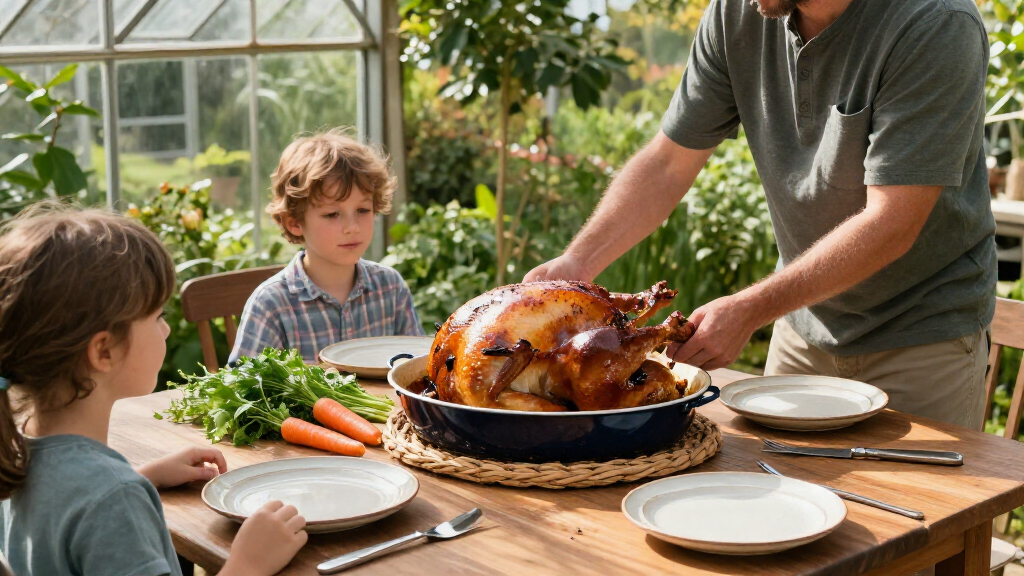
Choose a turkey roasting pan that fits your bird and oven, prepare it for roasting, and use it to support even cooking and safe handling. This guide is for home cooks with basic kitchen skills. Allow about 30–45 minutes to check your equipment and prepare the pan; the roasting itself takes longer and depends on the turkey’s weight and your recipe.

Get garden gear delivered free with Prime
- Fast, free delivery on millions of items
- Prime Video, Amazon Music and more included
- Member-only deals all year

Extra-Large Nonstick Turkey Roasting Pan with U-Shaped Rack, 18.7 x 13.6 in
- ✔ Material: Carbon steel
- ✔ Finish: Two-layer nonstick
- ✔ External dimensions: 18.7 × 13.6 × 6 in

EWFEN Nonstick Turkey Roasting Pan with U-Shaped Rack, 17 × 13 Inch
- ✔ Material: Carbon steel; also described as aluminized steel
- ✔ Finish: Nonstick
- ✔ Title dimensions: 17 × 13 in

Glad Nonstick Carbon Steel Roasting Pan with V-Shaped Rack, 15 x 10.3 Inches
- ✔ Material: Carbon steel
- ✔ Finish: Nonstick
- ✔ Dimensions: 15 × 10.3 × 2.8 in, excluding handles
Difficulty: Beginner | Time: 30-45 minutes to choose and prepare the pan; roasting time varies by turkey weight
What You’ll Need
Tools & Materials:
- Measuring tape or ruler
- Roasting pan with a stable rack, or a rack that fits inside the pan
- Oven mitts
- Instant-read or probe food thermometer
- Foil, if your recipe calls for it
Knowledge:
- Basic oven use
- How to read a turkey’s weight and follow a roasting recipe
Measure the inside of your oven, including the clearance needed to close the door. Check the turkey’s weight and the pan manufacturer’s temperature and care instructions before use.
Extra-Large Nonstick Turkey Roasting Pan with U-Shaped Rack, 18.7 x 13.6 in
For a household that routinely roasts a large bird, this pan makes the strongest case in the group: it is designed for turkeys up to 26 pounds, more than the EWFEN’s stated 22-pound limit and well beyond the compact Glad’s intended scale. Its removable U-shaped rack also lets us repurpose the pan for casseroles or baked dishes when turkey is off the menu.Its size is also the main condition on the recommendation. The listed internal dimensions are 16 × 12.5 × 3.5 inches, and the manufacturer calls for an oven with at least 20 inches of interior length, 15 inches of width, and 7 inches of height. We should measure before choosing it. The two-layer nonstick surface should help release food, but hand washing is recommended to extend its life. Compared with Glad, we gain capacity and flexibility while giving up a higher oven-temperature limit and simpler dishwasher-focused care.
Pros:
- Designed for turkeys up to 26 pounds.
- Removable U-shaped rack supports roasting and other baking uses.
- Angled handles leave more room for the cooking surface.
- Two-layer nonstick coating supports food release.
Cons:
- Requires substantial oven clearance; the specified minimum interior is 20 × 15 × 7 inches.
- Hand washing is recommended to preserve the coating.
- Nonstick care limits the use of abrasive cleaners and metal utensils.
Best for: Cooks who roast large turkeys and have verified that the pan and bird fit their oven.
Not ideal for: Anyone with a compact oven, a small household that rarely cooks large birds, or a preference for dishwasher-only care.
Bottom line: Choose this model when large-bird capacity and a removable rack matter more than compact storage or low-effort care.
“Choose this model when large-bird capacity and a removable rack matter more than compact storage or low-effort care.”
EWFEN Nonstick Turkey Roasting Pan with U-Shaped Rack, 17 × 13 Inch
EWFEN sits between the other two in stated turkey capacity: it is designed for a bird up to 22 pounds, offering more headroom than Glad without committing to the Extra-Large pan’s more demanding oven fit. Its U-shaped rack lifts food above drippings, and angled handles are intended to preserve cooking area around the pan. That combination suits cooks who want a dedicated turkey roaster without stepping up to the largest option.We should be cautious about relying on its size listing. The title says 17 × 13 inches, but the listed dimensions say 15 × 8 × 3 inches; the material is also described as both aluminized steel and carbon steel. These inconsistencies make it harder to judge fit than with the Extra-Large pan, whose internal dimensions are supplied. At 450°F, EWFEN shares the same stated temperature ceiling as that larger model and sits below Glad’s 464°F limit. Verify the listing and measure the oven before buying.
Pros:
- Designed to hold a turkey up to 22 pounds.
- U-shaped rack raises the bird above grease and juices.
- Angled handles are designed to preserve cooking space.
- Nonstick coating is described as free of PTFE, PFOA, cadmium, and lead.
Cons:
- Title dimensions conflict with the listed 15 × 8 × 3-inch dimensions.
- Material descriptions vary between aluminized steel and carbon steel.
- Maximum stated oven temperature is 450°F.
Best for: Cooks seeking a mid-size pan for a turkey up to 22 pounds who can confirm the actual dimensions before purchase.
Not ideal for: Buyers who need dependable dimensions for a tight oven fit or prefer product specifications with no material ambiguity.
Bottom line: EWFEN is a plausible middle-capacity choice, provided its size and material details are confirmed first.
“EWFEN is a plausible middle-capacity choice, provided its size and material details are confirmed first.”
Glad Nonstick Carbon Steel Roasting Pan with V-Shaped Rack, 15 x 10.3 Inches
Glad is the practical choice when a full-size turkey roaster would be awkward to store or manage. At 15 × 10.3 inches and 3.2 pounds, it is the most clearly compact option here; its V-shaped rack promotes airflow around the food, while sturdy handles help with lifting. The stated 464°F oven limit also exceeds the 450°F ceilings listed for EWFEN and the Extra-Large pan.That smaller footprint narrows its role. Unlike the two U-rack models, Glad has no stated turkey weight capacity, so we should not assume it can take a large holiday bird. It is a better fit for modest roasts and vegetables, or for cooks prioritizing a manageable pan. The dishwasher-safe listing may simplify cleanup, but the coating still calls for nonabrasive cleaning and nonmetal utensils. It also cannot go under the broiler or on a stovetop, which limits how we finish food or make gravy compared with an all-metal roasting pan.
Pros:
- Compact 15 × 10.3-inch footprint and 3.2-pound weight.
- V-shaped iron rack promotes airflow around food.
- Stated oven limit of 464°F is the highest of these three pans.
- Dishwasher-safe design can simplify cleanup.
Cons:
- No turkey weight capacity is provided, and the smaller footprint is less suited to large birds.
- Not safe for broiler, stovetop, or open-flame use.
- Nonstick surface requires nonabrasive cleaning and nonmetal utensils.
Best for: Cooks who want a compact, lighter roasting pan for modest roasts and value a higher stated oven limit.
Not ideal for: Anyone planning a large turkey, needing a pan for stovetop gravy or broiling, or wanting to use metal utensils freely.
Bottom line: Pick Glad for smaller roasts and easier handling, not as the default choice for a large Thanksgiving turkey.
“Pick Glad for smaller roasts and easier handling, not as the default choice for a large Thanksgiving turkey.”
As an Amazon Associate we earn from qualifying purchases.
Before You Start
Do not rely on the pan’s appearance or the turkey’s color to determine doneness. Use a food thermometer and follow a trusted recipe for oven temperature and timing. A filled roasting pan is heavy and may contain hot fat and juices, so plan a clear route from oven to a heat-safe surface before roasting.
Step-by-Step Instructions
Step 1: Measure your oven and turkey
Measure the usable width and depth of the oven rack, then check the turkey’s weight and approximate size. Leave room around the pan for air to circulate and confirm the oven door closes without touching it. Include the pan handles in your measurements.
Tip:Check the oven’s interior height too, especially if the turkey is tall or the pan has high sides.
Check: The pan can sit flat on the rack, the oven door closes, and there is clearance around the pan.
Step 2: Choose the pan material and shape
Select a sturdy, oven-safe pan large enough to hold the turkey without crowding it. Stainless steel and heavy-gauge aluminum are common choices; a covered or enamel-coated pan may also work if its instructions allow the cooking temperature. Choose a rectangular pan for a conventional oven and check that its sides are high enough to contain drippings without blocking too much heat from the bird.
Tip:A disposable foil pan can flex under a large turkey. If you use one, set it inside a rigid baking sheet or roasting pan before adding the bird.
Check: The pan’s temperature rating meets or exceeds the recipe’s oven temperature, and its base and handles feel stable.
Step 3: Fit a rack inside the pan
Place a roasting rack inside the pan so the turkey sits above the bottom. Confirm the rack is stable and does not rock or slide. If you do not have a rack, use a recipe-approved bed of sturdy vegetables, such as carrots, celery, and onion, to lift the bird slightly above the pan bottom.
Tip:A rack helps hot air reach more of the turkey and keeps the underside from sitting in accumulated juices.
Check: The turkey can rest securely above the pan bottom, with space for drippings to collect below.
Step 4: Set up a safe work area
Place the empty pan on a stable counter near the sink or preparation area. Set out oven mitts, a thermometer, and a heat-safe surface for the hot pan. Clear the route between oven and counter, and confirm the pan handles will remain accessible once the turkey is in place.
Tip:Do not plan to carry a hot, full pan across a crowded kitchen or rest it on a surface that can be damaged by heat.
Check: You have a stable landing place and an unobstructed path for moving the pan.
Step 5: Prepare the turkey and pan
Follow your recipe to thaw, remove packaging and giblets, and pat the turkey dry. Place it breast-side up on the rack, keeping the legs and wings within the pan’s edges. Add water, stock, vegetables, or seasoning only if the recipe calls for them; excess liquid can steam the bird and may overflow.
Tip:Wash hands and surfaces that touch raw turkey. Keep raw juices away from ready-to-eat food.
Check: The turkey sits securely, fits within the pan, and the pan is not filled so high that it could spill.
Step 6: Roast according to the recipe
Put the pan on the oven rack specified by your recipe, then roast at the listed temperature and begin checking near the expected finish time. Avoid opening the oven repeatedly, since heat loss can slow cooking. If the recipe directs you to rotate the pan, use oven mitts and turn it carefully without tipping the drippings.
Tip:If the top browns too quickly, follow the recipe’s guidance for loosely covering it with foil. Do not let foil touch an oven element.
Check: The turkey is cooking steadily, the pan remains level, and the drippings stay contained.
Step 7: Check doneness with a thermometer
Insert a food thermometer into the thickest part of the breast and the innermost part of the thigh, avoiding bone. Check more than one spot and follow current food-safety guidance; poultry should reach at least 165°F (74°C). If a reading is lower, return the turkey to the oven and check again after a short interval.
Tip:Color and clear juices alone cannot confirm that the turkey is safe to eat.
Check: The thermometer reads at least 165°F (74°C) in the checked thick areas.
Step 8: Rest and handle the pan carefully
Move the pan to the prepared heat-safe surface using both hands and oven mitts. Let the turkey rest for the time specified by your recipe before carving. Keep children and pets away from the hot pan, and transfer drippings for gravy only with a stable ladle or heat-safe vessel.
Tip:Do not place a hot pan on a cold or wet surface; sudden temperature changes can damage some materials.
Check: The turkey rests undisturbed, and the pan remains level while it cools enough to handle safely.
Common Mistakes to Avoid
- Choosing a pan based on the turkey alone and finding it does not fit the oven. — Measure oven width, depth, height, and door clearance before buying or using a pan.
- Using a thin disposable pan that bends under the turkey’s weight. — Support it with a rigid sheet pan or choose a sturdy roasting pan rated for the load.
- Filling the pan with too much liquid. — Add only the amount directed by the recipe; leave room for juices and fat to collect.
- Judging doneness by browned skin or cooking time alone. — Check the thickest areas with a food thermometer and cook to at least 165°F (74°C).
Troubleshooting
Problem: The turkey or pan does not fit in the oven.
Solution: Remove an oven rack if the appliance instructions permit and reposition the rack lower. If the door still will not close or the pan cannot sit level, use a smaller suitable pan or another oven.
Problem: The pan rocks or the rack shifts.
Solution: Take the pan out before cooking and reposition the rack on a flat base. Replace a warped rack or use a compatible stable rack; do not roast with the turkey unsteady.
Problem: The drippings are close to overflowing.
Solution: Carefully remove some liquid with a heat-safe ladle while the pan is stable. Do not lift or tilt a full hot pan; continue roasting with room for drippings to collect.
Problem: The turkey browns before it reaches a safe temperature.
Solution: Loosely cover the browned area with foil if your recipe allows, then continue roasting and recheck the thickest sections with a thermometer.
What Success Looks Like
The pan fits securely in the oven, supports the turkey without bending or rocking, and contains the drippings. The cooked turkey reaches at least 165°F (74°C) in the thickest breast and thigh areas, rests safely, and can be removed without spilling hot liquid.
Next Steps
Let the pan cool before cleaning it according to the manufacturer’s instructions. Remove stuck-on drippings with a soak rather than abrasive tools if the finish requires gentle care. Dry the pan and rack fully before storage, and check for warping, loose handles, or damaged coating before using them again.
Frequently Asked Questions
What size roasting pan do I need for a turkey?
Choose a pan that holds the turkey with some clearance at the sides and fits flat inside your oven with the door closed. Check the pan’s stated capacity and measure both the bird and oven before buying.
Can I roast a turkey without a rack?
Yes. Use a recipe-approved bed of firm vegetables to lift the turkey above the pan bottom, or use a compatible rack. Keep the bird stable and leave space for drippings.
Is a disposable foil pan safe for roasting turkey?
It can be used if it is rated for oven cooking, but it may bend when filled. Support it with a rigid baking sheet or roasting pan before adding the turkey, and move it carefully.
Should the roasting pan have a lid?
A lid is optional. Follow your recipe because covering the turkey changes browning and moisture. Confirm that the lid is oven-safe at the recipe’s temperature.
Can I use the roasting pan on the stovetop to make gravy?
Only if the manufacturer says the pan is safe for your stovetop type. Some pans warp or are not compatible with certain burners; transfer drippings to a suitable saucepan when in doubt.