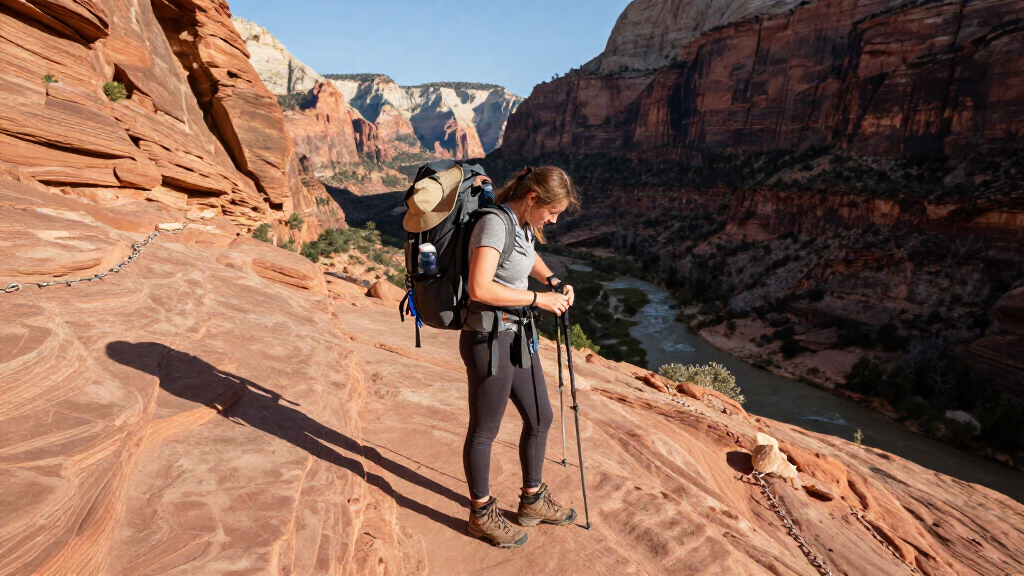

The best hiking gear for Angels Landing comes down to three things: grip and stability on the chained section, hydration for the exposed canyon heat, and a pack small enough to not throw off your balance on narrow ledges. The TETON Oasis Hydration Backpack stands out as my overall pick because it solves the water problem while staying compact enough for Walter’s Wiggles and the final ridge. For hikers who prioritize stability on the chains, the Hiker Hunger Carbon Fiber Trekking Poles offer the best strength-to-weight ratio here, while the Haimont 25L Daypack is the right call if you’re carrying layers for unpredictable Zion weather. The main tradeoff you’ll face is between pack capacity and agility — bigger packs hold more but feel dangerous when you’re clipping along a chain with 1,000-foot drops. Keep reading for the full breakdown of all ten options.

Get garden gear delivered free with Prime
- Fast, free delivery on millions of items
- Prime Video, Amazon Music and more included
- Member-only deals all year
Complete the kit


Key Takeaways
- Trekking poles that fold (Covacure, Hiker Hunger) beat twist-lock poles for Angels Landing because you must stow them in or on your pack for the chained half-mile — collapsibility isn’t optional, it’s a trail requirement.
- Hydration packs with built-in bladders (TETON Oasis, Maelstrom) outperform separate bottles plus a pack here, because you can drink one-handed on the switchbacks without stopping and blocking the trail behind you.
- 15L packs (BECOJADDE, Seektop) are the sweet spot for this hike — big enough for the permit-required essentials, small enough to keep your center of gravity tight on the chains.
- Cork grips (Trekology, Hiker Hunger) earned an edge over EVA foam in this lineup for summer hiking, when sweaty palms on the chain handover points make grip material a safety factor, not a comfort nicety.
- Carbon fiber poles are only worth the premium for this trail if you’re doing multiple Zion hikes in one trip; aluminum (Covacure, ALAFEN) handles the rocky Scouts Landing approach just fine at a lower cost.
| Covacure 7075 Aluminum Folding Hiking Poles, Adjustable, 2-Pack |  | Best Overall Trekking Poles | Material: 7075 aluminum alloy | Quantity: 2 poles | Adjustable length: 39.4–47.2 in (100–120 cm) | VIEW LATEST PRICE | See Our Full Breakdown |
| A ALAFEN 7075 Aluminum Collapsible Ultralight Trekking Pole |  | Best Value Single Pole | Material: 7075 aluminum alloy | Quantity: 1 pole | Adjustable length: 43.3–49 in | VIEW LATEST PRICE | See Our Full Breakdown |
| BECOJADDE 15L Foldable Hiking Backpack |  | Best Packable Backup Pack | Capacity: 15 L | Unfolded dimensions: 17.7 × 11 × 5.1 in | Folded dimensions: 7 × 6.3 in | VIEW LATEST PRICE | See Our Full Breakdown |
| TETON Oasis/TrailRunner Hydration Backpack with 2L Bladder |  | Best Hydration Setup | Bladder capacity: 2 liters | Storage capacity: 18L or 22L | Fit: Adjustable; men, women, and youth | VIEW LATEST PRICE | See Our Full Breakdown |
| Haimont 25L Lightweight Hiking Daypack with Rain Cover, Orange |  | Best Full-Featured Daypack | Capacity: 25 liters | Weight: 1.2 pounds | Dimensions: 7.98″D × 12.68″W × 5.98″H | VIEW LATEST PRICE | See Our Full Breakdown |
| Seektop 15L Lightweight Packable Hiking Backpack |  | Best Ultralight Backup Pack | Capacity: 15 L | Weight: 0.76 lb | Material: High-density polyester | VIEW LATEST PRICE | See Our Full Breakdown |
| Maelstrom Lightweight Hydration Hiking Backpack with 2L/3L Water Bladder |  | Best Hydration Pack | Capacity: 20 L | Bladder capacity: 2 L included; supports up to 3 L | Weight: 2 lb | VIEW LATEST PRICE | See Our Full Breakdown |
| Trekology Trek-Z Cork Grip Collapsible Trekking Poles |  | Best Overall Trekking Poles | Material: Aircraft-grade aluminum alloy | Grip: Natural cork with EVA foam lower grips | Adjustable length: 110–130 cm | VIEW LATEST PRICE | See Our Full Breakdown |
| Foldable Aluminum Trekking Poles with Cork or EVA Grips |  | Best Sized-to-You Value Poles | Material: Aircraft-grade aluminum | Collapsed length: 15 in | Weight per pole: 9.95 oz (short); 10.7 oz (long) | VIEW LATEST PRICE | See Our Full Breakdown |
| Hiker Hunger Outfitters Carbon Fiber Trekking Poles |  | Best Premium Ultralight Poles | Material: 3K carbon fiber | Weight per pole: 7.6 oz | Adjustable length: 24–55 in | VIEW LATEST PRICE | See Our Full Breakdown |
| hiking gear for Angels Landing | Material |
|---|---|
| Covacure 7075 Aluminum Folding | 7075 aluminum alloy |
| A ALAFEN 7075 Aluminum Collaps | 7075 aluminum alloy |
| BECOJADDE 15L Foldable Hiking | Tear-resistant, scratch-resistant fabric |
| TETON Oasis/TrailRunner Hydrat | — |
| Haimont 25L Lightweight Hiking | 600D polyester, Grid RPET |
| Seektop 15L Lightweight Packab | High-density polyester |
| Maelstrom Lightweight Hydratio | High-density polyester; food-grade bladder |
| Trekology Trek-Z Cork Grip Col | Aircraft-grade aluminum alloy |
| Foldable Aluminum Trekking Pol | Aircraft-grade aluminum |
| Hiker Hunger Outfitters Carbon | 3K carbon fiber |
More Details on Our Top Picks
Covacure 7075 Aluminum Folding Hiking Poles, Adjustable, 2-Pack
Angels Landing rewards poles more than almost any trail in Zion, because the final half-mile chains section punishes tired legs and loose footing. This pair stands out for me because you get two poles for what single-pole competitors charge, and the tri-fold design collapses under 14 inches — small enough to clip to a pack when the chains demand both hands. Compared with the A ALAFEN single pole, the wider 39.4–47.2 inch range fits shorter hikers better, which matters for families with teens on this route. The tradeoff: these ship requiring assembly and stop-limit tightening before use, so unlike the Trekology Trek-Z cork-grip poles, there’s a fiddling step before you can walk out the door.
Pros:- Two poles included at a single-pole-like outlay
- Tri-fold design packs under 14 inches for chain sections
- Wide 39.4–47.2 in range suits shorter and taller hikers
- Corrosion-resistant 7075 aluminum survives canyon scrapes
Cons:- Requires assembly and tightening before first use
- Stop-limit markings must be respected or poles can fail
Best for: Hikers who want a matched pair of adjustable, packable poles for the descent and the chained scramble without spending premium money
Not ideal for: Anyone who wants cork grips and tool-free readiness out of the box — the foam grips and pre-trip assembly will frustrate them
- Material:7075 aluminum alloy
- Quantity:2 poles
- Adjustable length:39.4–47.2 in (100–120 cm)
- Folded length:Under 14 in (35.5 cm)
- Grip:EVA foam with adjustable wrist straps
- Included tips:Three styles of rubber tips
Our verdict“The most balanced pick for Angels Landing: a full pair that packs away small when the chains take over.”
A ALAFEN 7075 Aluminum Collapsible Ultralight Trekking Pole
Not everyone wants a pair, and for one-pole hikers this model makes sense as a lean, simple option. The quick-lock adjustment from 43.3 to 49 inches is faster to fine-tune mid-climb than the Covacure tri-fold system, and the kit is genuinely complete: carry bag, mud basket, and replacement tungsten tips are all in the box, where the Trekology Trek-Z asks you to buy attachments separately in some configurations. My hesitation is fit — the 43.3-inch minimum targets riders 5’3″ and taller, so shorter hikers on Angels Landing’s steep switchbacks should look at the Covacure pair instead. Also note the listing itself is sloppy about folded length (13.4 vs. 14.1 inches), which tells you something about the attention to detail here.
Pros:- Quick-lock adjustment is fast on the trail
- Complete kit with carry bag, mud basket, and replacement tips
- Tungsten steel tip grips slickrock well
- Folds compactly for travel to Zion
Cons:- Single pole only — half the support of the Covacure pair
- Minimum length excludes shorter hikers
- Inconsistent folded-length spec in the listing
Best for: Taller day hikers who prefer traveling with one pole and want a full accessory kit included
Not ideal for: Hikers under 5’3″ or anyone who wants the stability of two poles on Walter’s Wiggles
- Material:7075 aluminum alloy
- Quantity:1 pole
- Adjustable length:43.3–49 in
- Folded length:Approx. 13.4–14.1 in
- Handle:EVA foam with wrist strap
- Tip:Tungsten steel
- Included components:Pole, carry bag, mud basket, replacement tips, user guide
- Recommended user height:5 ft 3 in–6 ft 2 in (160–187 cm)
Our verdict“A sensible one-pole choice for taller hikers, but shorter trekkers should pay a little more for the adjustable Covacure pair.”
BECOJADDE 15L Foldable Hiking Backpack
Angels Landing is a half-day hike with minimal gear needs, and this 15L pack matches that reality. Its defining trick is folding into its own 7 × 6.3 inch pocket, so I’d argue its best role is a stuff-in-the-suitcase backup for a Zion trip — the thing you unpack in Springdale rather than the pack you fly with on your back. The chest belt with whistle buckle is a nice safety touch the Seektop 15L competitor also offers, but the BECOJADDE pulls ahead on organization with anti-theft and phone pockets. Compared with the Haimont 25L, you give up the hydration sleeve, rain cover, and roughly 10 liters of space. And with no water-resistance rating stated, a storm on the plateau will soak whatever’s inside.
Pros:- Folds into its own pocket for luggage-friendly storage
- Seven-plus pockets keep phone and valuables organized
- Chest belt with whistle adds a safety margin
- Very light and compact for what it carries
Cons:- 15L capacity limits layers, food, and extras
- No water-resistance rating or included rain protection
- No dedicated hydration sleeve or bladder support
Best for: Travelers who want an emergency daypack that lives folded in luggage and deploys for short hikes
Not ideal for: Carry-it-all hikers needing water storage, rain protection, or more than minimal layers and snacks
- Capacity:15 L
- Unfolded dimensions:17.7 × 11 × 5.1 in
- Folded dimensions:7 × 6.3 in
- Material:Tear-resistant, scratch-resistant fabric
- Features:Phone pocket, front elastic mesh and zippered pockets, 2 water bottle holders, anti-theft pocket, chest belt with whistle
- Color:Beige
Our verdict“Buy it as a foldaway spare for quick hikes — not as your primary Angels Landing load carrier.”
TETON Oasis/TrailRunner Hydration Backpack with 2L Bladder
On a exposed, sandy climb like Angels Landing, sipping without stopping matters — both hands stay on the chains. This pack’s strength is the complete hydration system: a 2-liter bladder with a kink-free tube, push-lock bite valve, and an insulated pocket that keeps water drinkable through the midday heat. The Maelstrom competitor offers a larger 3L bladder option, but the TETON counters with a sewn-in rain cover, weather-guarded zippers, and a bungee system the Maelstrom lacks, making it the more weather-ready choice for sudden canyon storms. My main gripe: the pack weight isn’t listed anywhere, and the 18L vs. 22L size split means you need to check which version you’re actually ordering before checkout.
Pros:- Insulated 2L bladder with kink-free tube and locking bite valve
- Sewn-in rain cover and weather-guarded zippers
- Adjustable breathable fit for men, women, and youth
- 18L or 22L of organized storage plus bungee cargo
Cons:- Pack weight is not disclosed in the listing
- Capacity varies between 18L and 22L versions — easy to order wrong
- Bladder cleaning adds maintenance the BECOJADDE avoids
Best for: Hikers who prioritize hands-free drinking on hot, exposed sections and want weather protection built in
Not ideal for: Weight-obsessed ultralighters and buyers who won’t verify which capacity version they’re ordering
- Bladder capacity:2 liters
- Storage capacity:18L or 22L
- Fit:Adjustable; men, women, and youth
- Bladder features:Kink-free sip tube, push-lock bite valve, 2-inch opening
- Weather features:Sewn-in rain cover, weather-guarded zippers
- Extras:Insulated bladder pocket, bungee cord system
Our verdict“The strongest all-in-one hydration choice for the chains, provided you confirm the size before buying.”
Haimont 25L Lightweight Hiking Daypack with Rain Cover, Orange
If one pack has to cover your entire Zion trip — Angels Landing in the morning, The Narrows scouting in the afternoon — this is the one I’d point to. At 1.2 pounds it carries a hidden rain cover, an internal hydration sleeve with tube routing, and trekking pole loops that pair naturally with the Covacure poles when the chains start. That pole-carry feature alone separates it from both the BECOJADDE 15L and the TETON hydration pack, neither of which stows poles. The 600D RPET build and reflective orange shell feel more durable and visible than the BECOJADDE’s unmarked fabric too. Tradeoffs exist: it’s hand wash only, and while the hydration sleeve is there, no bladder is included — the TETON still wins if drinking-on-the-move is your top priority.
Pros:- Only 1.2 pounds despite rain cover and 7 pockets
- Trekking pole loops and hydration sleeve in one pack
- Durable 600D RPET construction with reflective details
- Hidden rain cover deploys fast in canyon storms
Cons:- Hydration bladder not included, unlike the TETON
- Hand wash only care requirement
- 25L may be tight for full-day or overnight loads
Best for: Hikers who want a single versatile daypack carrying layers, water bladder, and stowed trekking poles for a full park day
Not ideal for: Minimalists who find 25L overkill for a half-day summit push, or those wanting a bladder included
- Capacity:25 liters
- Weight:1.2 pounds
- Dimensions:7.98″D × 12.68″W × 5.98″H
- Material:600D polyester, Grid RPET
- Pockets:7 total, 3 zippered compartments
- Water resistance:Water resistant with hidden rain cover
- Special features:Hydration sleeve, trekking pole loops, ventilated back panel, reflective details
- Care:Hand wash only
Our verdict“The best do-everything daypack here for hikers pairing poles and hydration on a longer Zion itinerary.”
Seektop 15L Lightweight Packable Hiking Backpack
Most hikers heading up Angels Landing don’t need a full expedition pack — they need something that carries water, snacks, and a shell without weighing them down on the chained switchbacks. That’s exactly the niche the Seektop 15L fills. At 0.76 lb and folding into a pouch smaller than a paperback, it disappears into luggage or a car trunk, which the Maelstrom hydration pack — nearly triple the weight — can’t do. The ten-pocket layout is generous for this capacity, keeping camera phones and gloves separated from sunscreen, and the whistle buckle is a smart touch for a route with exposure. The tradeoff is real, though: 15 liters means you’re packing lean, with no room for extra layers plus bulky camera gear. Compared with the larger Haimont 25L, this pack sacrifices storage and structure for portability.
Pros:- Ultra-light at 0.76 lb and packs into its own pouch
- Ten pockets keep small essentials organized and reachable
- Chest strap with integrated whistle adds safety on exposed terrain
- Breathable mesh shoulder straps reduce sweat buildup
Cons:- 15 L capacity limits how much you can carry for longer or variable-weather days
- No hip belt means all weight rides on the shoulders when loaded
Best for: Minimalist day hikers and travelers who want a featherweight summit pack they can stash in luggage
Not ideal for: Hikers carrying extra layers, photography gear, or supplies for others — 15 liters fills up fast
- Capacity:15 L
- Weight:0.76 lb
- Material:High-density polyester
- Closure:SBS zippers
- Storage:10 pockets
- Folded size:7.48 × 7.87 in
- Care:Hand wash or machine wash
Our verdict“This pick makes the most sense for hikers who summit light and want a pack they’ll forget they’re wearing.”
Maelstrom Lightweight Hydration Hiking Backpack with 2L/3L Water Bladder
Angels Landing is a sweat-heavy climb with little shade, and sipping from a hose beats stopping to unsling a pack on a crowded chain section. The Maelstrom 20L stands out for including a replaceable bladder that accepts up to 3 liters, plus an insulated sleeve that keeps water drinkable through midday heat. Compared with the Seektop 15L, you gain a real harness system — chest and waist straps, breathable padded back panel — that stabilizes the load on steep descents. It also undercuts the TETON hydration packs on versatility, since helmet and tool storage make it usable for biking and skiing after your Zion trip. The catch: at 2 pounds empty, it’s the heaviest pack here, and the bite-valve takes adjustment if you’ve never used one. Fit dimensions aren’t published either, so torsos at either extreme should measure carefully.
Pros:- Includes a replaceable 2 L bladder that upgrades to 3 L capacity
- Insulated bladder compartment keeps water cool in desert heat
- Chest and waist straps plus padded back panel stabilize loads on steep terrain
- Reflective strips and built-in whistle add visibility and safety
Cons:- Bite-style drinking outlet takes getting used to for first-time users
- At 2 lb empty, it’s noticeably heavier than minimalist alternatives
Best for: Hot-weather hikers who want hands-free hydration and a stable, padded carry for the full climb
Not ideal for: Ultralight purists who find a 2-pound empty pack and bladder hardware excessive for a half-day hike
- Capacity:20 L
- Bladder capacity:2 L included; supports up to 3 L
- Weight:2 lb
- Material:High-density polyester; food-grade bladder
- Features:Insulated bladder sleeve, helmet and tool storage, padded back, chest and waist straps
- Safety:Reflective strips, built-in whistle
Our verdict“If staying hydrated without stopping is the priority, this option delivers the most complete hydration setup of the packs in this lineup.”
Trekology Trek-Z Cork Grip Collapsible Trekking Poles
For a route like Walter’s Wiggles and the final ridge, cork grips are the quiet differentiator — they wick sweat when palms get damp on the chains, where a slick grip is genuinely unsafe. The Trekology Trek-Z earns the top pole spot by balancing everything: aluminum shafts that survive rocky clanks, a 15-inch folded length that fits a carry-on-sized duffel, and a single 110–130 cm range that covers hikers from 5’2″ to 6’5″. Compared with the foldable aluminum poles from B0D853FKND, you trade the two-length customization for a simpler one-size buying decision. And against the Hiker Hunger carbon poles, the aluminum shaft is heavier but far more forgiving of the scrapes and drops that Zion’s sandstone invites. The EVA lower grips are a nice bonus for choking up on steep pitches.
Pros:- Cork grips absorb sweat for secure holds on chained sections
- Folds to 15 in for easy packing between trips
- Single 110–130 cm range fits users 5’2″ to 6’5″
- Aircraft-grade aluminum shafts shrug off rock contact
Cons:- Cannot be carried on most flights, complicating air travel to Utah
- Cork grips have slight rotational flex under hard torque
Best for: Hikers who want one durable, sweat-managing pole pair that fits most heights without guessing at sizing
Not ideal for: Frequent flyers — most airlines require trekking poles to be checked luggage
- Material:Aircraft-grade aluminum alloy
- Grip:Natural cork with EVA foam lower grips
- Adjustable length:110–130 cm
- Folded length:15 in (38 cm)
- Weight per pole:11.5 oz (330 g)
- Locking system:Metal flip lock
- Recommended height:5’2″–6’5″ (159–195 cm)
- Included:Pair of poles and carry bag
Our verdict“This pair is the safest all-around choice for Angels Landing — durable, grippy when sweaty, and sized for nearly everyone.”
Foldable Aluminum Trekking Poles with Cork or EVA Grips
Where the Trekology Trek-Z forces every hiker into one 110–130 cm range, this pair splits sizing into two options — 100–120 cm or 115–135 cm — which matters more than it sounds. Shorter hikers often end up poles that never compress enough for uphill sections, and taller users get locked-out locks; buying the right range avoids both problems. The choice between cork and EVA grips adds another layer of fit: cork for sweaty palms on the chains, EVA for a softer, all-weather feel. At 9.95 oz per pole in the short version, it undercuts the Trek-Z on weight while matching the 15-inch folded length. Reinforced joints and metal flip locks round out a solid build. The tradeoff: choose wrong on size range and there’s no cross-over coverage, and the two-SKU structure means less independent durability evidence than established competitors.
Pros:- Two size ranges provide a better fit for short and tall hikers
- Choice of cork or EVA foam grips with foam extensions
- Lighter than comparable aluminum pairs at 9.95 oz per pole
- Reinforced joints and metal flip locks for rocky terrain
Cons:- Split sizing means no single range covers 100–135 cm
- Less independent track record than longer-established pole brands
Best for: Shorter or taller hikers frustrated by one-size poles, and buyers who want to pick their grip material
Not ideal for: Hikers between sizes who want maximum adjustability from a single pole range
- Material:Aircraft-grade aluminum
- Collapsed length:15 in
- Weight per pole:9.95 oz (short); 10.7 oz (long)
- Adjustable lengths:100–120 cm or 115–135 cm
- Lock type:Metal flip locks
- Grip options:Cork or EVA foam, with EVA extensions
- Origin:Montana-based company; tested in the Rockies
Our verdict“A smart pick if standard pole ranges leave you hunched or overextended — just measure your ideal length before ordering.”
Hiker Hunger Outfitters Carbon Fiber Trekking Poles
At 7.6 oz per pole, this carbon pair is the lightest in the roundup — nearly 4 ounces lighter per pole than the Trekology Trek-Z, a difference you feel over a 5-mile round trip with 1,500 feet of gain. The 24–55 inch range is also the widest adjustment span here, covering uses well beyond Angels Landing, from short uphill scrambles to snow-season outings. Hiker Hunger backs the versatility with a full accessory kit — mud baskets, snow baskets, rubber feet, and tips — where the Trek-Z ships nearly bare. The cork-over-EVA grip with padded straps keeps long descents comfortable. The honest tradeoff: carbon fiber is stiff and light but less tolerant of jamming a tip into a rock crevice at a bad angle. Hikers who bash their poles around should stick with aluminum; disciplined users get a noticeably lighter ride.
Pros:- Featherweight 7.6 oz per pole reduces arm fatigue on long climbs
- Widest adjustment range in the lineup at 24–55 in
- Includes mud, snow, rubber, and tip accessories for varied terrain
- Padded straps and cork/EVA grips stay comfortable on descents
Cons:- Carbon fiber is more vulnerable to cracking from side-impact or tip jamming
- Higher price tier than aluminum alternatives in this guide
Best for: Weight-conscious hikers and year-round adventurers who want one pole quiver with full terrain accessories
Not ideal for: Rough handlers — carbon shafts can crack under lateral stress where aluminum would merely scratch
- Material:3K carbon fiber
- Weight per pole:7.6 oz
- Adjustable length:24–55 in
- Grip:Cork with EVA foam extension
- Locking mechanism:Metal flip locks
- Included:Mud baskets, rubber feet, rubber tips, snow baskets
- Warranty:1 year
- Model:HH1
Our verdict“The premium pick for hikers who count ounces and want poles that travel from Zion’s sandstone to winter trails.”
How We Picked
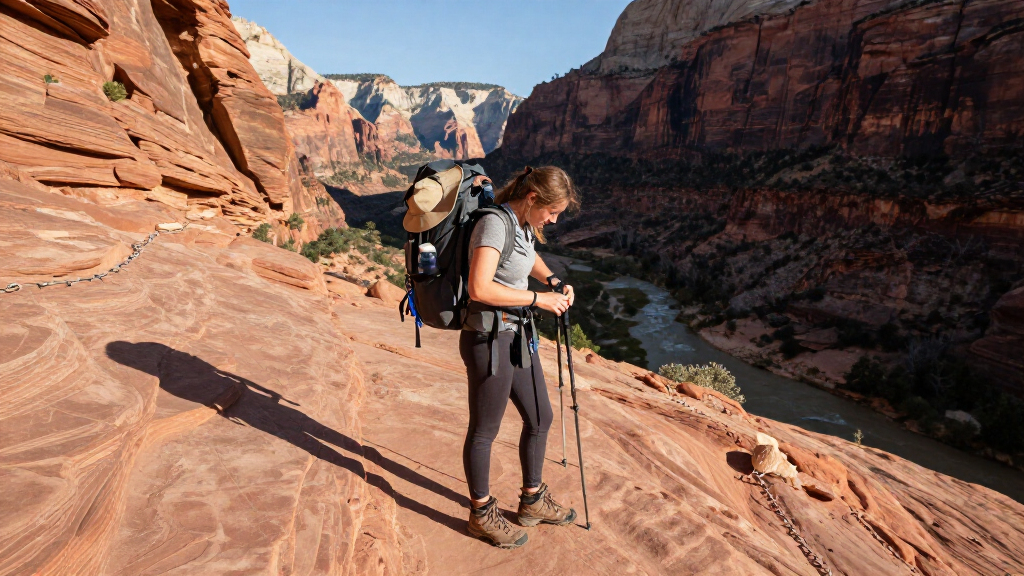
I judged every product against the specific demands of Angels Landing rather than general hiking use. That trail profile matters: a 5-mile round trip with 1,500 feet of gain, long sun-baked switchbacks, and a final half-mile where you clip into chains along a ridge with sheer drop-offs. So the evaluation criteria were stowed size (poles must collapse small enough to pack away for the chains), hydration access while moving, pack profile and stability, and grip security when hands are hot and sweaty. Build quality and adjustability came next, followed by versatility — whether a product earns its place if you also plan to hike The Narrows, Observation Point, or Emerald Pools on the same trip.
The ranking logic is straightforward: products that solve Angels Landing-specific problems ranked higher than products that are merely good all-arounders. That’s why hydration-integrated packs sit near the top of the pack category, why foldable poles outrank telescoping ones, and why smaller-capacity daypacks beat larger ones despite holding less. Where two products were close on function, I separated them by weight, grip material, and how forgiving they are for first-time visitors who may hike this trail exactly once.
Factors to Consider When Choosing Best Hiking Gear For Angels Landing
Angels Landing is not a gear-intensive hike, but the gear you bring has outsized consequences because of the chains. Before you buy anything from this roundup, understand these trail-specific factors that shaped the rankings.Why Pole Stowability Is Non-Negotiable
The most common gear mistake on this trail is showing up with poles you can’t fully put away. The chained final section requires both hands almost constantly, and poles strapped awkwardly across your pack become a lever that catches on rock, other hikers, or the chain itself. That’s why foldable poles ranked above telescoping ones throughout this comparison — a three or four-section fold collapses to roughly half the length of a collapsed twist-lock pole. If you already own telescoping poles, check whether they’ll fit vertically inside your pack or strap flat against the side before assuming they’ll work. Also note that the NPS discourages pole use in crowded sections, so plan around being able to carry them hands-free for at least half the hike.
Hydration Strategy for an Exposed Trail
Zion’s desert environment means the exposed switchbacks before Scouts Landing can hit temperatures 15 to 20 degrees hotter than the shuttle stop where you started, and there is no water source anywhere on the trail. A half-liter per hour is a realistic minimum in summer, which means most hikers need two liters just for this hike. The real decision is between a hydration bladder you sip from while walking and bottles you stop to grab. On a trail this crowded, stopping mid-switchback creates a traffic bottleneck behind you — which is why integrated hydration packs took the top spots. Whichever route you go, practice using it before the hike; a bladder with a kinked hose is worse than a bottle because you won’t discover the problem until you’re already thirsty.
Pack Size: Smaller Is Safer on the Chains
Capacity temptation is real — 25L packs feel like good value per liter — but on the chained ridge, a wide or fully loaded pack shifts your center of gravity outward exactly where you can’t afford it. For most hikers, 15L is plenty: water, snacks, sunscreen, a wind layer, and a first aid kit fit with room to spare. The 25L option in this lineup makes sense mainly if you’re hiking in shoulder season when you’re carrying insulation layers, or if this pack will pull double duty on longer trips. Look for a sternum strap regardless of size; it keeps the load from swinging when you lean sideways to let oncoming hikers pass on the narrow sections. Also check that whatever pack you choose can hold your collapsed poles securely.
Grip Material and Hands-Free Requirements
The chains themselves do the gripping on the final section, but everything before that — slickrock, sandy steps, steep grades — depends on your hands and poles working together. Cork grips absorb sweat and stay tacky when temperatures climb, which is why cork-equipped poles consistently outperformed EVA foam models in this comparison for a summer trail. EVA is softer and cheaper but gets slick when soaked with sweat, and it degrades faster under desert sun. If you run cold or hike in spring and fall, the difference narrows considerably. One more practical note: fingerless gloves are a popular add-on for the chains themselves, so if you go that route, your pole grips need to work with thin gloves too.
Permit Logistics That Affect Your Kit
Since 2022, hiking past Scouts Landing requires a permit obtained by lottery or day-before drawing, and that changes what you carry. You need to bring your permit (a phone screenshot usually works, but paper is a safe backup), which is one more reason a small pack with a secure pocket earns its keep. Permit holders also face time pressure — if the lottery assigns you a morning slot, you’re starting in cool shade that turns to full sun within two hours, so layering strategy matters more than on a casual day hike. Some hikers build their kit around a fast out-and-back; others linger at the summit. Know which one you are before choosing between an ultralight minimal setup and a more comfortable load-bearing one.
Aluminum vs. Carbon Fiber for This Trail
This trail doesn’t punish poles the way scree fields or river crossings do, which shifts the usual calculus. Carbon fiber’s vibration damping feels nicer on pavement-smooth sections of the West Rim Trail approach, and the weight savings add up if you’re doing Zion’s longer trails in the same week. But aluminum bends rather than shatters when wedged between rocks on the Scouts Landing boulder section, and it costs meaningfully less. For a one-time visitor, aluminum is the rational buy. Carbon earns its price only for multi-day Zion trips or hikers who already own lighter packs and are chasing every ounce. Neither material changes your safety on the chains, since poles should be stowed there anyway.
Frequently Asked Questions
Do I even need trekking poles for Angels Landing?
Not strictly, but they help on the 21 switchbacks of Walter’s Wiggles and the steep approach before Scouts Landing, where knee strain adds up on the descent. The critical thing to understand is that poles are a liability on the chained section — you need both hands on the chain, and loose poles have caused accidents and near-misses on the ridge. So if you bring them, they must collapse and stow securely, which is why foldable models dominate this roundup. Many hikers skip poles entirely and rely on the chains for the final section while using their legs for everything below. If you have healthy knees and reasonable balance, poles are a comfort upgrade, not a safety requirement.
How much water should my pack carry for this hike?
Plan on two liters for most of the year and closer to three if you’re hiking in June through August, when the exposed switchbacks offer zero shade and the canyon radiates heat back at you. The hike takes most people four to five hours with the summit stop included, and a liter per hour is a realistic burn rate in summer heat. A 2L bladder covers typical conditions, which is why the TETON Oasis and Maelstrom packs fit this trail so well. If you run hot or are hiking with kids, the 3L Maelstrom configuration gives you margin without needing a second bottle. Under no circumstances count on the water fountain situation at the Grotto — lines are common and the fountain has been down during peak season in past years.
Is a hydration bladder worth it over water bottles here?
On this specific trail, yes, mainly because of traffic. The switchbacks and chained sections are one-person-wide in places, and stopping to dig a bottle out of a side pocket creates a bottleneck behind you. A hose lets you drink while walking, which means you actually hydrate instead of postponing it — the pattern that leads to afternoon heat exhaustion on this trail. Bladders also lower your pack’s center of gravity compared with bottles in side pockets, which helps on lateral moves along the ridge. The tradeoff is that bladders are harder to clean, and you can’t visually monitor how much you’ve drunk, so some hikers carry one bottle as a backup gauge.
Should I buy a 15L or 25L pack for Angels Landing?
For this hike alone, 15L is the better fit — it holds your water, snacks, sun protection, permit, and a light layer without bulging outward, which matters when you’re squeezing past oncoming hikers on chains anchored to a cliff face. A 25L pack like the Haimont makes sense in two situations: you’re hiking in spring or fall when you’ll strip and stash insulating layers mid-hike, or you want one pack that also covers longer trails like Observation Point or a West Rim day hike. Overloading a 25L for a short hike just invites carrying weight you’ll never use. If Zion is a once-in-a-decade trip, buy for this trail specifically and borrow or rent bigger capacity later.
Are cork grips actually better than foam for desert hiking?
For Angels Landing in warm weather, cork has a genuine advantage: it wicks sweat, conforms to your hand over time, and stays grippy when temperatures climb past 90 degrees, while EVA foam gets slippery with perspiration. That matters most at the moments you’re transferring between pole and rock handholds on the approach, when a slick grip causes abrupt slips. Cork also resists UV degradation better, which matters if the poles live in your car between desert trips. Foam wins on cushioning and price, and if you’re hiking in cooler months the performance gap shrinks to nearly nothing. If you’re buying poles specifically for a summer Zion trip, cork is worth the premium; for occasional shoulder-season use, foam is perfectly serviceable.
Conclusion
Match the gear to your hiking style and this trail becomes far more manageable. For the best overall setup, pair the TETON Oasis Hydration Backpack with the Covacure 7075 Folding Poles — that combination covers hydration, stability, and the mandatory pole stowage for the chains at a reasonable total cost. For best value, the BECOJADDE 15L packable pack plus the ALAFEN collapsible pole gets you on the trail for minimal investment, ideal if Angels Landing is a one-time bucket-list hike. The best premium route is the Hiker Hunger Carbon Fiber poles with the Maelstrom 3L hydration pack, worth it if you’re spending a full week in Zion and counting ounces on longer trails. Beginners should lean toward the Trekology Trek-Z for its forgiving cork grips and simple adjustment, paired with the TETON’s foolproof bladder system. And for shoulder-season hikers carrying layers, the Haimont 25L with its included rain cover is the pick that fits. Whatever you choose, prioritize the two things this trail demands: hands-free pole stowage and water you can drink while moving.
Halloween Picks
halloween
As an affiliate, we earn on qualifying purchases.