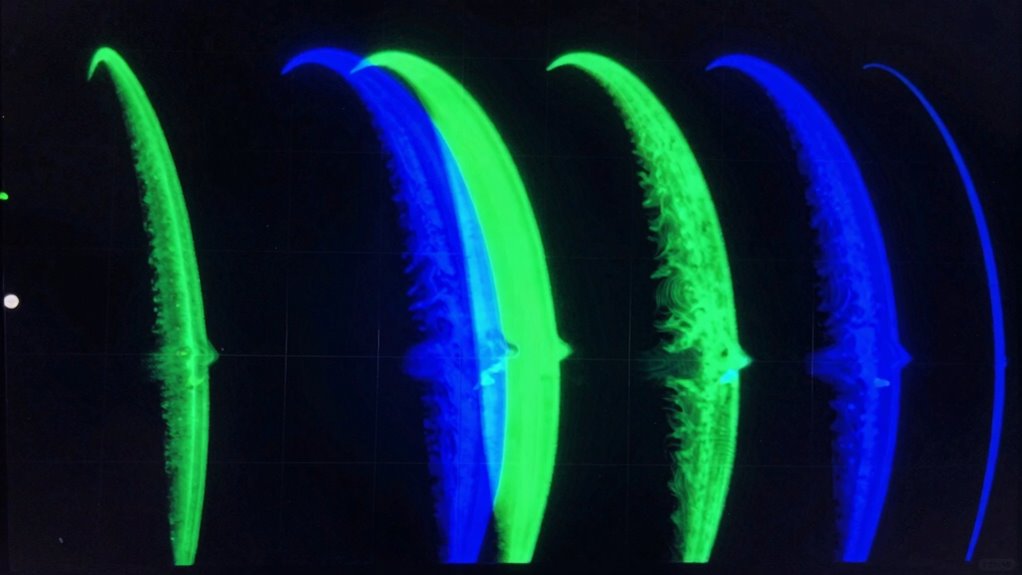

When you see arches on your fish finder, they show where fish are passing through the sonar cone, with well-defined arches indicating nearby, active fish. Not every arch is a true target; some are false signals caused by debris or structures. The shape and size of arches tell you about the fish’s size and movement. Recognizing these patterns helps you locate fish more effectively and adjust your approach, so keep exploring to learn how to interpret them better.
Key Takeaways
- Arches on a fish finder indicate fish passing through the sonar cone, with shape and size reflecting their proximity and size.
- Not all arches are true fish signals; some are false positives caused by debris or structures.
- Well-defined, solid arches suggest fish are close and at specific depths, guiding targeted fishing.
- Fish movement speed and size influence arch appearance; faster or larger fish produce different patterns.
- Reposition your boat based on arch patterns to improve bait placement and increase chances of a catch.
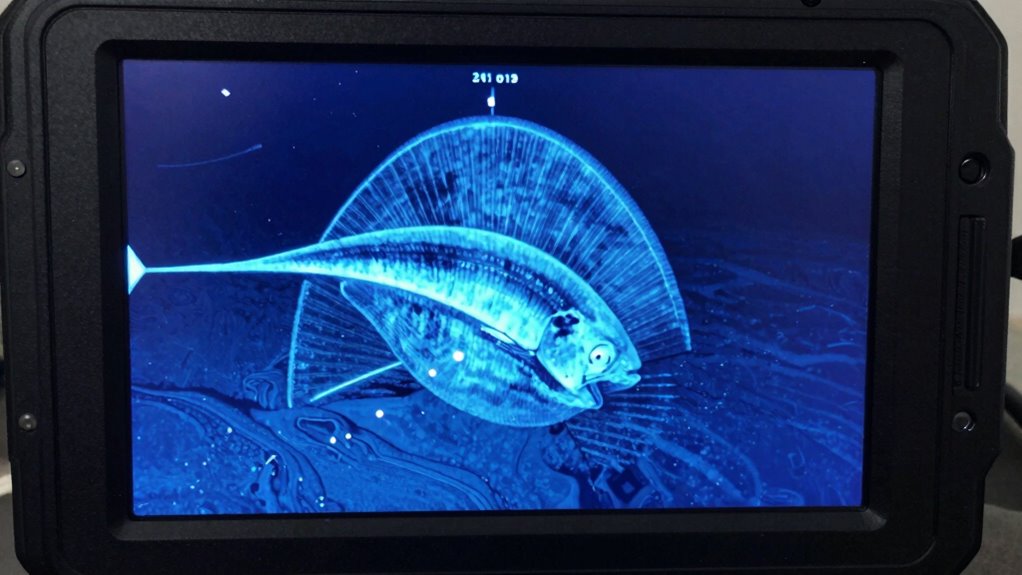
If you’re new to fishing, understanding how a fish finder works can considerably improve your chances of success. One of the most common features you’ll notice on a fish finder display is the series of arches. These arches indicate the presence of fish beneath your boat, but it’s essential to interpret them correctly. Recognizing what these “arches” mean—and what they don’t—can help you make smarter decisions about bait selection, boat positioning, and ultimately, your catch rate. The shape and size of the arch depend on how the fish moves through the cone-shaped sonar signal. A well-defined, solid arch usually indicates a fish close to your boat and at a specific depth. Smaller, faint arches might suggest smaller fish or fish that are farther from the center of the sonar beam. It’s tempting to chase every arch you see, but don’t forget that not every arch represents a target worth pursuing. Some might be false signals caused by debris or structures that reflect sonar waves differently. Being aware of false positives can save you time and frustration on the water. Bait selection plays a vital role once you spot these arches. If you’re consistently seeing arches at a particular depth, it’s a good idea to match your bait type and presentation to what’s likely to attract those fish. For example, if you notice a lot of arches around a certain depth, try using bait that mimics the local forage—whether that’s minnows, worms, or artificial lures. Adjust your bait and technique based on what the fish seem to be responding to, which increases your chances of success. Boat positioning is equally important in interpreting these arches. If you notice fish arches concentrated on one side of your boat, consider repositioning to get a better angle or to be directly above the fish. Moving your boat closer can improve your bait’s visibility and increase your chances of a strike. Conversely, if you see many arches but aren’t catching fish, it might be time to change your bait or technique rather than just your location.
Frequently Asked Questions
How Do I Distinguish Between Fish and Debris on the Screen?
To tell fish from debris on your fish finder screen, look for distinct arches or solid shapes that move consistently, unlike water clutter or sonar noise, which appear as scattered, irregular signals. Fish tend to create clear, defined arches, whereas debris and clutter often show as chaotic or fuzzy blips. Keep your sensitivity and noise reduction settings optimized, and focus on moving targets that resemble typical fish shapes to avoid confusion.
What Settings Optimize Fish Arch Detection?
While high sonar frequencies reveal detailed arches, adjusting display contrast enhances their clarity. To optimize fish arch detection, set your sonar frequency between 200-200kHz for sharper images, then increase display contrast to make arches stand out against the background. Lower frequencies can penetrate deeper but may soften arches, so find a balance. Fine-tuning these settings guarantees you spot those essential fish arches amid debris or clutter.
Can Water Temperature Affect Fish Finder Readings?
Water temperature does affect your fish finder readings because it influences fish behavior and their positioning in the water. As water heats up or cools down, fish may move deeper or shallower, making them harder or easier to detect. You should adjust your fish finder settings accordingly, paying attention to water temperature changes, to get clearer readings and better locate the fish based on their preferred temperature zones.
How Deep Can a Typical Fish Finder Scan?
You wonder how deep your fish finder can scan, and it’s impressive. Depending on the sonar frequency and transducer type, most units reach between 200 to 1,000 feet—sometimes even more. Low-frequency transducers penetrate deeper, revealing hidden underwater secrets, while high-frequency ones excel in shallow waters. Imagine a vertical line slicing through the water, revealing shadows and shapes—your fish finder’s sonar is capable of unveiling depths that seem almost limitless.
What Are the Limitations of Fish Finders in Heavy Cover?
In heavy cover, your fish finder faces limitations like difficulty detecting fish amid thick underwater vegetation and clutter. The sonar signals can get blocked or reflected by dense plants, causing interference and reducing accuracy. This makes it harder to distinguish fish from the cover, especially when vegetation is dense. You might see false echoes or missed targets, so adjusting sensitivity and using different frequencies can help improve performance in such challenging conditions.
Conclusion
So, next time you see those mysterious arches on your fish finder, remember—they’re not secret passages or underwater highways, just fish doing their best impression of a rainbow. Don’t get too carried away, imagining underwater parties or treasure chests; often, it’s just your electronics playing tricks. Embrace the arches for what they are—fisherman’s friendly illusions—and keep your expectations realistic. After all, in the quest for fish, a little skepticism is the true secret weapon.