
If you want a weather station with a lightning detector, my best overall pick is the AcuRite Iris 5-in-1 with HD Display for its balance of local readings and lightning alerts. The AcuRite Atlas is the standout for buyers seeking a more professional-style setup, while the Iris Wireless with HD Wi-Fi Display suits those who value connected access. The main tradeoff is choosing between display simplicity, Wi-Fi features, and the capabilities of the outdoor sensor array. Lightning detection is useful, but it does not replace official warnings or safe shelter practices. Read on for how the six options differ and which one best fits your setup.

Get garden gear delivered free with Prime
- Fast, free delivery on millions of items
- Prime Video, Amazon Music and more included
- Member-only deals all year
Complete the kit


Key Takeaways
- The Iris 5-in-1 with HD Display is my best overall pick because it pairs lightning detection with a clear local display without making connected features the main reason to buy.
- The Atlas is the premium-oriented choice for buyers who want a more professional-style station, though its broader setup may be more than a casual weather watcher needs.
- Wi-Fi is the key dividing line: the Optimus and Iris Wi-Fi models are better fits for connected access, while display-focused options favor straightforward at-home monitoring.
- Two Iris 5-in-1 listings call for careful model checking; compare the exact display and connectivity details rather than assuming similarly named versions are identical.
- Lightning detection appears across the lineup, so the best choice comes down to how you want to view weather data, what sensor setup you need, and how much complexity you will accept.
| AcuRite Iris 5-in-1 Weather Station with HD Display and Lightning Detection |  | Best for Detailed On-Site Monitoring | Measurements: Temperature, humidity, wind speed and direction, rainfall, and barometric pressure | Lightning detection: Up to 25 miles (40 km) | Wireless range: Up to 330 feet (100 meters) | VIEW ON AMAZON | See Our Full Breakdown |
| AcuRite Optimus (01224MCB) All-In-One Connected Weather Station with Wi-Fi Display |  | Best for Smart-Home Integration | Model: 01224MCB | Connectivity: Wi-Fi | Sensors: Temperature, humidity, rainfall, wind speed, wind direction, and lightning detection | VIEW ON AMAZON | See Our Full Breakdown |
| AcuRite Weather Station with Lightning Detection (01071), White |  | Best for Beginners | Model: 01071 | Sensors: Indoor and outdoor temperature and humidity | Lightning detection: Up to 25 miles | VIEW ON AMAZON | See Our Full Breakdown |
| AcuRite Iris (5-in-1) Professional Weather Station with LCD Display and Lightning Detection |  | Best for a Clear, At-a-Glance Display | Sensors: Temperature, humidity, wind speed and direction, barometric pressure, rainfall, and lightning detection | Lightning detection: Up to 25 miles | Display: Color LCD with auto-dimming and scrolling ticker | VIEW ON AMAZON | See Our Full Breakdown |
| AcuRite Iris Wireless Weather Station with HD Wi-Fi Display and Lightning Detection | 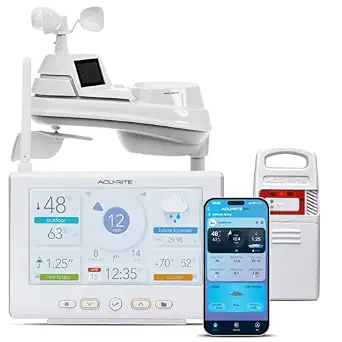 | Best for Remote Monitoring | Model: 01532M | Measurements: Indoor and outdoor temperature and humidity, wind speed and direction, rainfall, and barometric pressure | Lightning detection: Up to 25 miles | VIEW ON AMAZON | See Our Full Breakdown |
| AcuRite Atlas Professional Weather Station with Wi-Fi Display and Lightning Detection (01001M) |  | Best for Broad Weather Coverage | Model: 01001M | Connectivity: Wi-Fi | Measurements: Temperature, humidity, wind speed and direction, rainfall, UV, light intensity, and barometric pressure | VIEW ON AMAZON | See Our Full Breakdown |
| weather station with lightning detector | Display | Lightning detection | Forecast | Warranty |
|---|---|---|---|---|
| AcuRite Iris 5-in-1 Weather St | High-definition TFT with auto-dimming and sleep mode | Up to 25 miles (40 km) | Personalized 12-hour forecast | One-year limited warranty |
| AcuRite Optimus | Black LCD | — | — | Lifetime limited warranty |
| AcuRite Weather Station with L | — | Up to 25 miles | — | One-year limited warranty |
| AcuRite Iris | Color LCD with auto-dimming and scrolling ticker | Up to 25 miles | 12-hour hyperlocal forecast | — |
| AcuRite Iris Wireless Weather | High-definition, full-color display with fold-out tabletop stand | Up to 25 miles | 12-hour hyperlocal forecast | One-year limited warranty |
| AcuRite Atlas Professional Wea | High-definition display with optional battery backup | — | 12 hours | — |
More Details on Our Top Picks
AcuRite Iris 5-in-1 Weather Station with HD Display and Lightning Detection
This Iris makes the most sense for buyers who want full local weather coverage and a display that keeps useful history close at hand. Its outdoor sensor tracks wind, rain, temperature, and humidity, while the station adds barometric pressure and lightning detection up to 25 miles. Compared with the AcuRite 01071, it gives a much broader picture of outdoor conditions; unlike the Wi-Fi Iris 01532M, it does not offer app-based remote viewing in the supplied details. The HD display adds auto-dimming and sleep mode, and the records extend to weekly and monthly highs and lows for up to a year. The tradeoff is a more involved sensor placement requirement: the outdoor unit must remain within range of the display, and remote alerts are not part of its stated feature set.
Pros:- Measures temperature, humidity, wind, rainfall, and barometric pressure
- Detects lightning as far as 25 miles away
- Stores weekly and monthly highs and lows for up to a year
- HD display includes auto-dimming and sleep mode
Cons:- No smartphone app or remote access is specified
- Outdoor sensor placement is limited by the stated wireless range
- A detailed local sensor setup takes more effort than the 01071’s simpler indoor-outdoor monitoring
Best for: Home weather watchers who want wind and rainfall readings, lightning alerts, and long-term records on a dedicated indoor display
Not ideal for: Buyers who need readings and alerts on a phone while away from home, or who cannot place the outdoor sensor within wireless range
- Measurements:Temperature, humidity, wind speed and direction, rainfall, and barometric pressure
- Lightning detection:Up to 25 miles (40 km)
- Wireless range:Up to 330 feet (100 meters)
- Update interval:Every 18–36 seconds under normal conditions
- Display:High-definition TFT with auto-dimming and sleep mode
- Forecast:Personalized 12-hour forecast
- History:Up to one year of weekly and monthly highs and lows
- Sensor power:Dual solar cells power an internal fan
- Warranty:One-year limited warranty
Our verdict“Choose this Iris if you want broad weather measurements and a detailed local display, but choose the Wi-Fi Iris 01532M for remote access.”
AcuRite Optimus (01224MCB) All-In-One Connected Weather Station with Wi-Fi Display
The Optimus stands apart from the other picks by pairing lightning detection and core weather readings with app and smart-home connections in an all-in-one sensor. That compact setup may suit homes where a separate, more prominent outdoor station is awkward, while the AcuRite Iris 5-in-1 HD model offers a more detailed local display and year-long weather history instead. With the AcuRite NOW app, Google Home, and Amazon Alexa compatibility, the Optimus is the better fit for buyers who want connected access and voice-assistant links. Its tradeoff is platform dependence: full app and smart-home features require Wi-Fi, and the product is not compatible with legacy platforms such as My AcuRite or Weather Underground. The supplied specifications also do not state a lightning detection distance, so buyers who need a confirmed range should compare it with the 25-mile Iris and 01071 models.
Pros:- All-in-one outdoor sensor reduces the need for separate sensor assemblies
- Connects with the AcuRite NOW app
- Supports Google Home and Amazon Alexa
- Automotive-grade construction and a lifetime limited warranty
Cons:- Full app and smart-home features depend on Wi-Fi
- Not compatible with My AcuRite or Weather Underground
- The supplied product details do not specify lightning detection range
Best for: Smart-home households that want an all-in-one sensor, app access, and Google Home or Alexa integration alongside lightning detection
Not ideal for: Buyers who need Weather Underground or legacy AcuRite compatibility, or who require a stated lightning detection range
- Model:01224MCB
- Connectivity:Wi-Fi
- Sensors:Temperature, humidity, rainfall, wind speed, wind direction, and lightning detection
- Display:Black LCD
- App compatibility:AcuRite NOW
- Smart-home integration:Google Home and Amazon Alexa
- Construction:Automotive-grade
- Warranty:Lifetime limited warranty
Our verdict“Pick the Optimus for app-connected smart-home use, but favor the Iris 01532M if Weather Underground access or a stated 25-mile lightning range matters.”
AcuRite Weather Station with Lightning Detection (01071), White
The 01071 is the straightforward choice here: it tracks indoor and outdoor temperature and humidity, provides a self-calibrating 12-hour forecast, and warns of lightning up to 25 miles away. Heat and freeze alerts add practical value for basic household planning without asking buyers to interpret wind, rainfall, and pressure readings. That narrower scope is the main distinction from the AcuRite Iris 5-in-1 HD, which measures a much wider range of outdoor conditions. The LCD also supplies daily highs and lows, but the stated ±2 °F temperature accuracy is less precise than some buyers may want for close monitoring. The outdoor sensor reaches up to 330 feet from the display, though it needs four AA batteries, and the display uses AC power with optional AAA backup. Choose it for simple alerts, not a complete outdoor weather record.
Pros:- Monitors indoor and outdoor temperature and humidity
- Lightning alerts include audible and visual notification up to 25 miles away
- Self-calibrating forecast provides a 12-hour outlook
- Heat and freeze alerts support basic household planning
Cons:- Does not list wind, rainfall, or barometric-pressure measurements
- Temperature accuracy is specified as ±2 °F
- Batteries are not included, and the outdoor sensor requires four AA batteries
Best for: First-time weather-station buyers who want indoor-outdoor temperature and humidity, lightning alerts, and heat or freeze warnings
Not ideal for: Weather hobbyists who need wind, rainfall, or barometric-pressure measurements, or buyers who want app-based monitoring
- Model:01071
- Sensors:Indoor and outdoor temperature and humidity
- Lightning detection:Up to 25 miles
- Outdoor sensor range:Up to 330 feet (100 meters)
- Temperature accuracy:±2 °F
- Temperature range:32 °F to 120 °F
- Display and power:LCD; AC-powered with optional backup using 3 AAA batteries
- Outdoor sensor power:4 AA batteries
- Warranty:One-year limited warranty
Our verdict“Choose the 01071 for simple temperature, humidity, and lightning alerts; move up to an Iris 5-in-1 if you need wind and rain data.”
AcuRite Iris (5-in-1) Professional Weather Station with LCD Display and Lightning Detection
This Iris earns its place for buyers who want the full five-in-one weather picture presented on a color LCD that cycles through conditions, forecasts, and alerts. Like the HD Iris B01MF7HK97, it combines temperature, humidity, wind, pressure, rainfall, and lightning detection up to 25 miles. Its differentiator is the scrolling ticker, which keeps current conditions and alerts visible without making the buyer dig through an app. The product details also cite awards from consumer publications, though the practical choice between these two Iris stations rests more on display preference and connectivity: neither has smartphone access specified, while the Iris 01532M does offer Wi-Fi and remote alerts. The tradeoff is that this model relies on its local color LCD for viewing. It suits a fixed indoor monitoring spot better than a household that wants weather updates away from home.
Pros:- Combines temperature, humidity, wind, pressure, rainfall, and lightning detection
- Detects lightning up to 25 miles away
- Color LCD auto-dims and uses a scrolling ticker for conditions and alerts
- Provides a 12-hour hyperlocal forecast
Cons:- No Wi-Fi or smartphone app is specified
- The scrolling ticker may be less useful to buyers who prefer a fixed, immediately visible reading layout
- Supplied specifications do not state wireless range, update interval, or historical record duration
Best for: Households that want broad outdoor measurements and a color display that cycles through forecasts, conditions, and alerts
Not ideal for: Buyers who need phone alerts or remote readings, or who prefer the HD TFT display and long-term history details of the B01MF7HK97
- Sensors:Temperature, humidity, wind speed and direction, barometric pressure, rainfall, and lightning detection
- Lightning detection:Up to 25 miles
- Display:Color LCD with auto-dimming and scrolling ticker
- Forecast:12-hour hyperlocal forecast
- Sensor calibration:Self-calibrating sensors
- Display alerts:Current-condition and alert information shown in scrolling ticker
- Awards:Cited as Best Overall by Better Homes & Gardens and Best for inclement weather by GearLab
Our verdict“Choose this Iris for an at-a-glance color display and broad sensor coverage, but pick the Iris 01532M if remote access is a priority.”
AcuRite Iris Wireless Weather Station with HD Wi-Fi Display and Lightning Detection
Among these Iris models, the 01532M is the clearest choice for buyers who want lightning detection plus remote access. It covers temperature, humidity, wind, rainfall, and barometric pressure, then sends readings and alerts through the AcuRite NOW app over 2.4 GHz Wi-Fi. Its Weather Underground connection also gives it a sharing option absent from the B01MF7HK97 and the professional LCD Iris. That connectivity is the main reason to choose it; the local full-color HD display and 12-hour forecast keep it useful at home as well. The tradeoff is dependence on a compatible Wi-Fi network for connected functions. Unlike the Optimus, it specifies lightning detection up to 25 miles and Weather Underground support, but it uses a separate display and sensor arrangement rather than the Optimus’s all-in-one design.
Pros:- Measures indoor and outdoor temperature, humidity, wind, rainfall, and barometric pressure
- AcuRite NOW app supports remote readings and alerts
- Connects to Weather Underground
- HD full-color display and 12-hour hyperlocal forecast provide useful on-site monitoring
Cons:- Connected features require a 2.4 GHz Wi-Fi network
- AcuRite NOW and Weather Underground access depend on network connectivity
- The display and outdoor sensor setup is less compact than the Optimus all-in-one design
Best for: Homeowners who want a full weather station with 25-mile lightning detection, phone alerts, and Weather Underground data sharing
Not ideal for: Buyers without a 2.4 GHz Wi-Fi network, or those who prefer an all-in-one outdoor sensor and smart-home voice integration
- Model:01532M
- Measurements:Indoor and outdoor temperature and humidity, wind speed and direction, rainfall, and barometric pressure
- Lightning detection:Up to 25 miles
- Connectivity:2.4 GHz Wi-Fi
- App:AcuRite NOW with remote readings and alerts
- Data sharing:Weather Underground connection
- Display:High-definition, full-color display with fold-out tabletop stand
- Forecast:12-hour hyperlocal forecast
- Warranty:One-year limited warranty
Our verdict“Pick the Iris 01532M if you want broad measurements and remote lightning-related weather monitoring; choose a non-connected Iris if Wi-Fi is not available.”
AcuRite Atlas Professional Weather Station with Wi-Fi Display and Lightning Detection (01001M)
The Atlas suits buyers who want lightning alerts as part of a fuller picture of local conditions, rather than a standalone storm warning. Its lightning detection reaches up to 25 miles, while the outdoor sensor also tracks wind, rainfall, UV, light intensity, temperature, and humidity. That breadth sets it apart from the AcuRite Weather Station with Lightning Detection (01071), which is a simpler fit for shoppers focused on core readings and storm alerts. The Atlas display adds more than 20 data points, historical records, and a 12-hour forecast; Wi-Fi also enables Weather Underground connection for sharing data. The tradeoff is a more involved setup: the outdoor sensor needs installation, and battery backup is optional. Choose it for detailed monitoring, not for the simplest plug-in experience.
Pros:- Detects lightning up to 25 miles away
- Measures a broad range of indoor and outdoor conditions, including wind, rainfall, UV, and light intensity
- Wi-Fi connection supports Weather Underground sharing
- Display provides historical records and a 12-hour forecast
Cons:- Outdoor sensor requires installation
- Battery backup is optional rather than included as a standard feature
Best for: Home weather enthusiasts who want lightning alerts alongside wind, rainfall, UV, and other outdoor readings, plus Wi-Fi data sharing.
Not ideal for: Buyers who want a quick, low-installation setup or a basic lightning-and-temperature station; the outdoor sensor requires installation and the broad feature set may be more than they need.
- Model:01001M
- Connectivity:Wi-Fi
- Measurements:Temperature, humidity, wind speed and direction, rainfall, UV, light intensity, and barometric pressure
- Lightning detection range:Up to 25 miles
- Forecast:12 hours
- Data points:More than 20
- Display:High-definition display with optional battery backup
- Weather data sharing:Connects to Weather Underground
Our verdict“Choose the Atlas if you want wide-ranging weather measurements and Wi-Fi sharing alongside long-range lightning detection, and can manage outdoor sensor installation.”

How We Picked
I compared the six listed AcuRite models around what matters for this specific search: the presence of lightning detection, the outdoor station format, the display and connectivity options named for each product, and the likely ease of using the system day to day. I gave extra weight to whether a model appears suited to local, glanceable monitoring or connected access, since those choices affect how useful alerts and weather readings are at home.
The ranking favors a balanced setup first, then models with a clear advantage for a particular buyer. The Iris 5-in-1 with HD Display leads as a practical middle ground; the Atlas ranks higher for buyers who want a more advanced station, but its added scope is not necessary for everyone. Connected models rank well for remote-access priorities, while simpler display-oriented versions may suit buyers who prefer less reliance on network features. Product names alone do not establish exact sensor capabilities or compatibility, so I recommend checking the precise model number and included components before ordering.
| weather station with lightning detector | Measurements | Lightning detection | Display | Warranty |
|---|---|---|---|---|
| AcuRite Iris 5-in-1 Weather St | Temperature, humidity, wind speed and direction, rainfall, and barometric pressure | Up to 25 miles (40 km) | High-definition TFT with auto-dimming and sleep mode | One-year limited warranty |
| AcuRite Optimus | — | — | Black LCD | Lifetime limited warranty |
| AcuRite Weather Station with L | — | Up to 25 miles | — | One-year limited warranty |
| AcuRite Iris | — | Up to 25 miles | Color LCD with auto-dimming and scrolling ticker | — |
| AcuRite Iris Wireless Weather | Indoor and outdoor temperature and humidity, wind speed and direction, rainfall, and barometric pressure | Up to 25 miles | High-definition, full-color display with fold-out tabletop stand | One-year limited warranty |
| AcuRite Atlas Professional Wea | Temperature, humidity, wind speed and direction, rainfall, UV, light intensity, and barometric pressure | — | High-definition display with optional battery backup | — |
Factors to Consider When Choosing Weather Station With Lightning Detector
Before choosing a model, decide how you will use weather readings and what you expect lightning detection to do. These broader choices can matter more than small differences between similarly named stations.
Treat Lightning Detection as an Added Signal, Not a Safety System
A detector can help you notice nearby lightning activity, but it should not be your only source for storm alerts or decisions about going outdoors. Local conditions, the detector’s range, and the way alerts are delivered all affect usefulness. Check the product documentation for how detection is presented and whether alerts are audible, visual, or shown on a connected device. Do not assume every station handles alerts the same way just because lightning detection appears in the name. For safety decisions, pair the station with official weather alerts and follow established lightning precautions. Paying extra for connected features may help you check conditions away from the display, but it does not make the detector a substitute for emergency information.
Choose Local Display or Connected Access Before Comparing Models
A display-based station is convenient when you want readings in one room without opening an app or relying on a network connection. Wi-Fi models can suit households that want to check information beyond the display, but they add setup and network dependencies. A common mistake is to choose a connected station for features you will rarely use, or to buy a local-display model and later wish readings were available remotely. Think about who needs the information and where they will view it. If several people check weather from different locations, connected access may justify the added complexity. If one person mainly checks conditions at home, a clear display can be the more practical choice.
Match the Outdoor Station to the Weather Data You Actually Need
Stations with different sensor arrangements can serve different needs, even when both offer lightning detection. Decide whether you mainly want a broad snapshot of outdoor conditions or a more advanced station setup for ongoing observation. Look at the listed sensors and included components, not just labels such as “professional” or “all-in-one.” Those labels do not tell you whether the station measures every condition you care about or suits your installation. Compare product documentation for sensor coverage, placement guidance, and any components sold separately. A larger feature set is useful only when it gives you data you will use.
Check Placement, Range, and Installation Constraints
Outdoor sensor placement can shape the quality of readings as much as the station model does. Before buying, identify a suitable location with the clearance and mounting options the product instructions call for. Consider how far the outdoor unit will sit from the indoor display and check the stated transmission range under realistic conditions. Walls, metal structures, and interference can affect wireless communication, so a published maximum range may not match every property. Also account for access: a sensor that needs periodic attention should be reachable without risky ladder work. A simpler installation may be a better fit than a more capable station that is difficult to mount well.
Compare Similar Product Names and Exact Model Numbers
This lineup includes multiple Iris 5-in-1 products with similar names but different display or Wi-Fi wording. Do not assume that a shared family name means the same screen, connectivity, included accessories, or compatibility. Check the exact model number, package contents, and manufacturer documentation before choosing between listings. This is especially helpful when replacing an existing station or adding a display to equipment you already own. Confirm any app, network, or sensor requirements rather than relying on a short product title. A few minutes spent checking compatibility can prevent buying a version that does not match your intended setup.
Pay More for Features You Will Use Repeatedly
A premium-style station makes sense when its added capabilities support regular monitoring, a more involved setup, or connected access you genuinely need. It is harder to justify added complexity for a buyer who mainly wants a simple indoor readout and occasional lightning awareness. Consider ongoing needs too: batteries, sensor upkeep, mounting hardware, and network support can affect ownership beyond the initial setup. Read the maintenance guidance and confirm which parts are included or replaceable. If you are new to personal weather stations, a straightforward display model can help you learn which readings matter before moving to a more involved system. The right spend is tied to use, not the longest feature list.
Frequently Asked Questions
Can a weather station with lightning detection replace official storm alerts?
No. A station’s lightning feature can provide an additional indication of nearby activity, but it should not replace official alerts or emergency guidance. Detection methods, alert range, and display behavior can differ between models, so check the manual for the exact unit. Keep a reliable source of local weather warnings available, especially when storms may affect outdoor plans. Use the station as supporting information, not as proof that an area is safe. If thunder is audible or lightning is present, follow recognized shelter guidance.
Should I choose an AcuRite Wi-Fi model or a station with a local display?
Choose Wi-Fi when you expect to check readings away from the station or want connected access as part of your regular routine. A local display is a better match when you mainly want information at home and prefer not to depend on network setup. The Optimus and Iris Wi-Fi models are the connected options in this lineup, while the display-focused Iris variants emphasize at-home viewing. Check whether the particular model supports the access method you want and what network requirements apply. Do not pay for connectivity if you will only glance at a display in one room.
Are the two AcuRite Iris 5-in-1 models interchangeable?
Do not assume they are interchangeable based on the Iris 5-in-1 name alone. The listed versions describe different display or connectivity arrangements, including an HD display and a separate HD Wi-Fi display model. Compare the exact model number, package contents, and compatibility details in the manufacturer documentation. This matters if you already own an AcuRite sensor or plan to add another display later. If a listing does not clearly identify what is included, confirm those details before choosing it.
Is the Atlas a good choice for someone new to personal weather stations?
It can be, but its professional-style positioning may be more station than a beginner needs. If your priorities are a clear readout and lightning detection, the Iris 5-in-1 with HD Display is the simpler starting point in this comparison. The Atlas makes more sense when you expect to use its broader station setup and are comfortable checking installation and sensor details. Before choosing it, confirm that its specific features match the observations you want to make. A feature-rich system is not automatically easier or more useful for a first-time owner.
What should I verify before buying a weather station as a replacement or upgrade?
Start with the exact model number and confirm whether the outdoor sensor, display, and any mounting pieces are included. If you plan to reuse existing equipment, check manufacturer compatibility rather than relying on a shared brand or product-family name. Compare the display and Wi-Fi requirements with your current setup, and review how the station communicates between outdoor and indoor components. Check the installation guidance and stated range against your property layout. These checks are especially useful across this lineup because several products have similar names but distinct display and connectivity descriptions.
Conclusion
For the best overall balance, I recommend the AcuRite Iris 5-in-1 with HD Display; it pairs lightning detection with straightforward local viewing. The best premium fit is the Atlas for buyers who want a more professional-style station and expect to use its broader setup. For connected access, compare the Optimus and Iris Wireless with HD Wi-Fi Display, checking the exact network and package details before deciding. The best starting point for beginners is the display-focused Iris if simplicity matters more than remote access. For a more basic, display-led option, the AcuRite Weather Station with Lightning Detection (01071) may suit buyers who do not need the named Wi-Fi features of the connected models. Across all six, choose by display preference, sensor needs, and installation fit—and treat lightning detection as a supplement to official warnings.
Halloween Picks
halloween
As an affiliate, we earn on qualifying purchases.