
For a balanced camping and survival gear setup, I’d start with the 262-Piece Survival Kit as the best overall pick for its broad mix of first-aid supplies and tools, then add the LifeStraw Personal Water Filter for a compact way to treat drinking water and the MalloMe Collapsible LED Lantern for camp lighting. The main tradeoff is between all-in-one convenience and choosing a few focused tools that better match your trip. A large kit covers more situations but can add bulk, while compact items are easier to carry yet handle fewer needs. Read on for how the 15 options compare across water, fire, lighting, shelter, cooking, and field skills.

Get garden gear delivered free with Prime
- Fast, free delivery on millions of items
- Prime Video, Amazon Music and more included
- Member-only deals all year
Complete the kit


Key Takeaways
- The 262-Piece Survival Kit has the broadest stated range of supplies, but a large kit still calls for checking each item and adding anything your trip or first-aid plan requires.
- LifeStraw’s personal filter is aimed at treating water for one user, while the five-pack of reusable filter straws better suits groups that want separate personal units.
- The ferro rod and striker offer a simple fire-starting tool without relying on fuel, whereas the USB arc and butane lighter set provides two lighter styles but depends on charging or fuel.
- The folding pruning saw and pocket chainsaw serve different cutting preferences: a rigid-handled folding saw is easier to control for small tasks, while a flexible chain format packs into a smaller shape.
- Several low-bulk items fill narrow emergency roles, including glow sticks for visible light and Mylar blankets for heat reflection; they complement, rather than replace, a full shelter and lighting plan.
| 4-Inch Ferro Rod Fire Starter and Striker Kit | 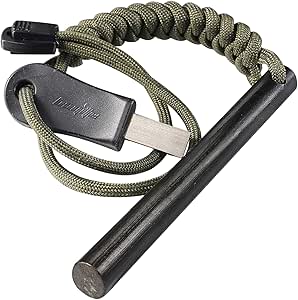 | Best for Reliable Fire Starting | Rod length: 4 in (10 cm) | Rod diameter: 3/8 in (10 mm) | Striker: Striker-Pro HSS steel with 6 striking edges | VIEW ON AMAZON | See Our Full Breakdown |
| Collapsible 2.1-Gallon Camping Water Container with Spout |  | Best for Packable Water Storage | Capacity: 2.1 gallons (8 liters) | Design: Collapsible and foldable | Spout: Included | VIEW ON AMAZON | See Our Full Breakdown |
| MalloMe Collapsible LED Camping Lantern, 300 Lumens |  | Best Compact Campsite Lantern | Light output: Up to 300 lumens | Illumination: 360-degree | LED technology: COB | VIEW ON AMAZON | See Our Full Breakdown |
| LifeStraw Personal Water Filter for Hiking, Travel, and Emergencies, Blue, 1-Pack |  | Best for Personal Water Treatment | Color: Blue | Pack size: 1 | Filter capacity: 4,000 liters (1,000 gallons) | VIEW ON AMAZON | See Our Full Breakdown |
| 262-Piece Survival Kit with First Aid Supplies, Tools, Tent, and Crossbody Bag |  | Best Broad Emergency Grab-and-Go Kit | Piece count: 262 | Bag: Crossbody bag with multiple compartments and MOLLE-compatible straps | Axe length: 17 in | VIEW ON AMAZON | See Our Full Breakdown |
| Sucrain 24-Inch Pocket Chainsaw with Paracord Handles |  | Best for Packable Wood Cutting | Product length: 24 inches | Listed blade length: 26 inches | Teeth: 11 | VIEW ON AMAZON | See Our Full Breakdown |
| Emergency Glow Sticks, 12-Hour Duration, Individually Wrapped |  | Best for No-Battery Emergency Lighting | Illumination: 360 degrees | Duration: Up to 12 hours | Waterproof: Yes | VIEW ON AMAZON | See Our Full Breakdown |
| TRIBERION 750 lb Paracord, 5/32 in (4 mm), 12-Strand, Multiple Lengths |  | Best for Heavy-Duty Utility Cord | Material: Polyester | Tensile strength: 750 lb tested | Diameter: 5/32 in (approximately 4 mm) | VIEW ON AMAZON | See Our Full Breakdown |
| Craft911 11-Inch Folding Camping Pruning Saw |  | Best for Controlled Camp Sawing | Blade length: 11 inches | Blade material: SK5 high-carbon steel | Teeth: 7 TPI, triple-cut | VIEW ON AMAZON | See Our Full Breakdown |
| Waterproof Outdoor Lighter Set with USB Arc Lighter and Refillable Butane Torch |  | Best Dual-Option Fire Lighting | Set includes: 1 USB arc lighter, 1 butane torch lighter, 1 USB cable, 2 lanyards | Water resistance: IP56 | Arc lighter capacity: Up to 300 uses per charge | VIEW ON AMAZON | See Our Full Breakdown |
| THTYBROS 17-Piece Camping Cookware Set |  | Best All-in-One Camp Kitchen Set | Pieces: 17 | Material: Hard-anodized aluminum | Pot capacity: 1.70 L | VIEW ON AMAZON | See Our Full Breakdown |
| Mylar Emergency Thermal Blankets, 4-Pack |  | Best Lightweight Emergency Backup | Quantity: 4 blankets | Material: Aluminized Mylar | Dimensions: 82 × 52 in each | VIEW ON AMAZON | See Our Full Breakdown |
| DOZAVI 17-in-1 Survival Kit with Waterproof Case |  | Best Compact Grab-and-Go Kit | Brand: DOZAVI | Number of pieces: 17 | Case: Waterproof | VIEW ON AMAZON | See Our Full Breakdown |
| Bushcraft 101: A Field Guide to the Art of Wilderness Survival |  | Best Skills-Building Guide | Title: Bushcraft 101: A Field Guide to the Art of Wilderness Survival | ASIN: 1440579776 | Series: Bushcraft Survival Skills | VIEW ON AMAZON | See Our Full Breakdown |
| Practical Survival Reusable Emergency Water Filter Straws, 5-Pack |  | Best Multi-Person Water Filtration Backup | Pack size: 5 filters | Filtration method: Hollow fiber membrane | Bacteria and parasite removal: Over 99.99% | VIEW ON AMAZON | See Our Full Breakdown |
More Details on Our Top Picks
4-Inch Ferro Rod Fire Starter and Striker Kit
For a compact fire-starting tool, I’d choose this kit over the broad but less clearly specified fire-starting supplies in the 262-Piece Survival Kit. Its 4-inch ferrocerium rod is described as waterproof and weatherproof, so damp conditions need not rule out making sparks. The included six-edge HSS steel striker gives you several striking surfaces, while the attached paracord helps with grip and carry. Sparks reach up to 5,500°F, but that figure describes spark temperature—not a guarantee that damp tinder will catch without preparation.
The tradeoff is that this is a spark maker, not a complete fire kit: you still need suitable tinder and must use the included hard striker or another sufficiently hard blade. Compared with a packaged emergency kit, it takes less space and has a clearer purpose, but offers none of the extra supplies.
Pros:- Waterproof and weatherproof rod is suited to outdoor use in varied conditions.
- Six striking edges provide multiple usable surfaces.
- Compact 4-inch rod is practical for carrying in a camping kit.
- Five feet of paracord is included for grip and carry.
Cons:- Requires the included hard steel striker or another sufficiently hard blade.
- Does not include tinder or other materials that help turn sparks into a sustained fire.
Best for: Campers and hikers who want a dedicated, weather-resistant spark source and already know how to prepare tinder.
Not ideal for: Beginners seeking an all-in-one fire kit, or anyone who wants a starter that works without a separate hard striker and prepared tinder.
- Rod length:4 in (10 cm)
- Rod diameter:3/8 in (10 mm)
- Striker:Striker-Pro HSS steel with 6 striking edges
- Paracord length:5 ft
- Spark temperature:Up to 5,500°F (3,000°C)
- Weather resistance:Waterproof and weatherproof
Our verdict“Choose this compact kit if you want a dedicated spark source for prepared outdoor use, rather than a complete survival bundle.”
Collapsible 2.1-Gallon Camping Water Container with Spout
I’d pick this container when carrying a useful reserve matters more than keeping water on your person. Its 2.1-gallon (8-liter) capacity suits a campsite, RV, or emergency supply, while the foldable design takes less storage space than a rigid jug when empty. Separate inlet and outlet openings make filling and pouring distinct tasks, and the included spout is intended to support controlled dispensing.
Compared with the LifeStraw Personal Water Filter, this is a storage and transport solution, not a way to make untreated water safe to drink. The reinforced seams and odor-resistant plastic are useful design claims, but the supplied details do not establish long-term durability in the field. I’d also plan to clean and dry it carefully between trips; a collapsible container can be awkward to store if moisture remains inside.
Pros:- Holds 2.1 gallons (8 liters) for campsite or emergency water storage.
- Collapses for easier storage and transport when empty.
- Separate inlet and outlet openings support refilling and pouring.
- Includes a spout and uses odor-resistant plastic.
Cons:- Requires careful cleaning and drying between uses.
- Stores water but does not filter or purify it.
- Field durability is not established by the supplied product details.
Best for: Car campers, RV travelers, and preparedness-minded households needing a foldable container for carrying or storing a larger water reserve.
Not ideal for: Backpackers who need a small personal water supply, or buyers who need a filter rather than a container for untreated water.
- Capacity:2.1 gallons (8 liters)
- Design:Collapsible and foldable
- Spout:Included
- Inlet and outlet:Separate openings
- Material:Durable, odor-resistant plastic
- Warranty:Lifetime
- Pack size:1
Our verdict“Choose it for foldable, higher-capacity water storage at camp or in an RV, not for treating water on the trail.”
MalloMe Collapsible LED Camping Lantern, 300 Lumens
This lantern’s main advantage is straightforward: it folds down to 3.7 inches, then opens to provide 360-degree light without a complicated setup. Up to 300 lumens makes it a practical option for lighting a tent or nearby camp area, while the pull-up and push-down operation is easy to understand when you need light quickly. Its water-resistant construction adds flexibility for ordinary outdoor use, though it is not described as waterproof.
Compared with the multiple lighting options in the 262-Piece Survival Kit, the MalloMe is simpler and more focused, but does not offer that kit’s range of emergency supplies. It also depends on three AAA batteries, which are not included, so it is not ready to use straight from the package. I’d choose it for compact camp lighting, not as a substitute for a broader emergency lighting plan.
Pros:- Collapses to 3.7 inches for compact storage.
- Provides up to 300 lumens of 360-degree illumination.
- Pull-up and push-down operation keeps use simple.
- Water-resistant design suits routine outdoor use.
Cons:- Requires three AAA batteries, which are not included.
- Water-resistant construction is not specified as waterproof.
- Offers a single lantern function rather than the broader supplies found in a survival kit.
Best for: Campers and travelers who want a small, simple lantern for tent or campsite lighting and can pack spare AAA batteries.
Not ideal for: Buyers seeking included batteries, a rechargeable light, or equipment specified for submersion or severe weather.
- Light output:Up to 300 lumens
- Illumination:360-degree
- LED technology:COB
- Power source:3 AAA batteries (not included)
- Collapsed height:3.7 in
- Design:Collapsible with foldaway handles
- Water resistance:Water-resistant
Our verdict“Choose this lantern for compact, easy-to-operate campsite lighting if you’re willing to bring three AAA batteries.”
LifeStraw Personal Water Filter for Hiking, Travel, and Emergencies, Blue, 1-Pack
For someone who needs a personal way to filter water on the move, this straw has a more specific job than the 2.1-Gallon Camping Water Container: it treats water as you drink rather than carrying a reserve. The stated filtration claims include 99.999999% bacteria removal, 99.999% parasite removal, and microplastic removal down to 1 micron. Its stated capacity of up to 4,000 liters gives it a substantial use horizon for hiking and emergency planning, though that figure does not mean the filter is a water-storage container.
The tradeoff is its personal-use format: it does not provide the larger supply or dispensing convenience of the collapsible container, and the provided details do not specify a separate clean-water reservoir. It also cannot replace broader water treatment for every possible contaminant. I’d favor it for individual backcountry use, while groups may want a method suited to treating and storing water for several people.
Pros:- Specified to remove 99.999999% of waterborne bacteria and 99.999% of parasites.
- Removes microplastics down to 1 micron and reduces turbidity.
- Rated for up to 4,000 liters (1,000 gallons) of filtered water.
- Made with BPA-free materials.
Cons:- Personal drinking format does not store or dispense water for a group.
- The supplied filtration claims do not cover every possible contaminant.
- Product details do not specify a separate clean-water reservoir.
Best for: Solo hikers and travelers who want a lightweight personal filter for drinking from water sources and value stated bacteria, parasite, and microplastic removal.
Not ideal for: Groups needing a shared water supply, or buyers seeking a storage container or treatment for contaminants not listed in the product details.
- Color:Blue
- Pack size:1
- Filter capacity:4,000 liters (1,000 gallons)
- Bacteria removal:99.999999%
- Parasite removal:99.999%
- Microplastic removal:Down to 1 micron
- Material:BPA-free
Our verdict“Choose this filter for personal drinking-water treatment on hikes or during travel, but pair it with a storage solution when you need a carried reserve.”
262-Piece Survival Kit with First Aid Supplies, Tools, Tent, and Crossbody Bag
This kit stands out for putting several categories of emergency gear in one crossbody bag: first aid supplies, lighting, fire-starting gear, water storage, fishing equipment, and tools. The included 17-inch axe and shovel, emergency tent, and blanket give it a broader campsite and preparedness focus than the single-purpose ferro rod or compact MalloMe lantern. MOLLE-compatible straps and multiple compartments also provide ways to organize and carry the assortment.
That breadth comes with a major information gap: the description does not identify every item among the 262 pieces, making it difficult to judge completeness, quality, or what may need replacing. The listed materials and lighting duration offer some guidance, but durability under harsh conditions is not independently established. Compared with buying dedicated tools separately, this is more consolidated; compared with focused gear, it gives you less clarity about each component. I’d inspect the contents and verify critical supplies before relying on it for remote travel.
Pros:- Combines first aid, lighting, fire-starting gear, water storage, and tools.
- Includes a 17-inch axe and shovel, emergency tent, and blanket.
- Crossbody bag has multiple compartments and MOLLE-compatible straps.
- Several lighting options are included, with a stated duration of up to 72 hours.
Cons:- The description does not identify all 262 individual pieces.
- Durability under harsh conditions is not independently verified.
- Broad contents make it harder to judge the quality and suitability of each component.
Best for: New preparedness buyers and car campers who want a broad assortment of emergency supplies organized in one carry bag.
Not ideal for: Experienced backcountry users who need known specifications and field-verified reliability for each tool and medical item.
- Piece count:262
- Bag:Crossbody bag with multiple compartments and MOLLE-compatible straps
- Axe length:17 in
- Shovel length:17 in
- Tool material:Carbon steel
- Lighting duration:Up to 72 hours
Our verdict“Choose this kit for a consolidated starter assortment, but verify its contents and critical gear before depending on it in remote conditions.”
Sucrain 24-Inch Pocket Chainsaw with Paracord Handles
The Sucrain pocket chainsaw suits campers who want a cutting tool that packs smaller than a rigid saw and can handle branches or firewood prep without a full-size bow saw. Its 170 g weight and included storage bag make it easier to carry on hikes than the Craft911 folding saw, while the flexible chain can wrap around wood that is awkward to position. The bidirectional teeth are designed to cut on both strokes, though actual progress still depends on the wood and steady pulling. Paracord handles keep the package simple, but they offer less structure than the Craft911’s rubber handle, and the listed 24-inch product length differs from its 26-inch blade-length spec. I’d choose it for low-bulk carry, not as the only saw for frequent or heavy cutting.
Pros:- Lightweight at 170 g and folds for compact carrying
- Bidirectional teeth are designed to cut on both strokes
- Paracord handles keep the design simple and packable
- Storage bag is included
Cons:- Flexible chain may be less controlled than the Craft911 folding saw
- Product length is listed as 24 inches while blade length is listed as 26 inches
Best for: Backpackers and minimalist campers who want a lightweight manual saw for occasional branch clearing and firewood preparation.
Not ideal for: Campers who need a rigid, easy-to-control saw for repeated heavy cuts or prefer a clearly consistent blade measurement.
- Product length:24 inches
- Listed blade length:26 inches
- Teeth:11
- Blade material:Alloy steel
- Handle material:Nylon paracord
- Weight:170 g
- Power source:Manual
- Included component:Storage bag
Our verdict“Choose the Sucrain if low carry weight matters more than the stability of a rigid folding saw.”
Emergency Glow Sticks, 12-Hour Duration, Individually Wrapped
These glow sticks fill a different role from the MalloMe collapsible LED camping lantern: they provide simple, battery-free marker light rather than a bright, reusable source for camp tasks. Their 360-degree illumination and up-to-12-hour duration suit marking a tent, trail point, or emergency kit location when power is unavailable. Individual foil wrapping helps protect each stick from light and moisture before use, and the waterproof, non-flammable construction makes them useful when conditions rule out a flame. The tradeoff is that activation is single-use: each stick must be bent, snapped, and shaken, and the harder-to-snap design may be difficult for some users. I’d pack these as backup visibility, not as a replacement for a lantern or headlamp.
Pros:- Provides 360-degree illumination for up to 12 hours
- Individually foil-wrapped for storage protection
- Waterproof, non-toxic, and non-flammable by description
- Does not rely on batteries or charging
Cons:- Single-use activation cannot be reversed or switched off
- Harder-to-snap design may be challenging to activate
Best for: Campers and emergency-kit planners who want individually protected, battery-free light for marking locations or signaling.
Not ideal for: People who need reusable task lighting, a focused beam, or light they can switch off and save for later.
- Illumination:360 degrees
- Duration:Up to 12 hours
- Waterproof:Yes
- Toxicity:Non-toxic
- Flammability:Non-flammable
- Packaging:Individually foil-wrapped
Our verdict“Pack these as dependable emergency markers, but choose the MalloMe lantern for reusable camp lighting.”
TRIBERION 750 lb Paracord, 5/32 in (4 mm), 12-Strand, Multiple Lengths
TRIBERION’s cord is the utility pick for campers who need a supply of line for shelter rigging, gear tie-downs, or emergency repairs. Its 750 lb tested tensile strength exceeds the familiar 550 lb rating associated with standard paracord, while the 12 inner yarns and 32-strand sheath describe a substantial construction for general outdoor use. Compared with the paracord handles on the Sucrain pocket chainsaw, this is a spool-oriented supply meant for a range of camp tasks, not a finished carry feature. The polyester material is described for use in sun, rain, and snow, but a strength rating is not a safe working load: knots, abrasion, and anchor points affect performance. I’d select a length to suit the kit rather than carry excess cord without a planned use.
Pros:- 750 lb tested tensile strength is above the common 550 lb paracord rating
- 12 inner yarns and a 32-strand woven sheath
- Polyester construction is specified for sun, rain, and snow
- Available in several lengths to match different kit needs
Cons:- The tensile rating should not be treated as a safe working load
- Knots, anchor points, and wear can reduce real-world strength
- Length options may make it easy to carry more cord than needed
Best for: Campers, bushcraft users, and emergency-kit builders who want versatile utility cord and understand how to secure and inspect rigging.
Not ideal for: Anyone planning to suspend people or critical loads based only on the tensile-strength figure, or who needs a preconfigured rope system.
- Material:Polyester
- Tensile strength:750 lb tested
- Diameter:5/32 in (approximately 4 mm)
- Core:12 inner yarns, each made of 3 twisted strands
- Sheath:32-strand woven sheath
- Available lengths:100 ft, 200 ft, 500 ft, 1000 ft
Our verdict“Choose this cord for adaptable camp utility, while treating its strength rating as a limit rather than a load-planning guarantee.”
Craft911 11-Inch Folding Camping Pruning Saw
The Craft911 is the more controlled cutting choice beside the flexible Sucrain pocket chainsaw. Its 11-inch curved SK5 blade folds for transport, while the TPR rubber handle gives the user a rigid grip for pruning branches and processing manageable wood. Triple-cut, 7 TPI teeth are intended to move through cuts quickly, making this a practical tool for campers who value a familiar saw shape over the chainsaw’s ultra-light, wraparound format. That control comes with limits: the blade requires a clear swing and user effort, and its length is less suited to large limbs or thick logs. I’d favor it for bushcraft and camp cleanup where accuracy matters, but take the Sucrain if minimizing carried weight is the higher priority.
Pros:- Folding design helps protect and pack the blade
- Curved SK5 high-carbon steel blade with triple-cut teeth
- TPR rubber handle is designed for a non-slip grip
- Rigid saw format offers more control than a flexible pocket chainsaw
Cons:- Manual sawing takes effort, especially during repeated cuts
- The 11-inch blade may be limiting for larger wood
- Requires room to position and move the saw
Best for: Campers and bushcraft users who want a folding, rigid-handled saw for pruning and cutting modest branches with more control.
Not ideal for: Backpackers prioritizing the lightest possible cutting tool or users who regularly need to cut large logs and limbs.
- Blade length:11 inches
- Blade material:SK5 high-carbon steel
- Teeth:7 TPI, triple-cut
- Blade shape:Curved
- Handle material:TPR rubber
- Power source:Manual
- Design:Folding
- Dimensions:14.01 x 2.36 x 0.98 inches
Our verdict“Pick the Craft911 for controlled branch work; choose the Sucrain when compact weight matters more than a rigid grip.”
Waterproof Outdoor Lighter Set with USB Arc Lighter and Refillable Butane Torch
This set offers two ignition methods in one compact package: a rechargeable USB arc lighter and a refillable butane torch. That flexibility gives it a different role from the 4-inch ferro rod starter elsewhere in the roundup: the lighters are convenient when charged or fueled, while a ferro rod avoids dependence on those supplies. The arc lighter is rated for up to 300 uses per charge and recharges in 1.5 hours; the torch supplies an adjustable jet flame up to 1.8 inches. Both are described as wind-resistant and IP56-rated, which helps for outdoor carry but does not make them substitutes for careful fire-site practice. The torch arrives without butane, and the arc option needs charging, so neither is ready indefinitely without resupply. I’d treat this as convenience gear with a separate backup fire method.
Pros:- Includes both a rechargeable arc lighter and refillable torch
- IP56-rated protection and wind-resistant designs are specified
- Arc lighter is rated for up to 300 uses per charge
- Compact set includes USB cable and two lanyards
Cons:- Butane torch arrives unfilled, and butane is not included
- Arc lighter depends on charging and has a listed 1.5-hour charge time
- Both ignition options depend on equipment condition and available supplies
Best for: Car campers and preparedness-minded users who want two compact ignition options and can keep the arc lighter charged and the torch fueled.
Not ideal for: Long trips without charging or butane access, or anyone seeking a standalone fire starter with no consumable or power needs.
- Set includes:1 USB arc lighter, 1 butane torch lighter, 1 USB cable, 2 lanyards
- Water resistance:IP56
- Arc lighter capacity:Up to 300 uses per charge
- Arc lighter charging time:1.5 hours
- Torch flame length:Up to 1.8 inches
- Torch flame temperature:2800°F
- Dimensions:1.9 × 2.7 × 0.7 inches
- Weight:0.15 lb
- Butane included:No
Our verdict“Choose this set for convenient dual ignition on supported trips, but pair it with a non-powered backup such as a ferro rod.”
THTYBROS 17-Piece Camping Cookware Set
For campers who want cookware and eating gear in one packable bundle, I’d rank the THTYBROS 17-piece set ahead of assembling separate pots, plates, and utensils. Its 1.7 L pot and 1.15 L kettle offer different jobs at camp: cooking a small meal and heating water without relying on one vessel. Hard-anodized aluminum heats quickly, while the silicone handles give a more secure grip when handling hot cookware. The full set also includes cups, plates, cutlery, and cleaning accessories, a broader camp-kitchen package than the individual survival tools elsewhere in this roundup. The tradeoff is that the 2.75 lb packed set weighs more than a minimalist cook kit, and its 7-inch pan and pot capacity may feel tight for group meals. I’d choose it for organized car camping or shared trips, not ultralight solo travel.
Pros:- Combines cookware, tableware, cutlery, and cleaning accessories in one set
- Hard-anodized aluminum heats quickly for camp cooking
- Silicone handles provide a heat-resistant, non-slip grip
- Packs into a compact carrying bag
Cons:- At 2.75 lb, it is a substantial load for minimalist backpacking
- The 1.70 L pot and 7-inch pan can limit meal size for groups
Best for: Campers who want a coordinated cooking, eating, and cleanup kit for car camping or small-group trips.
Not ideal for: Ultralight backpackers and larger groups who need lower carried weight or cookware sized for several servings.
- Pieces:17
- Material:Hard-anodized aluminum
- Pot capacity:1.70 L
- Kettle capacity:1.15 L
- Frying pan size:7 in
- Weight:2.75 lb
- Packed dimensions:7.5 × 7.5 × 5 in
- Warranty:1 year
Our verdict“Choose this set if you want one organized camp kitchen for a small group and can accept its weight and modest cookware capacity.”
Mylar Emergency Thermal Blankets, 4-Pack
I’d give this four-pack a place in an emergency kit for its low-bulk, multipurpose backup, not as a replacement for a sleeping bag or regular blanket. Each blanket unfolds to 82 × 52 inches and can serve as a body-heat reflector, ground cover, or temporary shelter layer. Having four makes it easier to outfit several people or stash spares across a car, pack, and home kit. Compared with the emergency blanket included in the DOZAVI 17-in-1 kit, this product supplies multiple blankets as its main purpose rather than bundling one with assorted tools. The limitation is the nature of thin Mylar: it offers emergency protection, but the supplied details don’t establish how it performs in sustained exposure or repeated rough handling. I’d carry it as a lightweight contingency item and pair it with insulation suited to the trip.
Pros:- Four blankets provide backup for multiple people or locations
- Each unfolds to a usable 82 × 52-inch size
- Can serve as a heat-reflecting layer, ground cover, or temporary shelter
- Lightweight and compact for emergency-kit storage
Cons:- Emergency protection is not a substitute for a regular blanket or sleeping insulation
- Specific durability and performance testing details are not provided
Best for: Hikers, drivers, and household emergency planners who want several compact backup heat and shelter layers.
Not ideal for: Campers seeking a comfortable nightly blanket or a proven standalone layer for prolonged cold-weather exposure.
- Quantity:4 blankets
- Material:Aluminized Mylar
- Dimensions:82 × 52 in each
- Heat retention:Up to 90%
- Reusable:Yes
Our verdict“Pack this four-pack as compact emergency backup, but bring proper sleep insulation for routine camping or extended cold exposure.”
DOZAVI 17-in-1 Survival Kit with Waterproof Case
The DOZAVI 17-in-1 kit suits buyers who want a ready-organized assortment of small emergency tools rather than a specialized piece of gear. Its case measures 7.3 × 4.3 × 2 inches, and the waterproof case helps keep the contents together in a backpack, car, or boat. A compass, flashlight, fire starter, wire saw, emergency blanket, tactical pen, and multi-function tool card cover varied contingencies in a compact package. That breadth is its advantage over the dedicated THTYBROS cookware set, which supports camp meals but not general emergency needs. The tradeoff is limited product detail: materials and durability aren’t specified, the flashlight batteries are not included, and the warranty is only one month. I’d treat this as a convenient starter assortment, then check each item and add tools matched to the trip rather than assuming the kit replaces a considered survival setup.
Pros:- Includes 17 assorted survival and outdoor items
- Compact case keeps the tools organized for transport
- Waterproof case is suited to wet outdoor settings
- Includes varied items such as a compass, fire starter, and emergency blanket
Cons:- Flashlight batteries are not included
- Specific materials and durability details are not provided
- One-month warranty offers limited coverage
Best for: New campers, drivers, and boaters who want a compact assortment of basic emergency tools in one case.
Not ideal for: Experienced backcountry users who need documented materials, long-term durability, or a fully specified kit ready without added batteries.
- Brand:DOZAVI
- Number of pieces:17
- Case:Waterproof
- Case dimensions:7.3 × 4.3 × 2 in (18.5 × 11 × 5 cm)
- Flashlight batteries:Not included
- Warranty:One month
Our verdict“Pick this as a compact starter kit for general outdoor contingencies, but inspect its contents and supply the flashlight batteries before relying on it.”
Bushcraft 101: A Field Guide to the Art of Wilderness Survival
For a camping and survival kit, knowledge can complement hardware, and Bushcraft 101 is the lineup’s dedicated wilderness-skills pick. Rather than adding another tool beside the DOZAVI 17-in-1 kit, this field guide focuses on bushcraft and survival skills, making it a different kind of preparation: useful for readers who want to build understanding alongside the equipment they carry. Its place in the Bushcraft Survival Skills series also gives readers a defined subject area rather than a general gear assortment. The supplied product information is brief, though, so I can’t judge its specific topics, depth, format, or how well it serves as an on-trail reference. It also cannot replace practical equipment such as the THTYBROS cookware set or emergency supplies. I’d choose it for study and skill development, not as the only survival resource packed for an outing.
Pros:- Focused on wilderness survival and bushcraft skills
- Part of a dedicated Bushcraft Survival Skills series
- Offers a knowledge-based complement to physical tools such as the DOZAVI survival kit
Cons:- Does not provide physical camping or emergency equipment
- Available product details do not specify topics, format, or level of instruction
Best for: Campers and aspiring bushcraft practitioners who want a wilderness survival guide to complement hands-on practice and carried gear.
Not ideal for: Buyers looking for physical emergency equipment, or readers who need verified details about the book’s format and specific contents before choosing.
- Title:Bushcraft 101: A Field Guide to the Art of Wilderness Survival
- ASIN:1440579776
- Series:Bushcraft Survival Skills
Our verdict“Choose this as a bushcraft learning resource to complement your gear, not as a substitute for equipment or field practice.”
Practical Survival Reusable Emergency Water Filter Straws, 5-Pack
When untreated water is the main concern, I’d prioritize this five-filter pack over general-purpose survival assortments such as the DOZAVI kit: it is built around water treatment, with one backflushing plunger per filter. The hollow-fiber membrane is listed to remove over 99.99% of waterborne bacteria and parasites and filter microplastics down to 0.1 micron. A claimed capacity of up to 1,800 gallons per filter gives each unit a substantial stated service life, though the product also lists a six-year shelf life. These straws still depend on having a water source and using gravity; no powered filtration is listed. I’d also distinguish filtration claims from broader water-treatment needs, since the supplied details don’t describe removal of viruses or chemicals. This set makes the most sense for groups or distributed emergency kits, while a solo camper may not need five separate filters.
Pros:- Pack includes five filters for multiple users or emergency kits
- Listed to remove over 99.99% of waterborne bacteria and parasites
- Filters microplastics down to 0.1 micron
- Each filter includes a backflushing plunger
Cons:- Requires a water source and gravity; powered filtration is not listed
- Six-year product shelf life limits long-term storage planning
- Supplied filtration details do not specify virus or chemical removal
Best for: Families, group campers, and emergency planners who want several portable filters with individual backflushing tools.
Not ideal for: Solo hikers seeking a single compact filter, or anyone who needs documented protection against viruses or chemical contaminants.
- Pack size:5 filters
- Filtration method:Hollow fiber membrane
- Bacteria and parasite removal:Over 99.99%
- Microplastic filtration:Down to 0.1 micron
- Filter capacity:Up to 1,800 gallons per filter
- Product shelf life:6 years
- Dimensions:8 × 1.5 × 1.5 in
- Item weight:56.7 g
- Included accessories:One backflushing plunger per filter
Our verdict“Choose this pack for group water-filtration backup, provided its listed treatment scope fits your water risks and storage timeline.”

How We Picked
I compared the 15 items by the job they do in a camping or emergency setup: water access, fire, lighting, first aid, shelter, cooking, cutting, cordage, and skills. I gave more weight to products with a clear use and a practical role in a kit than to sheer item count or broad survival labeling. I also looked at portability, stated construction or operating features, ease of use, and how much extra equipment or maintenance each option may require.
The ranking reflects usefulness across common outdoor needs, not a claim that one item can cover every emergency. The broad 262-piece kit leads for range, while focused tools such as the LifeStraw and lantern rank as strong additions for specific needs. Compact emergency items and learning resources have value, but their narrower roles keep them below options that address more immediate or recurring camp tasks. I treat listed capacities and features as product claims, not proof of performance in every field condition.
Factors to Consider When Choosing Camping And Survival Gear
I’d build a gear list around the trip’s risks and conditions, rather than treating a survival label or high item count as a complete plan. These factors can help you decide what belongs in your pack and what should stay at home.
Start With Your Most Likely Needs
Match gear to the setting, trip length, group size, and forecast before buying for rare scenarios. A day hike near reliable facilities calls for a different setup than a remote overnight trip with uncertain water access. List the problems you could realistically face, then assign a tool or backup plan to each one. A broad kit may look reassuring, but it can leave gaps if it lacks the specific item your route demands. Avoid buying duplicates of low-priority tools while missing water treatment, warmth, or navigation needs. Revisit the list when seasons, destinations, or group members change.
Plan Water Treatment as a System
Water gear works best when you plan for collection, treatment, and storage together. A personal filter can help with drinking directly from a source, but it does not carry water back to camp by itself. A collapsible container solves storage and transport, yet it does not treat the water inside. Check the filter’s stated limits and care instructions, and learn what conditions require another treatment method. Group trips may need more capacity or separate personal units, depending on how people move and share supplies. Do not assume a filter makes every source safe for every contaminant.
Choose Fire Tools You Can Operate in Conditions
Fire starters differ in what they need from you: a ferro rod relies on technique and suitable tinder, while a butane torch needs fuel and an arc lighter needs a charged battery. Wind, dampness, cold, and limited dexterity can make a tool harder to use than its packaging suggests. If fire is part of your safety plan, practice with the actual tool before depending on it. Carrying two fire methods only helps if they do not share the same failure point. Follow local fire rules and keep a no-fire backup for warmth and meals.
Separate Emergency Warmth From Shelter
A reflective emergency blanket is light to carry, but it is not a substitute for a sleeping bag, insulated clothing, or a weatherworthy shelter. Its usefulness depends on how it is deployed and whether you can protect it from tearing or wind. Think through the full warmth system: a dry base layer, insulation, a barrier from wind or ground chill, and a way to stay sheltered. Pack emergency blankets as backups rather than planning to sleep comfortably in them. For longer trips, practice setting up your primary shelter before leaving home.
Weigh Bulk Against Readiness
Large kits can gather many useful categories in one bag, but they can be harder to inspect, organize, and carry than a small set of chosen tools. Compact gear saves pack space, though a small item may do only one job or require accessories. Before buying, check the packed dimensions and weight against the space and load you can realistically carry. Make sure you can locate key supplies quickly rather than burying them in a crowded pouch. A modular setup can let you leave home with only the items needed for a particular outing. The right balance is the smallest load that still covers your planned needs and backups.
Treat Skills and Maintenance as Part of the Kit
Equipment cannot replace knowing how to use it, and some gear needs routine care to remain ready. Read instructions, test basic operation at home, and learn how to clean or store filters, lighters, saws, and cookware. A survival field guide can support learning, but reading alone does not build hands-on skill. Check consumables and charged devices before each trip, and replace damaged or expired supplies. Practice should stay within safe conditions, especially for fire, cutting tools, and first aid. A smaller kit you understand can be more useful than a larger one you have never opened.
Frequently Asked Questions
Should I buy a large survival kit or assemble my own camping gear?
A large kit can provide a quick starting point when you do not yet have supplies across several categories. Its item count does not show whether the contents fit your route, climate, group, or skill level. Inspect the contents, identify gaps, and remove items that add weight without serving your plan. An assembled kit takes more time but gives you control over quality, fit, and familiar tools. Many buyers can use a broad kit as a base and build a smaller, trip-specific load from it.
Do I need both a personal water filter and a collapsible water container?
They solve different parts of the water problem: a filter treats water for drinking, while a container carries or stores it. If you will collect water away from camp, having both can make the routine more practical. A container alone does not make untreated water safe, and a personal filter may not provide convenient storage for a group. Consider how far you’ll travel between sources and how much water your group needs at camp. Check the filter’s stated use and plan another treatment method if your expected sources fall outside its limits.
Are glow sticks a substitute for a camping lantern?
No. Glow sticks can provide simple, low-maintenance visibility, but they do not offer the same directed or adjustable illumination as a lantern. They can be useful as markers or backups when batteries are unavailable, but they are a poor choice for cooking, reading, or lighting a shared camp area. Think about whether you need hands-free area light, a personal light, or a marker that stays visible. A lantern and small backup light serve different tasks, so choose based on the activities and conditions you expect.
Which type of fire starter makes sense if I rarely camp?
A lighter is often familiar to occasional campers, but its fuel or charge can run out and its operation may be affected by conditions. A ferro rod avoids a fuel cartridge but takes practice and requires suitable tinder. For infrequent trips, choose a method you can operate confidently, then carry a separate backup and test both before departure. Keep tinder protected from moisture, since a spark alone does not create a fire. Local fire restrictions may also mean you need a no-flame plan for meals and warmth.
Can an emergency blanket replace a sleeping bag on an overnight trip?
An emergency blanket should not be treated as a sleeping bag replacement. It is a lightweight backup for reflecting body heat, while a sleeping bag provides insulation and comfort suited to a planned overnight stay. Wind, moisture, ground temperature, and the way the blanket is secured all affect its usefulness. Choose sleep insulation for the lowest conditions you expect, and pair it with appropriate ground protection and shelter. Keep a reflective blanket as an emergency layer rather than the foundation of your sleep system.
Conclusion
For the broadest ready-made starting point, I’d choose the 262-Piece Survival Kit as best overall, then inspect and tailor its contents to the trip. The best value in practical coverage comes from selecting focused essentials rather than paying for gear you will not carry; among these options, the ferro rod, collapsible container, and Mylar blanket each fill a distinct role. For a best premium-style setup, I’d pair the LifeStraw with a durable, trip-appropriate water storage plan and dependable lighting instead of relying on one product to do everything. Beginners may prefer the MalloMe lantern and LifeStraw for clear, specific tasks, while experienced users can add the pocket chainsaw or folding saw based on their cutting needs. For specific needs, choose glow sticks for backup visibility, paracord for cordage, cookware for meal preparation, or the field guide for building knowledge; match each addition to a real gap in your kit.
Fall Picks
fall essentials
As an affiliate, we earn on qualifying purchases.