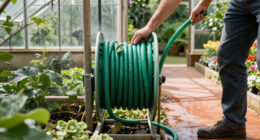
Store a garden hose neatly on its reel so it is easier to use next time and less exposed to kinks, dirt, and weather damage. This guide is for homeowners and gardeners with a manual or wall-mounted hose reel; the same preparation applies to most wheeled reels. Allow about 10-20 minutes, depending on hose length and how much water remains in it.

Get garden gear delivered free with Prime
- Fast, free delivery on millions of items
- Prime Video, Amazon Music and more included
- Member-only deals all year

Suncast Smart Trak Hose Reel Hideaway, 225 ft, Brown
- ✔ Brand: Suncast
- ✔ Model: SMW200
- ✔ Capacity: Up to 225 ft of standard 5/8 in. vinyl hose

Metal Garden Hose Reel Deck Box with Durable Steel Construction, 150 ft 5/8" Capacity, Manual Rewind Guide and No-Leak Aluminum C…
- ✔ Brand: AQUAZILLA
- ✔ Model: AQ+150FT5/8
- ✔ Capacity: 150 ft of 5/8 in. hose

Suncast 100-Foot Garden Hose Reel Hideaway, Cyberspace Gray
- ✔ Brand: Suncast
- ✔ Model: CPLPHH100CD
- ✔ Capacity: 100 ft
Difficulty: Beginner | Time: 10-20 minutes
What You’ll Need
Tools & Materials:
- Garden hose reel
- Outdoor faucet or shutoff valve
- Gloves, if the hose or reel is dirty
Knowledge:
- Basic operation of the outdoor faucet
- How to release the reel lock or handle, if fitted
Check the reel manufacturer’s instructions if the reel has a powered winding mechanism, an unusual locking system, or specific winter storage requirements. Do not force a stuck handle or connector.
Suncast Smart Trak Hose Reel Hideaway, 225 ft, Brown
When our priority is storing a long hose inside a freestanding enclosure, the Suncast Smart Trak Hideaway offers the broadest capacity in this group: up to 225 feet of standard 5/8-inch vinyl hose. Its resin box helps keep hose off the ground and shielded from sun and weather, which makes the storage itself part of the appeal. The Smart Trak guide distributes hose as we rewind, helping reduce tangles without requiring a wall mount or assembly.Compared with the AQUAZILLA, Suncast offers more stated capacity and a weather-resistant resin enclosure, while the steel AQUAZILLA may appeal more to buyers seeking a metal frame. Against the compact Suncast 100-Foot model, this one accommodates substantially more hose but needs a larger storage footprint. The main limitation is shared by all three picks: winding remains manual. It is also designed for standard vinyl hose, so we should check compatibility before choosing it for a different hose type.
Pros:
- Holds up to 225 feet of standard 5/8-inch vinyl hose.
- Enclosed resin body helps protect hose from UV rays, weather, and ground contact.
- Smart Trak guide helps distribute hose during manual rewinding.
- Freestanding, comes assembled, and is made in the USA.
Cons:
- Rewinding still requires turning the crank by hand.
- Designed for standard 5/8-inch vinyl hose, limiting the stated compatibility.
Best for: Gardeners with a long, standard 5/8-inch vinyl hose who want a freestanding enclosure and guided manual rewinding.
Not ideal for: Buyers who need powered winding, a smaller storage footprint, or a reel specified for hose types beyond standard 5/8-inch vinyl.
Bottom line: Choose the Smart Trak when long-hose capacity and enclosed storage matter more than avoiding manual rewinding or keeping the reel compact.
“Choose the Smart Trak when long-hose capacity and enclosed storage matter more than avoiding manual rewinding or keeping the reel compact.”
Metal Garden Hose Reel Deck Box with Durable Steel Construction, 150 ft 5/8" Capacity, Manual Rewind Guide and No-Leak Aluminum C…
The AQUAZILLA gives buyers a different priority from the resin hideaways: galvanized steel construction with a powder-coated finish, plus aluminum connections. It stores up to 150 feet of 5/8-inch hose and includes a manual rewind guide intended to keep the hose straight as we wind it. An openable lid makes loading more accessible, while the included five-foot inlet hose connects the reel to the water supply.Its capacity sits between the 225-foot Smart Trak and the smaller 100-foot Suncast, so it can suit a medium-to-long hose without choosing the largest box in the lineup. The tradeoff is substantial portability: at 30 pounds, it is better treated as a fixed spot in the garden than something to carry around after each use. The four-foot crank also means we still do the winding ourselves. Compared with the Suncast models, AQUAZILLA provides a metal frame and lists pressure handling up to 150 PSI, but it does not match the Smart Trak’s stated capacity or the 100-foot model’s accessory-storage role.
Pros:
- Galvanized steel frame with corrosion-resistant powder coating.
- Stores up to 150 feet of 5/8-inch hose.
- Manual rewind guide helps keep hose straight and reduce kinks.
- Includes a five-foot inlet hose and aluminum connections.
Cons:
- At 30 pounds, it is difficult to move once positioned.
- Manual crank requires physical effort to rewind the hose.
Best for: Buyers who want a freestanding metal reel for a 5/8-inch hose and plan to keep it in one location.
Not ideal for: Anyone who needs a lightweight, frequently moved reel or wants to avoid manual cranking.
Bottom line: Pick AQUAZILLA for a metal construction and guided storage in a fixed location, accepting less capacity than the largest Suncast and more weight than either resin option.
“Pick AQUAZILLA for a metal construction and guided storage in a fixed location, accepting less capacity than the largest Suncast and more weight than either resin option.”
Suncast 100-Foot Garden Hose Reel Hideaway, Cyberspace Gray
For a shorter hose and a smaller storage job, the Suncast 100-Foot Hideaway keeps the setup simple. Its resin enclosure stores up to 100 feet of 5/8-inch vinyl hose, and the manual crank handles winding. The compact box also has space for items such as gloves and nozzles, so it can consolidate a few garden essentials alongside the hose.This is the easiest fit in the lineup when a 225-foot capacity would be unnecessary bulk: it has a smaller stated capacity than both the Smart Trak and AQUAZILLA, but that can make sense for a modest garden hose and limited storage space. It also differs from AQUAZILLA by using resin rather than a metal frame, and its dimensions are specified at 20.5 by 15.5 by 16.25 inches. The compromise is clear: it is not the choice for a long hose, and its 5/8-inch vinyl compatibility and hand-operated winding leave little flexibility for buyers with other hose types or a preference for powered retraction.
Pros:
- Compact storage for up to 100 feet of 5/8-inch vinyl hose.
- Resin enclosure helps protect the hose from weather.
- Can store garden gloves, nozzles, and other small accessories.
- No assembly required; includes a manual crank.
Cons:
- Capacity is lower than both other options in this roundup.
- Designed for 5/8-inch vinyl hose and requires hand winding.
Best for: Gardeners with up to 100 feet of standard 5/8-inch vinyl hose who want a compact enclosure with room for small accessories.
Not ideal for: Buyers with a hose longer than 100 feet, a non-vinyl hose, or a need for a metal reel or powered winding.
Bottom line: Choose this Suncast when compact, combined hose-and-accessory storage matters more than capacity or metal construction.
“Choose this Suncast when compact, combined hose-and-accessory storage matters more than capacity or metal construction.”
As an Amazon Associate we earn from qualifying purchases.
Before You Start
Choose a spot where draining water can run away from the house foundation, electrical equipment, and slippery walkways. If freezing weather is approaching, plan to disconnect and store the hose and reel according to their materials and manufacturer guidance. A hose left full of water can split when that water freezes.
Step-by-Step Instructions
Step 1: Turn off the water
Close the outdoor faucet fully. If the faucet has a separate shutoff valve, close that too. Keep the hose nozzle or spray head open briefly to release pressure, then close it again before handling the connectors.
Tip:A pressurized hose can spray water when disconnected. Point the nozzle away from people and fragile items while releasing pressure.
Check: No water flows from the nozzle, and the hose feels depressurized rather than firm from trapped pressure.
Step 2: Disconnect the hose from the faucet
Unscrew the hose connector from the outdoor faucet by turning it counterclockwise. Hold the connector, not the hose, and avoid twisting the hose itself. If the connection is stiff, use a rubber grip or cloth for traction instead of forcing it with pliers.
Tip:Leave any washer inside the hose connector in place. A missing or damaged washer can cause leaks when you reconnect the hose.
Check: The hose is free of the faucet, and its connector and washer remain intact.
Step 3: Drain the hose
Lift the free end of the hose and walk toward the reel, raising sections as you go to move water toward the open end. Keep the nozzle open while draining. If the hose is long, work along it in manageable sections rather than trying to lift its full length at once.
Tip:Let the water drain onto a suitable planted or gravel area. Avoid creating a puddle on a path where someone could slip.
Check: Water stops flowing from the open end, and the hose feels lighter and more flexible.
Step 4: Inspect and clean the hose
Look along the hose for splits, bulges, crushed areas, or sharp kinks. Wipe off mud and plant debris with a damp cloth. Check both connectors for grit and damage, then set the nozzle to its closed position so dirt cannot enter while the hose is stored.
Tip:Mark a damaged section for repair or replacement before winding. Wrapping a leak or bulge tightly onto the reel can make damage harder to spot later.
Check: The hose is reasonably clean, free of trapped debris at the ends, and any visible damage has been noted.
Step 5: Set the reel for winding
Place a portable reel on stable, level ground, or confirm a wall-mounted reel is secure. Release the reel lock if needed and check that the handle turns freely. Keep fingers away from pinch points between the drum, frame, and handle.
Tip:Do not wind a hose onto a reel with a loose frame, damaged crank, or unstable base. Repair the reel or use another storage method first.
Check: The reel stays steady when you turn its handle, and the winding mechanism moves without catching.
Step 6: Wind the hose in even layers
Feed the hose onto the reel using the guide or inlet provided. Turn the handle slowly while guiding the hose from side to side so each loop sits beside the previous one. Keep gentle tension on the hose, but do not pull hard enough to stretch it or kink it. Pause if a loop crosses, bunches, or catches, then straighten it before continuing.
Tip:Keep the hose connector from striking the frame. On a reel with a leader hose, connect and wind the main hose as the manufacturer specifies.
Check: The hose forms orderly layers across the drum, without tight bends, tangled crossings, or sections hanging off the reel.
Step 7: Secure the hose and store the reel
Attach the hose end to its holder or clip, if the reel has one. Lock the drum or fold in the handle as instructed by the manufacturer. Store the reel in a sheltered, ventilated location away from sharp edges, direct heat, and vehicle traffic. If it must remain outdoors, use a cover made for the reel that does not trap standing moisture.
Tip:For winter storage, disconnect the reel from the faucet and drain the leader hose and reel connection too. Follow the manufacturer’s instructions for removing or protecting the reel.
Check: The hose end is secured, the reel cannot unwind freely, and the whole unit is stable and protected from avoidable damage.
Common Mistakes to Avoid
- Leaving the reel connected to a faucet during freezing weather. — Disconnect and drain the hose and exposed reel connections before freezing temperatures arrive.
Troubleshooting
Problem: The hose will not wind smoothly.
Solution:
Stop turning the handle and check for a kink, crossing loop, or hose caught against the frame. Straighten the hose and restart slowly. If the crank still binds, inspect the reel for debris or damage before applying more force.
Problem: Water keeps coming out while draining.
Solution:
Keep the nozzle open and raise the hose in sections from the far end toward the reel. Check that there are no low sections holding water; reposition the hose so each section slopes toward the open end.
Problem: The hose connector is stuck on the faucet.
Solution:
Confirm the water is off and pressure has been released. Use a rubber grip or cloth and turn the connector by hand. If mineral buildup is visible, apply a suitable outdoor-safe descaling method to the connector, then rinse it; avoid twisting or crushing the hose.
Problem: The reel tips or shifts while winding.
Solution:
Stop winding and place the reel on level ground. Secure its base if the design allows it, or have another person steady it. For a wall reel, stop using it until its mounting and fasteners have been checked.
What Success Looks Like
The hose is drained, clean enough for storage, and wound in even, relaxed layers with no kinks or loops dragging on the ground. Its end is secured, the reel is stable, and the stored setup is protected from traffic and harsh weather. When you unwind it next time, the hose should feed out without snagging or remaining sharply bent.
Next Steps
Check the hose and reel briefly before each use, especially after winter storage. Replace cracked washers, repair small hose leaks with a compatible kit, and retire hoses with major splits or bulges. After watering, repeat the shutoff, drain, wind, and secure routine. Before a freeze, move the reel to sheltered storage and follow its care instructions.
Frequently Asked Questions
Should I leave water in a hose stored on a reel?
Drain as much water as practical before storage. Water adds weight, and water left in the hose can freeze and cause damage in cold weather.
Can I store a hose reel outside?
Many reels can remain outdoors, but shelter helps protect the hose and reel from sun, rain, and freezing conditions. Check the product instructions and use a ventilated cover if appropriate.
How tightly should I wind the hose?
Wind it snugly enough to stay on the drum, but do not stretch or sharply bend it. Smooth, even loops make unwinding easier and reduce strain.
Do I need to disconnect the hose after every use?
Follow the faucet and reel instructions. Disconnecting is especially helpful before freezing weather, when moving the reel, or if the connection leaks or will be unused for a long period.