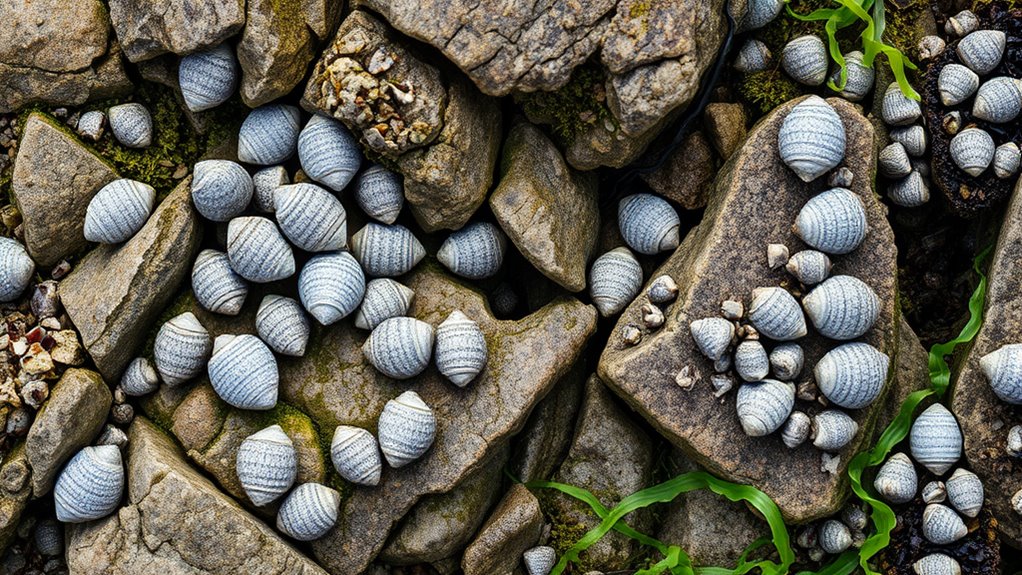

On rocky shores, you’ll see limpets and barnacles busy with foraging and survival. Limpets cling tightly to rocks, scraping algae with their radula for nutrients, while barnacles attach permanently using strong adhesives and filter plankton with their feathery cirri. Both species have tough shells or surfaces to resist waves and predators. Their unique adaptations let them thrive in this challenging environment. Keep exploring to discover how their behaviors support their survival in tide pool ecosystems.

Get garden gear delivered free — and shop member deals
- Fast, free delivery on millions of items
- Access to Prime Big Deal Days deals on October 6–7
- Prime Video, Amazon Music and more included
Key Takeaways
- Limpets graze on algae by scraping rocks with their radula during low tide, playing a vital role in tide pool ecology.
- Barnacles attach permanently to rocks using a strong adhesive and filter feed with feathery cirri.
- Both species are adapted to withstand wave action, temperature fluctuations, and exposure to air.
- Limpets cling tightly to rocks, enabling them to survive vigorous waves and high tides.
- Barnacles respond quickly to environmental changes, maximizing feeding in the shifting tide pool environment.

Have you ever wondered what creatures scavenge along rocky shores? These bustling habitats are teeming with life, each species uniquely adapted to survive the challenging environment. When exploring tide pools and rocky outcroppings, you’ll quickly notice limpets and barnacles clinging tightly to the rocks. Their presence is a testament to intricate marine adaptations that allow them to thrive in this dynamic ecosystem. In tide pool ecology, these animals play vital roles, and understanding their behavior offers insight into how life persists where land and sea meet.
Limpets are fascinating examples of marine adaptation. These small, conical mollusks possess a powerful, muscular foot that creates a strong suction, enabling them to cling securely to rocks even during vigorous waves and high tides. Their shells are often smooth or slightly ridged, reducing drag and preventing dislodgement. During low tide, limpets graze on algae, scraping it off the rock surfaces with a radula—an organ equipped with rows of tiny teeth. This feeding behavior exemplifies how they exploit resources in tide pool ecology, taking advantage of the algae that flourish in sunlit, nutrient-rich shallow waters. The resilience of limpets isn’t just about staying attached; their ability to regulate internal moisture and withstand temperature fluctuations highlights their specialized marine adaptations, helping them survive exposure to air and harsh conditions.
Barnacles, on the other hand, are crustaceans that have evolved a different set of marine adaptations. When you see these tiny, cemented creatures encrusted on rocks, you’re witnessing a remarkable example of life attachment strategies. Barnacles secrete a strong adhesive that binds them permanently to surfaces, a crucial adaptation for tide pool ecology, where wave action constantly threatens their stability. Once attached, they develop a hard calcareous shell that offers protection from predators and physical damage. Barnacles are filter feeders; they extend feathery appendages called cirri to capture plankton and organic particles from the water. Their ability to quickly respond to changes in water flow and temperature demonstrates their finely tuned marine adaptations, enabling them to maximize feeding opportunities in the constantly shifting tide pool environment.
Both limpets and barnacles exemplify how marine adaptations are essential for survival along rocky shores. Their strategies for attachment, feeding, and temperature tolerance allow them to thrive amid the ebb and flow of tides. As you observe these creatures in tide pool ecology, you witness nature’s ingenuity—each adaptation carefully honed to withstand the relentless forces of the ocean. Their resilience not only sustains them but also highlights the delicate balance of life in this vibrant, ever-changing habitat.
Frequently Asked Questions
Are Limpets and Barnacles Edible for Humans?
Limpets and barnacles can be edible for humans, but you should consider edibility concerns before tasting them. Limpets are sometimes eaten in coastal regions, often cooked or grilled, while barnacles are used in some cuisines like Spain’s galatea. However, verify proper identification and preparation, as contaminated or incorrectly identified specimens may pose health risks. Always verify local guidelines and consult experts to avoid potential dangers.
How Do Limpets and Barnacles Defend Against Predators?
Imagine you’re a limpet, clinging tightly to a rocky surface during a predator attack. You defend yourself with predator avoidance strategies like a tough, conical shell that deflects blows and minimizes damage. Your defensive shell features, such as a strong, adhesion-enhanced foot, help you stay anchored and resist being dislodged. These adaptations make it difficult for predators like crabs or birds to pry you off, ensuring your survival on the rocky shore.
Can Limpets and Barnacles Survive in Polluted Waters?
You’ll find that limpets and barnacles have limited pollution tolerance, meaning they struggle to survive in waters with poor water quality. If pollution levels rise, their ability to thrive diminishes, and they may die off or move away. While some barnacles can tolerate moderate pollution, overall, their survival depends heavily on clean, unpolluted water, so high pollution levels threaten their existence on rocky shores.
What Is the Lifespan of Limpets and Barnacles?
They say “time flies when you’re having fun,” and that’s true for limpets and barnacles. Their lifespan varies, with limpets living from 1 to 10 years and barnacles up to 20 years. Environmental impacts, like pollution and wave action, influence these lifespan variations. You’ll find that cleaner, stable environments generally help these creatures thrive longer, while harsh conditions may shorten their lives considerably.
Do Limpets and Barnacles Have Any Ecological Benefits?
Limpets and barnacles offer significant ecological benefits by helping create habitats on rocky shores. Their presence stabilizes the environment, providing shelter and surfaces for other marine organisms. Limpets control algae growth, preventing overgrowth that could harm coral and other species. Barnacles, in turn, serve as food for predators and contribute to the biodiversity of the ecosystem, making them essential for maintaining healthy, balanced rocky shore habitats.
Conclusion
So, next time you explore the rocky shore, notice how limpets and barnacles shape the ecosystem. Observe their movements, their adaptations, their resilience. Recognize how they cling, how they feed, how they survive amidst waves and predators. Appreciate how their foraging connects to the tide’s rhythm, the rock’s stability, and the ocean’s life. Understand how you’re part of this cycle, witnessing nature’s balance, learning from its persistence, and respecting its intricate harmony.
Fall yard work Picks
leaf blowers
As an affiliate, we earn on qualifying purchases.