Choosing the right equipment for Angels Landing requires balancing weight savings with safety and comfort on exposed ridges. My top pick for most hikers is the Osprey Sirrus 34L Women’s Hiking Backpack because its ventilated back panel reduces sweat accumulation during steep climbs, while the TrailBuddy Lightweight Trekking Poles provide necessary stability on the sandy switchbacks. The primary tradeoff you face is between minimalism and preparedness; carrying too little water risks dehydration in the desert heat, while bulky packs can throw off your center of gravity near the chain section. This guide breaks down which hydration systems and support tools actually perform well on this specific Utah trail.

Get garden gear delivered free with Prime
- Fast, free delivery on millions of items
- Prime Video, Amazon Music and more included
- Member-only deals all year
Complete the kit


Key Takeaways
- Ventilated back panels are more important than total capacity for the steep, sweaty ascent to Angels Landing.
- Carbon fiber poles offer a weight advantage that matters less than grip comfort during the final exposed chain section.
- Hydration bladders with bite valves are safer than bottle holders, which can snag on the chain or rock faces.
- A pack volume between 20L and 34L is the sweet spot; anything larger shifts your balance dangerously on narrow ledges.
- Aluminum poles are more durable against rock strikes than carbon, making them a better value for first-time visitors.
| CamelBak Cloud Walker 18 Hydration Backpack with Crux Reservoir |  | Best Overall Hydration System | Capacity: 18 Liters | Reservoir Volume: 2.5 Liters | Weight: Not specified | VIEW LATEST PRICE | See Our Full Breakdown |
| Deuter Guide 22 SL Women’s Alpine Backpack, 22 L, Lagoon-Ink |  | Best Fit for Women | Capacity: 22 liters | Weight: 690 g | Fit: Women’s specific | VIEW LATEST PRICE | See Our Full Breakdown |
| Osprey Sirrus 34L Women’s Hiking Backpack |  | Best for Ventilation & Comfort | Capacity: 34 liters | Weight: 3 pounds | Suspension System: AirSpeed | VIEW LATEST PRICE | See Our Full Breakdown |
| TrailBuddy Lightweight 7075 Aluminum Trekking Poles |  | Best Value Trekking Poles | Shaft material: Aircraft-grade 7075 aluminum | Handle material: Cork and EVA | Lock type: Lever locks | VIEW LATEST PRICE | See Our Full Breakdown |
| Maelstrom 40L Hiking Backpack with Rain Cover |  | Best Budget Capacity | Capacity: 40 liters | Weight: 2.2 pounds | Material: Rip-stop 210D nylon | VIEW LATEST PRICE | See Our Full Breakdown |
| Water Buffalo Sherpa 22L Hiking Hydration Backpack with 2L Bladder |  | Best Hydration Integration | Capacity: 22 liters | Bladder Capacity: 2 liters | Weight: 1.05 kg | VIEW LATEST PRICE | See Our Full Breakdown |
| Cascade Mountain Tech Lightweight Aluminum Trekking Poles with Cork and Extended EVA Grips |  | Best Grip Versatility | Shaft Material: Aircraft-grade 6061 aluminum | Grip Material: Cork with extended EVA | Weight: 10.4 oz per pole | VIEW LATEST PRICE | See Our Full Breakdown |
| Mountainsmith Zerk 40L Hiking Backpack, Cyan Blue |  | Best Lightweight Capacity | Capacity: 40 liters | Weight: 1.9 pounds | Max Load: 30 pounds | VIEW LATEST PRICE | See Our Full Breakdown |
| Cascade Mountain Tech Trekking Poles – Carbon Fiber Walking or Hiking Sticks |  | Best Ultra-Lightweight Option | Material: Carbon Fiber shaft, EVA handle | Weight: 8.16 ounces | Extended Length: 54 inches | VIEW LATEST PRICE | See Our Full Breakdown |
| hiking gear for Angels Landing | Weight | Material | Capacity |
|---|---|---|---|
| CamelBak Cloud Walker 18 Hydra | Not specified | Nylon, Polyester | 18 Liters |
| Deuter Guide 22 SL Women’s Alp | 690 g | Nylon | 22 liters |
| Osprey Sirrus 34L Women’s Hiki | 3 pounds | 100% Recycled Nylon | 34 liters |
| TrailBuddy Lightweight 7075 Al | 9.7 ounces per pole | — | — |
| Maelstrom 40L Hiking Backpack | 2.2 pounds | Rip-stop 210D nylon | 40 liters |
| Water Buffalo Sherpa 22L Hikin | 1.05 kg | 150D ripstop polyester, 420D jacquard nylon | 22 liters |
| Cascade Mountain Tech Lightwei | 10.4 oz per pole | — | — |
| Mountainsmith Zerk 40L Hiking | 1.9 pounds | Nylon | 40 liters |
| Cascade Mountain Tech Trekking | 8.16 ounces | Carbon Fiber shaft, EVA handle | — |
More Details on Our Top Picks
CamelBak Cloud Walker 18 Hydration Backpack with Crux Reservoir
This pack stands out for its integrated Crux reservoir, which delivers water more efficiently than standard bladders, reducing the effort needed to stay hydrated on steep ascents. Unlike the Deuter Guide 22 SL, which requires a separate hydration purchase, the Cloud Walker offers a ready-to-go solution right out of the box. The Air Support back panel keeps your back cooler than the padded backs found on budget packs, a critical advantage when scrambling up slick rock. However, the 18-liter capacity limits its utility if you need to carry extra layers or snacks for a full day. It is best suited for hikers who prioritize hydration speed and ventilation over maximum storage space.
Pros:- Integrated high-flow Crux reservoir simplifies hydration management.
- Air Support back panel enhances airflow and reduces sweat buildup.
- Removable waist strap provides stability during technical scrambling.
Cons:- 18-liter capacity is too small for multi-day or heavy-gear day hikes.
- 2.5-liter reservoir may require frequent refills on long routes.
Best for: Hikers who prioritize hands-free hydration and ventilation on hot, exposed trails.
Not ideal for: Hikers needing to carry significant gear, such as extra layers or lunch, due to limited capacity.
- Capacity:18 Liters
- Reservoir Volume:2.5 Liters
- Weight:Not specified
- Dimensions:10.24″ W x 18.11″ H
- Material:Nylon, Polyester
- Warranty:Got Your Bak Lifetime Warranty
Our verdict“This is the best choice for hikers who want a complete, breathable hydration solution without adding bulk.”
Deuter Guide 22 SL Women’s Alpine Backpack, 22 L, Lagoon-Ink
Designed with a women-specific fit, this pack addresses common fit issues that generic packs ignore, such as shorter torso lengths and narrower shoulder placement. Compared to the CamelBak Cloud Walker 18, the Deuter offers a more secure, body-hugging fit that is better suited for the technical scrambling sections of Angels Landing. The 690-gram weight makes it exceptionally light, though you lose the integrated hydration system found in the CamelBak. Its Alpine back system prioritizes stability and ventilation, ensuring the pack stays put when you are moving dynamically. This model is ideal for women who need a precise fit for active movement on steep terrain.
Pros:- Women-specific geometry ensures a comfortable, secure fit.
- Extremely lightweight at 690 g, reducing fatigue on long climbs.
- Includes specialized attachments for climbing gear and helmets.
Cons:- Does not include a hydration bladder, requiring a separate purchase.
- Water-resistant fabric may not withstand heavy downpours without a cover.
Best for: Women hikers who require a precise, lightweight fit for technical scrambling and alpine conditions.
Not ideal for: Hikers who prefer an all-in-one hydration system or need more than 22 liters of storage.
- Capacity:22 liters
- Weight:690 g
- Fit:Women’s specific
- Dimensions:8.5 × 10 × 23 in
- Material:Nylon
- Hydration System:2 L compatible
Our verdict“This pack is the superior choice for women seeking a lightweight, secure fit for technical trail movement.”
Osprey Sirrus 34L Women’s Hiking Backpack
The AirSpeed suspension system keeps the pack suspended off your back, creating an air gap that dramatically improves ventilation compared to the direct-contact backs of the Deuter Guide 22 SL or Maelstrom 40L. This feature is invaluable on hot days when sweat accumulation can cause discomfort and chafing. With a 34-liter capacity, it offers significantly more room than the smaller packs, allowing you to carry layers and food for a full day. The panel-loading design makes accessing gear easier than top-loading packs. While it is heavier than the Deuter, the trade-off in comfort and capacity makes it a strong contender for longer, hotter hikes on exposed ridges.
Pros:- AirSpeed suspension provides superior ventilation and comfort.
- 34-liter capacity accommodates layers, food, and emergency gear.
- Constructed from sustainable, recycled materials.
Cons:- Heavier than ultralight competitors like the Deuter Guide.
- May feel bulky for short, fast-paced hikes.
Best for: Women hikers who prioritize maximum ventilation and need substantial capacity for full-day excursions.
Not ideal for: Hikers who prefer a minimalist, ultra-light setup or have limited storage needs.
- Capacity:34 liters
- Weight:3 pounds
- Suspension System:AirSpeed
- Material:100% Recycled Nylon
- Dimensions:10.6″D x 14.2″W x 22.4″H
- Water Resistance:Water Resistant (with included raincover)
Our verdict“Choose this pack if you need maximum cooling and storage space for long, hot days on the trail.”
TrailBuddy Lightweight 7075 Aluminum Trekking Poles
These poles offer a compelling balance of durability and weight, using 7075 aluminum shafts that resist bending better than cheaper alternatives while remaining lighter than steel. The lever locks provide quick adjustments, which is helpful when transitioning from the flat approach to the steep chains section of Angels Landing. Compared to the Cascade Mountain Tech Lightweight Aluminum Trekking Poles, the TrailBuddy set includes more accessories like mud and snow baskets, adding versatility. The cork and EVA handles absorb sweat effectively, preventing blisters during strenuous climbs. While they may not collapse as compactly as some carbon fiber options, their robust construction and included accessories make them a practical, cost-effective choice for most hikers.
Pros:- 7075 aluminum shafts offer high strength-to-weight ratio.
- Lever locks allow for rapid, tool-free length adjustment.
- Includes a wide range of accessories like baskets and tips.
Cons:- Collapsed length of 24.5 inches is longer than compact travel poles.
- Aluminum shafts may bend under extreme lateral pressure.
Best for: Hikers seeking durable, adjustable poles with comprehensive accessories at a reasonable cost.
Not ideal for: Ultralight enthusiasts who need the absolute lightest poles and smallest packed size.
- Shaft material:Aircraft-grade 7075 aluminum
- Handle material:Cork and EVA
- Lock type:Lever locks
- Weight:9.7 ounces per pole
- Adjustable length:24.5–54 inches
- Warranty:5-year limited warranty
Our verdict“A reliable, feature-rich option for hikers who want durability and convenience without paying for carbon fiber.”
Maelstrom 40L Hiking Backpack with Rain Cover
This pack delivers 40 liters of storage at a fraction of the cost of premium brands, making it a practical option for those who need to carry extra gear without a high investment. It includes an integrated rain cover, offering better weather protection out of the box than the Osprey Sirrus 34L, which requires careful use of its cover. The breathable padded back provides decent comfort, though it lacks the advanced ventilation systems of higher-end packs like the Deuter or Osprey. The soft shell construction means it does not hold its shape when empty, which can make packing difficult. It is best suited for casual hikers or those who need maximum capacity for a low price, accepting some compromises in structure and weight.
Pros:- Large 40-liter capacity accommodates significant gear loads.
- Includes an integrated rain cover for weather protection.
- Adjustable straps help customize the fit for various body types.
Cons:- Soft structure makes it difficult to pack or carry when empty.
- Lacks advanced ventilation, leading to a hotter back.
Best for: Budget-conscious hikers who need large capacity for day trips or overnighters.
Not ideal for: Hikers who prioritize lightweight gear, structured packing, or advanced ventilation.
- Capacity:40 liters
- Weight:2.2 pounds
- Material:Rip-stop 210D nylon
- Dimensions:8.86 × 12.99 × 23.62 inches
- Water resistance:Water-resistant fabric; included rain cover
- Pockets:8
Our verdict“An affordable, high-capacity option for hikers who value storage space over weight savings and structure.”
Water Buffalo Sherpa 22L Hiking Hydration Backpack with 2L Bladder
This pack distinguishes itself by including a 2-liter hydration bladder out of the box, a feature often sold separately in competitors like the CamelBak Cloud Walker. For Angels Landing, where water sources are scarce on the switchbacks, having a dedicated reservoir saves space and weight compared to carrying multiple bottles. The rainproof zipper liners are a critical detail for desert storms or morning condensation, offering better protection than the standard zippers found on many daypacks. However, the 22-liter capacity is tighter than the Mountainsmith Zerk, meaning you must pack meticulously to fit extra layers or a camera. The lifetime warranty provides peace of mind, but the lack of depth specifications suggests a potentially narrow profile that may struggle with bulky rain shells.
Pros:- Includes a BPA-free 2-liter hydration bladder with a wide opening for easy cleaning
- Rainproof zipper liners protect electronics and clothing from sudden weather changes
- Dedicated trekking pole holders and gear loops keep equipment accessible on steep sections
- Lifetime warranty covers long-term durability concerns for frequent users
Cons:- The 2-liter bladder limit may require frequent refills on extended outings
- The 22-liter volume is restrictive for hikers who carry significant extra layers or gear
- Inconsistent dimension specs make it difficult to gauge total packing volume accurately
Best for: Hikers who want a complete hydration solution without buying a separate bladder or bottles.
Not ideal for: Photographers or hikers who need to carry large camera bodies or bulky jackets alongside their water.
- Capacity:22 liters
- Bladder Capacity:2 liters
- Weight:1.05 kg
- Material:150D ripstop polyester, 420D jacquard nylon
- Pockets:Six storage pockets
- Warranty:Lifetime
Our verdict“This is the ideal choice for hikers who prioritize integrated hydration and weather protection over maximum cargo capacity.”
Cascade Mountain Tech Lightweight Aluminum Trekking Poles with Cork and Extended EVA Grips
These poles stand out for their dual-grip design, featuring cork for sweat absorption and extended EVA foam for resting your hand on steep descents like the final climb of Angels Landing. While the TrailBuddy poles offer similar aluminum durability, this model’s cork material provides a more natural, cushioned feel that reduces blister risk during long, hot hikes. The quick-lock mechanism allows rapid length adjustments between 26 and 54 inches, which is essential when transitioning from flat sand to steep rock steps. The tradeoff is the disassembled length of roughly 20–21 inches, which makes them bulkier to pack than folding poles. They are heavier than carbon options but significantly more forgiving if you slam them against rock walls.
Pros:- Cork and extended EVA grips provide superior comfort and moisture management
- Aircraft-grade aluminum shafts resist bending under heavy lateral pressure
- Quick-lock system allows fast length adjustments for varying trail angles
- Includes tungsten carbide tips and multiple basket types for varied surfaces
Cons:- Disassembled sections are nearly 21 inches long, limiting compact storage options
- At 10.4 ounces per pole, they are heavier than carbon fiber alternatives
- The aluminum construction may transmit more vibration on rocky descents
Best for: Hikers who sweat heavily or need multiple hand positions to manage fatigue on steep, uneven terrain.
Not ideal for: Minimalists who prioritize ultra-lightweight gear or need poles that fit into compact travel bags.
- Shaft Material:Aircraft-grade 6061 aluminum
- Grip Material:Cork with extended EVA
- Weight:10.4 oz per pole
- Length Range:26–54 inches
- Adjustment Mechanism:Quick lock
- Tip Material:Tungsten carbide
Our verdict“Choose these poles for their superior hand comfort and durability, accepting the extra weight for better control on technical trails.”
Mountainsmith Zerk 40L Hiking Backpack, Cyan Blue
The Mountainsmith Zerk offers a compelling middle ground between daypacks and overnight packs. At just 1.9 pounds, it is significantly lighter than the Deuter Guide 22 SL while offering nearly double the capacity at 40 liters. This extra volume is perfect for Angels Landing hikers who want to carry extra water, a heavier rain shell, or a picnic without feeling weighed down. The removable frame sheet and waistbelt allow you to strip the pack down for fast-and-light hikes, a flexibility the fixed-frame Osprey Sirrus lacks. However, the roll-top closure requires more effort to access gear quickly compared to traditional zippered lids, and the 30-pound load limit means it is not suitable for carrying heavy camera rigs or substantial food supplies.
Pros:- Extremely lightweight at 1.9 pounds despite its 40-liter capacity
- Removable frame sheet and waistbelt allow customization for different load needs
- Angled side pockets and front mesh pocket provide easy access to essentials
- Reflective details enhance visibility in low-light conditions
Cons:- Roll-top closure is slower to open than zippered alternatives
- Maximum recommended load of 30 pounds limits heavy gear carrying
- Hand-wash-only care instructions complicate maintenance after muddy trails
Best for: Fast-and-light hikers who need more capacity than a daypack but want to minimize weight.
Not ideal for: Hikers who need quick access to gear mid-hike or those carrying loads exceeding 30 pounds.
- Capacity:40 liters
- Weight:1.9 pounds
- Max Load:30 pounds
- Closure:Roll top with compression buckles
- Frame Sheet:Removable EVA Atilon
- Material:Nylon
Our verdict“This pack is the best choice for hikers seeking maximum volume with minimal weight penalty.”
Cascade Mountain Tech Trekking Poles – Carbon Fiber Walking or Hiking Sticks
These poles are defined by their carbon fiber construction, weighing only 8.2 ounces each. Compared to the aluminum TrailBuddy or the Cascade Mountain Tech Aluminum models, this weight reduction is noticeable over a 5-mile hike with 1,500 feet of elevation gain. The oversized EVA grip is simple but effective, though it lacks the sweat-wicking properties of the cork grips on the aluminum model. The primary tradeoff for this weight saving is durability under extreme stress; carbon fiber is stiffer and less forgiving than aluminum if you slam the pole into rock or use it for leverage on tricky climbs. For Angels Landing’s steep, rocky terrain, this requires a slightly more careful handling technique to avoid accidental breakage.
Pros:- Ultra-lightweight at approximately 8.2 ounces per pole
- Quick-lock system offers a wide 26–54 inch adjustment range
- Non-slip EVA grip provides sufficient comfort for steep inclines
- Includes versatile accessories like snow and mud baskets
Cons:- Carbon fiber is less forgiving than aluminum under extreme stress or misuse
- Limited to a single color and size option
- The stiff carbon shaft may transmit more vibration on rocky terrain
Best for: Speed hikers and ultralight enthusiasts who prioritize weight savings over maximum durability.
Not ideal for: Beginners or aggressive hikers who might misuse the poles or subject them to heavy lateral force.
- Material:Carbon Fiber shaft, EVA handle
- Weight:8.16 ounces
- Extended Length:54 inches
- Folded Length:26 inches
- Lock Type:Quick lock
- Included Components:2 poles, baskets, tips, clip, carry case
Our verdict“Pick these poles if every ounce matters and you are willing to handle them with care to preserve their lightweight integrity.”
How We Picked
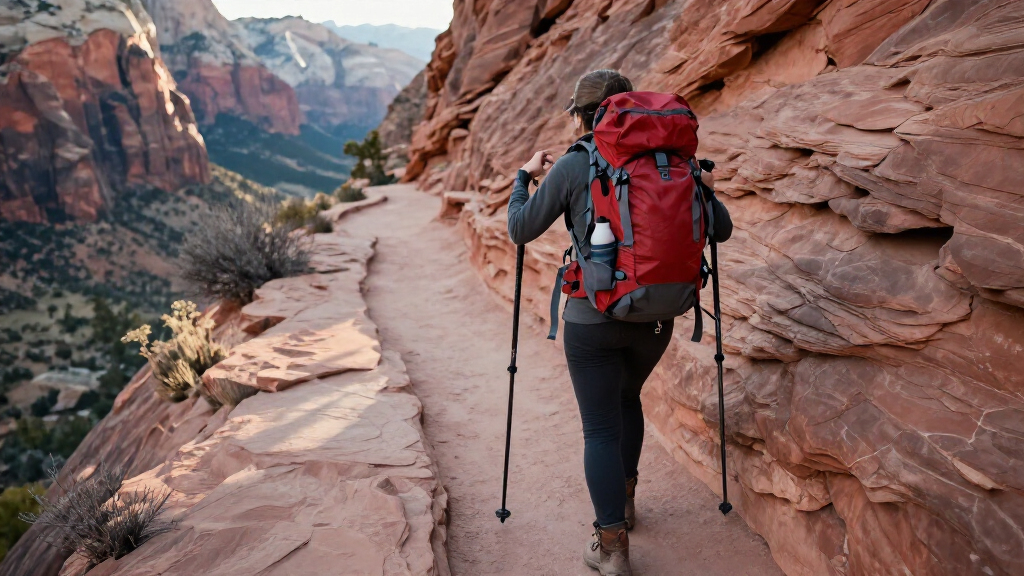
I evaluated these nine products based on three specific criteria relevant to the Angels Landing trail: heat management, stability on exposed terrain, and ease of access while wearing a harness or holding chains. Packs were ranked by how well their suspension systems kept weight centered over the hips, reducing shoulder fatigue on the steep switchbacks. Hydration systems were judged on the reliability of their bite valves and the ease of refilling at the bottom of the canyon.
Trekking poles were compared by tip durability against sandstone and grip comfort during long descents. Products that required frequent adjustment or had bulky external pockets that could snag on the chain were penalized heavily. The final ranking reflects a hierarchy of safety and comfort, prioritizing gear that minimizes distraction and physical strain in a high-consequence environment.
Factors to Consider When Choosing Best Hiking Gear For Angels Landing
Selecting gear for Angels Landing is different from choosing equipment for a generic forest trail. The desert environment, steep elevation gain, and exposed chain section demand specific features that might be overkill or inadequate elsewhere.Hydration Strategy and Pack Integration
Water is the most critical resource on this trail, and how you carry it affects your safety. Hydration bladders are preferred over handheld bottles because they keep your hands free for the chains and reduce the risk of dropping a water source onto other hikers below. Look for packs with dedicated hydration sleeves that prevent the bladder from shifting, which can cause awkward weight distribution on narrow ridges. Bite valve reliability is another factor; a leaky valve in a desert heat can waste precious water and soak your gear. I prioritized systems where the hose routing does not interfere with shoulder strap adjustments, allowing for a snug fit that stays secure during scrambling.Pack Volume and Center of Gravity
Many hikers make the mistake of bringing a large 40L+ pack for this day hike, which raises their center of gravity and increases the feeling of instability near the edge. A 20L to 34L capacity is sufficient for water, snacks, layers, and a first aid kit without creating excessive bulk. Smaller packs sit closer to your back, keeping your center of gravity low and improving balance on the sandy switchbacks. If you must carry more, choose a pack with a robust hip belt that transfers weight to your hips, rather than one that relies on shoulder straps. External pockets should be minimal; protruding items can catch on the chain or rock, creating a hazardous snag point.Trekking Pole Material and Grip
Trekking poles are controversial on Angels Landing, with some hikers preferring bare hands for the chain section. However, they are invaluable for the long ascent and descent through the Narrows. Aluminum poles are generally better for this trail because they resist denting when they inevitably hit sandstone rocks, whereas carbon fiber poles can crack under lateral stress. Grip material matters more than weight; cork or extended EVA foam provides a secure hold even when sweaty, preventing slips during steep descents. Avoid poles with complex locking mechanisms that require two hands to adjust, as you often need to stow or deploy them quickly while holding a fixed point.Ventilation and Heat Management
The desert sun creates intense heat, and the steep grade generates significant body heat. Packs with solid foam back panels will leave you drenched in sweat, leading to chafing and discomfort. Trampoline-style suspended mesh or channel-ventilated back panels allow air to circulate between your back and the pack, keeping you cooler. This feature is not just about comfort; overheating can lead to heat exhaustion, a real risk on this exposed trail. When comparing packs, prioritize those with high ventilation ratings even if they weigh a few ounces more, as the thermal regulation benefit outweighs the minor weight penalty on a hot, dry day.Durability Against Sand and Rock
Angels Landing is a sandy, rocky environment. Fine sand gets into everything, including zippers, buckle mechanisms, and pole joints. Sealed zippers or those with protective flaps prevent grit from jamming the closure, ensuring you can access your layers or snacks when the weather turns. Poles with internal locking systems are more prone to sand clogging than external lever locks, which are easier to clear. Check for abrasion-resistant fabric on the bottom of your pack, as you will likely set it down on rough stone often. Gear that fails due to sand intrusion becomes a liability, forcing you to stop and troubleshoot in an unsafe location.Frequently Asked Questions
Do I really need trekking poles for Angels Landing?
While many hikers skip poles for the final chain section, they are highly recommended for the majority of the hike. The ascent involves steep, sandy switchbacks where poles reduce knee strain and improve traction on loose gravel. During the descent, they provide stability on the slick sandstone steps that can be treacherous when wet or icy. If you choose to use them, ensure they are collapsible enough to strap securely to your pack before reaching the chains so they do not become a tripping hazard.How much water should I carry in my pack for this hike?
The National Park Service recommends carrying at least one gallon (3.8 liters) of water per person for the Angels Landing hike, especially during the warmer months. This amount accounts for the strenuous elevation gain and the lack of water sources on the trail itself. A 2-liter bladder plus a 1-liter bottle is a common configuration that fits well in 20-30L packs. Carrying less increases the risk of dehydration, which can impair judgment on exposed ledges, so err on the side of carrying more than you think you need.Is a hydration bladder better than water bottles for this specific trail?
Hydration bladders are generally superior for Angels Landing because they keep your hands free for the safety chains and rock scrambling. Bottles require you to stop and remove them from pockets or holders, which can be awkward and unsafe when you need both hands on the chain. Additionally, bladders allow for consistent sipping, which helps maintain hydration levels better than the sporadic drinking associated with bottles. Just ensure your bladder has a bite valve that shuts off completely to prevent leaks from soaking your gear.What is the ideal pack size for a day hike to Angels Landing?
A pack size between 20 and 34 liters is ideal for this hike. This volume is large enough to hold your required water, snacks, layers, and a first aid kit, but small enough to maintain a low center of gravity. Packs larger than 40 liters tend to be too bulky for the narrow trail sections and can throw off your balance near the edge. Stick to streamlined designs with minimal external attachments to avoid snagging on the chain or rock faces.Are expensive carbon fiber poles worth it for this trail?
For most visitors to Angels Landing, standard aluminum poles offer better value and durability. Carbon fiber poles are lighter, but the weight savings are marginal over a day hike compared to the risk of breakage when poles strike the hard sandstone. Aluminum poles can withstand the knocks and scrapes of the rocky terrain without failing, whereas carbon fiber can develop micro-fractures from lateral impacts. Unless you are an ultra-lightweight thru-hiker, the durability and lower cost of aluminum make it the more practical choice for this specific environment.Conclusion
Choosing the right gear for Angels Landing comes down to prioritizing stability and heat management over raw capacity. For most hikers, the Osprey Sirrus 34L offers the best balance of ventilation and storage, making it the best overall choice for staying cool and balanced on the ridge. If you are looking for the best value, the CamelBak Cloud Walker 18 provides reliable hydration integration without the bulk, perfect for those who prefer a minimalist approach. For beginners who need extra support on the steep grades, the TrailBuddy Aluminum Trekking Poles are a durable and affordable addition that significantly reduces knee stress. Those seeking a premium experience with specialized fit should look at the Deuter Guide 22 SL, which offers exceptional comfort for smaller frames. Ultimately, match your pack volume to your water needs and choose poles that offer secure grips, ensuring you have the confidence to enjoy the view without worrying about your equipment.